





Equipe Publication
Carrigrès revenue falls 17% in 2025 as price pressure weighs on quarry operations
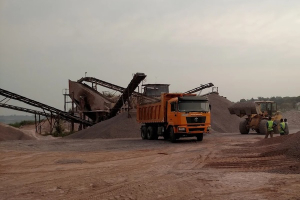
Carrigrès, the construction aggregates quarry owned by the TEXAF group, closed 2025 with revenue down roughly 17% to 4.2 million euros, from approximately 5 million euros in 2024. The decline came even as demand picked up in the second half of the year, which was not enough to offset weaker market conditions.
The group attributed the drop primarily to a roughly 26% fall in the average selling price of its products. That pressure hurt the unit's performance, which ended the year with a net loss of 20,000 euros, according to the group's annual results, despite a roughly 10% increase in sales volumes.
TEXAF describes the business as particularly volatile, given its dependence on construction market conditions and competition. That volatility is reflected in the unit's recent performance. In 2023, the quarry benefited from strong demand and firm prices, lifting revenue to approximately 6.29 million euros, even as volumes sold fell around 4% from 2022. In 2024, revenue then dropped roughly 19%, amid what the group described as uncertainty over public investment.
Despite the 2025 results, TEXAF said it is continuing to invest in the business. The group said in its report that it has already paid a deposit on a new screen and crusher for the quarry, aiming to improve operational performance.
The Carrigrès quarry, which the group has operated since the 1950s, has an estimated annual capacity of 600,000 tons. The group also estimates recoverable reserves at around 25 million tons. The quarry produces a range of aggregates for the construction sector, from rubble stone to crushed sand, as well as various types of gravel and chippings used in concrete, road construction and civil engineering.
The group noted, however, that part of the quarry's land is illegally occupied by squatters, a situation that could limit future expansion.
Timothée Manoke
Paycode partners with industry groups to digitize microfinance in DR Congo
Paycode Fintech Congo has signed an agreement with two industry associations to lead the technical rollout of a digital microfinance platform in the Democratic Republic of Congo, under a World Bank-supported initiative known as the Transforme project.
The accord, signed on April 15, 2026, in Kinshasa, brings together the local subsidiary of Paycode, an African fintech specializing in digital payments and biometric identity, the Association nationale des institutions de microfinance (ANIMF) and the Association professionnelle des coopératives d'épargne et de crédit (Aprocec).
The agreement builds on a contract signed in February 2025 between the Transforme project and a consortium comprising Paycode Fintech Congo, Banktech Software Services Limited and Hong Kong Top Wise Communications. That contract covers the digitization of the microfinance sector and the supply of 10,000 payment terminals; financial terms were not disclosed.
Scope of the Platform
According to a statement from the Transforme project, the initiative aims to modernize microfinance institutions (MFIs) and savings and credit cooperatives (COOPECs) while integrating them into the formal financial system. The agreement mandates Paycode to handle the operational and technical implementation of an integrated platform.
The platform is expected to include a core banking system, an enterprise resource planning (ERP) solution, a card payment module and the issuance of Mosolo payment cards. The goal is to enable MFIs and COOPECs to connect to the national payment switch, a key step toward their integration into the formal financial system and the broader adoption of electronic payments.
The solution will rely on a full technology stack including servers, storage capacity, security devices and telecommunications networks. Paycode will also provide hosting, systems maintenance, user training and merchant onboarding to support local adoption of the tools.
As part of this framework, the company is developing the e-Dapt platform, designed to address the specific challenges of the Congolese market. It is expected to support bulk payment processing, batch clearing and settlement, as well as real-time offline transactions via biometric cards suited to areas with limited connectivity.
Terminal Deployment
The project also calls for the deployment of 10,000 electronic point-of-sale terminals across the DRC's 145 territories. The devices will incorporate biometric identification solutions and will be paired with multi-application cards compliant with EMV standards (Europay, Mastercard and Visa).
According to the Transforme project, the initiative is expected to improve access to financial services, formal savings and credit for small and medium-sized enterprises, particularly in trade, agriculture and services. It is also part of a national strategy to reduce cash usage in favor of electronic payments.
The DRC's financial inclusion rate has risen from 38.5% in 2022 to 50% currently, an increase largely driven by the rollout of mobile payment solutions. This trend aligns with the implementation of the National Financial Inclusion Strategy 2023-2028, adopted in July 2023, and is supported by efforts to strengthen payment infrastructure and instruments.
Ronsard Luabeya
Bunia airport ready for jet operations after $48 million upgrade
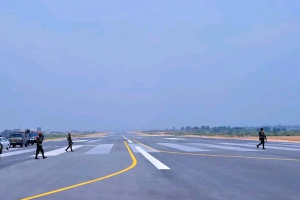
The airport in Bunia, capital of Ituri province, has entered a new phase of operations, with its upgraded runway now able to handle larger jet aircraft, including Airbus models, authorities said.
For years, air traffic at Bunia was limited by the technical constraints of its old runway.
The upgrade was demonstrated on April 20, 2026, when Compagnie Africaine d'Aviation (CAA) landed a flight at the airport. Passengers and crew praised the improved runway, now extended and suitable for jet operations.
The work is part of a rehabilitation and modernization project launched in June 2022. It was carried out by Mont Gabaon SARLU under the supervision of the Bureau central de coordination (BCECO), at a cost of more than $48 million, according to the Finance Ministry.
The project included extending the runway to 2,500 meters, widening it, expanding the apron, and building a new terminal and control tower.
Initially scheduled for completion within 36 months, the project was delayed by technical and logistical challenges, including soil conditions and material supply issues. The airport remained operational throughout, supporting humanitarian and cargo operations.
With the upgrade complete, Bunia airport is now equipped to handle larger aircraft, which could boost passenger and freight traffic. The modernization is also expected to improve the province’s connectivity with the country’s main economic centers and strengthen its integration into the national economy.
Boaz Kabeya
Haropa Port eyes support role in Kisangani–Kinshasa River transport revival
French public port authority Haropa Port has signaled interest in providing technical assistance for the development of river transport along the Kisangani-Kinshasa corridor in the Democratic Republic of Congo.
The possibility was discussed during a meeting held on Wednesday, April 22, 2026, when Vice Prime Minister and Transport Minister Jean-Pierre Bemba received French Ambassador to the DRC Rémi Maréchaux. Representatives from the French Development Agency (AFD) and Haropa Port also attended.
Haropa Port is a French public institution and the largest river-maritime port complex on the Seine axis, bringing together the ports of Le Havre, Rouen and Paris. It is France’s leading port and the fourth-largest in northern Europe by tonnage, with global maritime connections. The group serves a hinterland including the Seine Valley and the greater Paris region, representing a market of about 25 million people.
Internationally, Haropa Port develops partnerships focused primarily on technical cooperation and sharing port and logistics expertise. In Africa, the group has established collaborations with the Autonomous Port of Pointe-Noire in Congo and the Port of Kribi in Cameroon. These partnerships aim to improve port performance, digitalize operations and develop integrated logistics solutions.
In the case of the DRC, discussions are still at an early stage. Haropa Port’s interest is limited to technical support, and no concrete project or formal commitment has been announced.
Boaz Kabeya
DR Congo awards €25 mln solar mini-grid contract to German firm
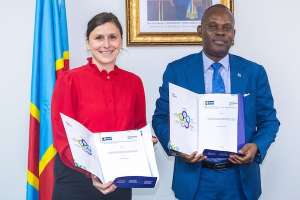
The Democratic Republic of Congo's rural electrification agency signed a commercial contract on April 21, 2026, with German company Off-Grid Europe to deploy solar photovoltaic mini-grids across the country.
According to a statement from the National Agency for Rural and Peri-Urban Electrification and Energy Services (ANSER), the agreement covers a €25 million project. The first phase includes the installation of 8.5 megawatt-peak capacity, expected to benefit 27,700 households across six localities.
ANSER said the deal represents a pilot phase of a broader program aimed at electrifying 27 agglomerations nationwide. The initiative is part of the national solar mini-grid program designed to accelerate access to electricity in rural and peri-urban areas.
At this stage, the agreement with Off-Grid Europe marks a key commercial step in the project, which will still require further technical and operational planning.
Based in Germany, Off-Grid Europe says it specializes in off-grid energy solutions. Founded in 2010, it designs, installs and maintains photovoltaic systems combined with battery storage for areas not connected to the national grid.
The company reports projects in Africa, including in Senegal, and operations in Nigeria, Cameroon and Guinea focused on autonomous energy systems.
With this agreement, ANSER continues its strategy of mobilizing technical and financial partners to expand rural electrification in a country where access to electricity remains limited outside major urban centers.
Ronsard Luabeya
Lac Tanganyika : Zijin Mining déploie 4 navires pour évacuer le lithium de Manono
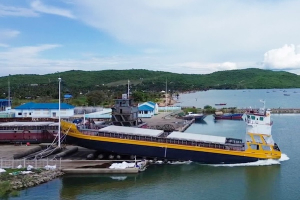
Le groupe chinois Zijin Mining structure le corridor logistique destiné à relier son projet de lithium de Manono, dans la province du Tanganyika, aux infrastructures portuaires tanzaniennes. Il finalise actuellement la construction de quatre navires cargos appelés à opérer sur le lac Tanganyika.
Selon le média tanzanien The Citizen, le chantier de ces quatre navires avait dépassé 95 % d’exécution en mars 2026. Le journal indique que deux unités étaient alors achevées, qu’une troisième attendait l’approbation de la Tanzania Shipping Agencies Corporation (TASAC), et que le quatrième navire venait d’être mis à l’eau, avec une finalisation attendue en juillet 2026.
Zijin avait déjà annoncé, en novembre 2025, la mise à l’eau du premier vraquier de la série, Golden Voyage No.1, présenté comme un maillon clé de la future route d’exportation entre la RDC et la Tanzanie. Le groupe précise que chaque navire mesure 70,08 mètres de long sur 15 mètres de large, avec une capacité de transport de 2 000 tonnes et une autonomie de 1 000 milles nautiques.
Les navires ont été fabriqués sous forme modulaire en Chine par Shandong Xinneng Shipbuilding, puis expédiés en Tanzanie pour assemblage final au port de Karema. D’après The Citizen, c’est en octobre 2023 que Golden Voyage Logistics, filiale de Zijin, a sollicité un espace dans ce port pour lancer le projet.
Corridor logistique multimodal
Ce dispositif doit soutenir en priorité la chaîne logistique du projet de lithium de Manono. Selon les informations déjà publiées sur ce dossier, les produits issus du projet doivent être transportés par route sur environ 440 kilomètres entre Manono et Kalemie, avant d’être chargés sur le lac Tanganyika en direction de Kigoma, puis acheminés par voie terrestre vers Dar es Salaam pour exportation.
Cette organisation s’inscrit dans une stratégie logistique plus large. En août 2025, Zijin a signé en Tanzanie un accord de concession pour exploiter le port de Kigoma ainsi que le terminal de Malindi, au port de Dar es Salaam, avec un programme de modernisation des entrepôts, des zones de stockage et des équipements de manutention.
Sur le plan industriel, le projet de Manono est dimensionné pour une capacité annuelle d’exploitation et de traitement de 5 millions de tonnes de minerai. L’unité est appelée à traiter 500 000 tonnes de concentré de spodumène afin de produire environ 95 170 tonnes de sulfate de lithium brut par an, avec une mise en service annoncée pour le 30 juin 2026.
Dans ce contexte, le déploiement des navires sur le lac Tanganyika apparaît comme un élément central de la sécurisation du corridor d’exportation de Zijin depuis l’est de la RDC vers l’océan Indien.
Timothée Manoke
Lire aussi :
Lithium de Manono : l’investissement de Zijin estimé à près d’un milliard de dollars
Kisangani–Kinshasa : Haropa Port veut appuyer la relance du transport fluvial
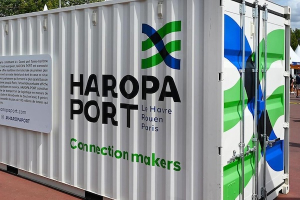
Le groupe portuaire français Haropa Port a exprimé son intérêt pour apporter un appui technique au développement du transport fluvial sur l’axe Kisangani–Kinshasa. Cette perspective a été évoquée lors d’une audience accordée, mercredi 22 avril 2026, par le vice-Premier ministre en charge des Transports, Jean-Pierre Bemba, à l’ambassadeur de France en RDC, Rémi Maréchaux, accompagné notamment de représentants de l’Agence française de développement (AFD) et de Haropa Port.
Établissement public français, Haropa Port constitue le grand ensemble portuaire fluvio-maritime de l’axe Seine, regroupant les ports du Havre, de Rouen et de Paris. Il s’agit du premier port de France et du quatrième port nord-européen en tonnage, connecté à l’ensemble des continents grâce à une offre maritime internationale. Cet ensemble s’appuie sur un hinterland couvrant notamment la vallée de la Seine et la région parisienne, soit un marché d’environ 25 millions de consommateurs.
À l’international, Haropa Port développe des partenariats principalement fondés sur la coopération technique et le partage d’expertise portuaire et logistique. En Afrique, le groupe a notamment engagé des collaborations avec le Port autonome de Pointe-Noire, au Congo, et avec le Port de Kribi, au Cameroun. Ces partenariats portent sur l’amélioration de la performance portuaire, la digitalisation des opérations et le développement de solutions logistiques intégrées.
Dans le cas de la RDC, les échanges s’inscrivent à ce stade dans une phase exploratoire. L’intérêt exprimé par Haropa Port porte sur un appui technique, sans qu’un projet concret ni un engagement formel n’aient encore été annoncés.
Boaz Kabeya
Solaire : l’Allemand Off-Grid Europe signe un contrat de 25 millions € en RDC
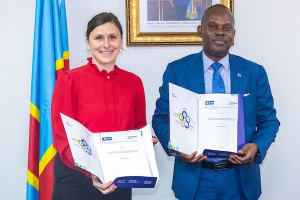
L’Agence nationale de l’électrification et des services énergétiques en milieux rural et périurbain (Anser) a signé, le 21 avril 2026, un contrat commercial avec la société allemande Off-Grid Europe en vue du déploiement de mini-réseaux solaires photovoltaïques en République démocratique du Congo.
Selon une communication de l’Anser, l’accord porte sur un projet de 25 millions d’euros. Cette première phase prévoit l’installation d’une capacité totale de 8,5 mégawatts-crête (MWc), avec un impact attendu sur 27 700 ménages répartis dans six agglomérations du pays.
L’agence précise qu’il s’agit d’une phase pilote d’un programme plus large, dont l’objectif final est d’électrifier 27 agglomérations à travers le pays. L’initiative s’inscrit dans le cadre du programme national d’électrification par mini-réseaux solaires photovoltaïques, mis en place pour accélérer l’accès à l’électricité dans les zones rurales et périurbaines.
À ce stade, l’accord signé avec Off-Grid Europe marque une étape commerciale dans la préparation du projet, qui devra encore se traduire par une structuration opérationnelle et technique des infrastructures à déployer.
Basée en Allemagne, Off-Grid Europe se présente comme une entreprise spécialisée dans les solutions énergétiques hors réseau. Fondée en 2010, elle conçoit, installe et maintient des systèmes photovoltaïques associés à des solutions de stockage par batteries, destinés aux zones non connectées au réseau national.
L’entreprise met également en avant plusieurs réalisations en Afrique, notamment au Sénégal, ainsi que des interventions au Nigeria, au Cameroun et en Guinée, dans le domaine des systèmes énergétiques autonomes.
Avec cet accord, l’Anser poursuit sa stratégie de mobilisation de partenaires techniques et financiers pour renforcer l’électrification rurale, dans un pays où l’accès à l’électricité demeure encore très limité en dehors des grands centres urbains.
Ronsard Luabeya
Lire aussi :
Électrification rurale : Infinite Capital vise 100 millions $ d’investissements pour la RDC
Solaire: l’ANSER s’allie à Propav pour développer deux centrales au Lualaba
Centrale hydroélectrique de Mbombo : l’ANSER porte le projet de 10 à 20 MW
Aéroport de Bunia : la piste modernisée permet désormais l’accueil d’avions de grande capacité
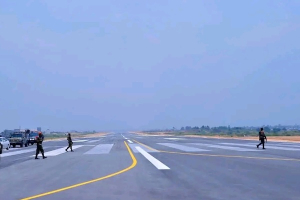
L’aéroport de Bunia, chef-lieu de la province de l’Ituri, a franchi un nouveau palier opérationnel avec la possibilité d’accueillir désormais des avions à réaction de plus grande capacité. Selon les autorités, la mise en service de la piste modernisée permet désormais à des appareils de type Airbus d’atterrir sans difficulté, élargissant les capacités de desserte de cette plateforme aéroportuaire.
Cette évolution intervient après plusieurs années durant lesquelles le trafic aérien de Bunia était limité par les caractéristiques techniques de l’ancienne piste. L’un des faits marquants de cette nouvelle phase a été l’arrivée, le 20 avril 2026, d’un vol exploité par la Compagnie Africaine d’Aviation (CAA), citée comme illustration concrète de l’adaptation de l’aéroport aux exigences d’exploitation des avions à réaction. Des passagers et des membres d’équipage ont salué la qualité de la piste, désormais plus longue et mieux aménagée pour les opérations d’atterrissage.
Ces avancées font suite aux travaux de réhabilitation et de modernisation lancés en juin 2022. Le chantier a été exécuté par Mont Gabaon SARLU, sous la coordination du Bureau central de coordination (BCECO), pour un coût évalué à plus de 48 millions de dollars, selon des chiffres avancés par le ministère des Finances. Il comprenait notamment l’allongement de la piste à 2 500 mètres, son élargissement, l’extension de l’aire de stationnement, ainsi que la construction d’une nouvelle aérogare et d’une tour de contrôle.
Le projet avait été initialement annoncé pour une durée de 36 mois, mais son exécution a été ralentie par plusieurs contraintes techniques et logistiques, notamment la nature du sol, l’approvisionnement en matériaux et certaines difficultés liées au chantier. Pendant toute cette période, l’aéroport est resté en activité, notamment pour les besoins humanitaires et logistiques.
Grâce à cette montée en capacité, l’aéroport de Bunia dispose désormais d’infrastructures mieux adaptées à l’accueil d’appareils plus performants, ce qui pourrait faciliter le transport de passagers et de fret à plus grande échelle. À terme, cette modernisation est aussi appelée à renforcer la connectivité de l’Ituri avec les principaux centres économiques du pays et à soutenir le désenclavement de la province.
Boaz Kabeya
Lire aussi :
Est de la RDC : Mont Gabaon obtient 153,9 millions $ de marchés publics
Aéroport de Bunia : la fin des travaux de modernisation annoncée pour février 2026
Microfinance : Paycode au cœur de la digitalisation du secteur en RDC
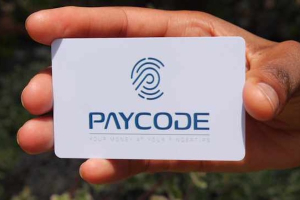
A travers le projet Transforme, porté avec l’appui de la Banque mondiale, la République démocratique du Congo engage une digitalisation du secteur de la microfinance, en s’appuyant sur un opérateur technologique appelé à jouer un rôle central : Paycode Fintech Congo. Le 15 avril 2026 à Kinshasa, la filiale locale de Paycode, fintech africaine spécialisée dans les paiements digitaux et l’identité biométrique, a signé un accord avec l’Association nationale des institutions de microfinance (ANIMF) et l’Association professionnelle des coopératives d’épargne et de crédit (Aprocec).
Cet accord s’inscrit dans la continuité du contrat signé en février 2025 entre le projet Transforme et un consortium comprenant Paycode Fintech Congo, Banktech Software Services Limited et Hong-Kong Top Wise Communications, portant sur la digitalisation du secteur de la microfinance et la fourniture de 10 000 terminaux de paiement, pour un montant qui n’a pas été communiqué.
Selon une communication du projet Transforme, cette initiative vise à moderniser les institutions de microfinance (IMF) et les coopératives d’épargne et de crédit (COOPEC), tout en les intégrant au système financier formel. L’accord confie à Paycode la mise en œuvre opérationnelle et technique d’une plateforme intégrée. Celle-ci devrait notamment comprendre un système de core banking, un progiciel de gestion intégré (ERP), un module monétique, ainsi que la production de cartes de paiement Mosolo. L’objectif est de faciliter l’interconnexion des IMF et des COOPEC au switch monétique national, une étape clé pour leur intégration dans le système financier formel et pour l’élargissement de l’usage des paiements électroniques.
La solution repose sur une infrastructure technologique complète incluant serveurs, capacités de stockage, dispositifs de sécurité et réseaux de télécommunications. Paycode assurera également l’hébergement, la maintenance des systèmes, la formation des utilisateurs ainsi que l’enrôlement des commerçants, afin de favoriser l’appropriation locale des outils.
Dans ce cadre, l’entreprise développe la plateforme e-Dapt, conçue pour répondre aux contraintes du marché congolais. Elle devrait notamment permettre le traitement de paiements groupés, la compensation et le règlement par lots, ainsi que l’exécution de transactions hors ligne en temps réel via des cartes biométriques, adaptées aux zones à faible connectivité.
Le projet prévoit par ailleurs le déploiement de 10 000 terminaux de paiement électronique (TPE) à travers les 145 territoires de la République démocratique du Congo. Ces équipements intégreront des solutions d’identification biométrique et seront associés à des cartes multi-applicatives conformes aux standards EMV (Europay, Mastercard et Visa).
Selon le projet Transforme, cette initiative devrait améliorer l’accès des petites et moyennes entreprises, notamment dans le commerce, l’agriculture et les services, aux services financiers, à l’épargne formelle et au crédit. Elle s’inscrit également dans une stratégie nationale visant à réduire l’usage des espèces au profit des paiements électroniques.
En RDC, le taux d’inclusion financière est passé de 38,5 % en 2022 à 50 % actuellement, une progression attribuée en grande partie au déploiement des solutions de paiement mobile. Cette dynamique s’inscrit dans la mise en œuvre de la Stratégie nationale d’inclusion financière 2023-2028, adoptée en juillet 2023, et repose sur le renforcement des infrastructures et des instruments de paiement.
Ronsard Luabeya
Lire aussi :
Paiement électronique : lancement du groupement interbancaire de la RDC d’ici fin mars 2026
Services financiers : la fintech Paymetrust autorisée à opérer en RDC