





Equipe Publication
Relance de la MIBA : Bond Equipment retenue pour fournir 57 millions $ d’équipements

La Société minière de Bakwanga (MIBA) avance dans son projet de relance. Dans un avis daté du 6 mai 2026, son directeur général, André Kabanda Kana, a attribué à Bond Equipment (PTY) LTD le marché relatif à l’acquisition de matériels industriels destinés à la relance de l’entreprise à Mbuji-Mayi.
Le montant total du marché s’élève à 57,45 millions dollars TTC. Il est réparti en cinq lots, auxquels s’ajoutent 2,3 millions dollars de frais de transport. Les détails techniques des équipements concernés ne sont pas précisés dans l’avis consulté.
Cette attribution reste provisoire, conformément aux règles applicables aux marchés publics. Elle intervient après l’ouverture des plis, le 3 mars 2026, l’examen du rapport d’évaluation des offres, le 13 mars 2026, puis l’avis de non-objection de la Direction générale du contrôle des marchés publics (DGCMP), daté du 27 mars 2026.
Cette opération intervient dans le contexte des efforts de relance de la MIBA, alors que les 50 millions dollars promis par le chef de l’État pour soutenir l’entreprise étaient annoncés comme en voie de décaissement. L’avis d’attribution ne permet toutefois pas d’établir si ces fonds ont déjà été décaissés ni s’ils financent directement ce marché.
La relance de la MIBA s’inscrit dans un plan minimum évalué à environ 70 millions dollars, destiné notamment à renforcer les capacités de production, sécuriser les concessions et relancer les activités minières de l’entreprise publique.
Bond Equipment faisait partie des sociétés sud-africaines déjà citées dans les discussions autour de la relance de la MIBA. L’entreprise dispose aussi d’une référence dans le secteur minier congolais : Ivanhoe Mines avait indiqué qu’elle fabriquait l’unité de séparation en milieu dense destinée au concentrateur de la mine de zinc de Kipushi.
Les prochaines étapes devront confirmer l’attribution définitive, la signature du contrat, le calendrier de livraison des équipements et les modalités exactes de financement.
Timothée Manoke
Lire aussi :
Relance de la Miba : les 50 millions $ promis par Tshisekedi en voie de décaissement
Cuivre : China Railway veut transformer des actifs de la MIBA en projet d’envergure
DR Congo central bank: 85% of $10 billion in imported cash exited banking system in 2025

The governor of the Democratic Republic of Congo’s central bank said 85% of the $10 billion in U.S. dollar cash imported into the country in 2025 never entered the banking system.
Of the $10 billion in dollar banknotes brought into the country that year, only about $1.5 billion was reflected in bank deposits, central bank governor André Wamesso said at an April 28 press conference.
“The Banque Centrale du Congo conducted a study. In 2025, we imported $10 billion in U.S. dollar banknotes, but deposits increased by only around $1.5 billion,” Wamesso said. “Where did the remaining $8.5 billion go?”
The question was largely rhetorical. In an interview broadcast on April 18 by Top Congo, Wamesso had already said that part of the imported cash was being used by money-laundering networks and terrorist financiers. The former economic adviser to President Felix Tshisekedi said armed groups operating in eastern Congo paid fighters in dollars despite having no formal means of obtaining them.
In response, the BCC’s Monetary Policy Committee decided at its April 9 meeting to grant the central bank sole authority to import foreign-currency banknotes and to ban foreign-currency cash transactions from April 9, 2027.
U.S. sanctions
At the April 28 press conference, Wamesso also warned that the uncontrolled circulation of dollar cash posed risks to the Congolese financial system.
With several rebel leaders already under U.S. sanctions, he said the DRC could face accusations that U.S. currency was circulating for the benefit of sanctioned individuals. That, he warned, could lead to restrictions on access to the U.S. dollar financial system, a risk heightened by the country’s placement on the Financial Action Task Force (FATF) grey list in 2022, which has strained ties between Congolese banks and correspondent banks abroad.
“These measures are also intended to help the country comply with U.S. sanctions,” Wamesso said, adding that the U.S. government “fully supports” the BCC’s decisions.
Washington has increasingly used sanctions as a tool to secure access to critical minerals in eastern DRC.
“The Treasury Department will not hesitate to take action against groups that deny the United States and our allies access to the critical minerals vital for our national defense,” John K. Hurley, the Treasury under secretary for terrorism and financial intelligence, said in August 2025 after sanctions were imposed on armed group leaders and networks accused of fueling instability in mineral-rich areas, including coltan- and tin-producing zones.
Less than a year later, Washington escalated further by sanctioning former President Joseph Kabila.
Pierre Mukoko
RDC-Tanzanie : vers un renforcement de la coopération contre la fraude sur les carburants
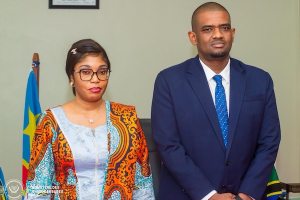
La République démocratique du Congo et la Tanzanie veulent approfondir leur coopération énergétique, notamment dans l’aval pétrolier et la lutte contre la fraude sur les produits en transit. Le sujet a été évoqué le 7 mai 2026 à Dodoma, lors d’une rencontre entre la ministre congolaise des Hydrocarbures, Acacia Bandubola, et le ministre tanzanien de l’Énergie, Deogratius Ndejembi.
Selon le ministère congolais des Hydrocarbures, les échanges ont porté sur l’expertise technique, l’exploitation pétrolière, la gestion commune du potentiel du lac Tanganyika, ainsi que la sécurisation des recettes publiques dans l’aval pétrolier.
Cette démarche s’inscrit dans le prolongement des alertes formulées ces derniers mois par la ministre des Hydrocarbures sur les importations de carburants par la voie Sud. En janvier 2026, Acacia Bandubola avait dénoncé un système de fraude douanière touchant les produits pétroliers finis importés dans le Haut-Katanga.
Selon une correspondance adressée à la DGDA, sur près de 2 millions de mètres cubes de carburants importés en 2025 via ce corridor, seule une partie aurait fait l’objet d’un dédouanement régulier. Cette situation aurait entraîné un manque à gagner évalué à près de 800 millions de dollars.
À Dodoma, les autorités congolaises et tanzaniennes n’ont pas encore détaillé les mécanismes envisagés. Mais l’objectif affiché est de mieux encadrer les flux pétroliers régionaux, de réduire les circuits de fraude et de sécuriser les recettes publiques.
La rencontre a également permis d’aborder l’exploitation du lac Tanganyika, présenté par le ministère comme une zone d’intérêt commun à fort potentiel pétrolier. Les deux pays disent vouloir harmoniser leur approche afin de faire de cette coopération énergétique un levier de croissance mutuelle.
Ronsard Luabeya
Lire aussi :
Carburants : Acacia Bandubola dénonce une fraude douanière massive au Haut-Katanga
Haut-Katanga : des miniers dans le viseur pour non-respect des règles sur les carburants
Cash : 8,5 milliards $ importés en 2025 sont sortis du circuit bancaire, selon la BCC

Le chiffre a été révélé lors d’une conférence de presse du gouverneur de la Banque centrale du Congo (BCC), le 28 avril dernier : sur les 10 milliards de dollars américains en cash importés en 2025, 8,5 milliards seraient aussitôt sortis du circuit bancaire, soit 85 % du volume global.
« Nous avons fait une étude au niveau de la Banque centrale du Congo. En 2025, nous avons importé pour 10 milliards en dollars américains de cash. (…) Les dépôts n’ont augmenté que d’environ 1,5 milliard de dollars », a déclaré André Wameso. Et de s’interroger : « Où sont donc passés les 8,5 milliards que nous avons importés dans notre économie ? »
Mais il s’agit, en réalité, d’une question rhétorique. Lors d’une interview diffusée le 18 avril sur Top Congo, le gouverneur avait déjà indiqué qu’une partie du cash importé chaque année des États-Unis alimente les circuits de blanchiment de capitaux, voire de financement du terrorisme. L’ancien conseiller économique du président Tshisekedi affirme notamment que la rébellion active dans l’Est du pays paie ses troupes en dollars alors qu’elle n’est pas en mesure d’en importer.
En réponse à cette situation, lors de sa réunion du 9 avril, le Comité de politique monétaire de la BCC a décidé de réserver à la banque centrale l’exclusivité de l’importation physique des billets en monnaies étrangères et d’interdire les transactions en espèces en devises à partir du 9 avril 2027.
Sanctions américaines
Pour justifier les décisions du CPM, André Wameso a également mis en lumière, lors de la conférence de presse du 28 avril, le risque que la circulation incontrôlée du cash en dollars fait peser sur le système financier congolais. Plusieurs dirigeants de la rébellion étant sous le coup de sanctions américaines, le gouverneur a notamment suggéré que la RDC pourrait être accusée de laisser circuler la monnaie américaine au profit de personnes sanctionnées. Ce qui pourrait donner lieu à des restrictions d’accès au système financier en dollars, dans un contexte où l’inscription du pays, en 2022, sur la liste grise du Groupe d’action financière (GAFI) a déjà compliqué les relations entre les banques locales et leurs correspondants.
« Toutes ces mesures sont donc aussi prises pour aider notre pays à respecter les sanctions américaines… », a fait savoir le gouverneur, qui affirme par ailleurs que le gouvernement américain soutient les décisions de la BCC « à 100 % ».
Les États-Unis ont fait des sanctions une arme pour assurer leur accès aux minerais critiques dans l’Est de la RDC. « Le département du Trésor n’hésitera pas à prendre des mesures contre les groupes qui empêchent les États-Unis et leurs alliés d’accéder aux minerais essentiels à notre défense nationale », avait prévenu, en août 2025, John K. Hurley, sous-secrétaire au Trésor chargé de la lutte contre le terrorisme et du renseignement financier, après des sanctions contre des responsables de groupes armés et certains réseaux accusés d’alimenter l’instabilité dans ces zones riches en minerais critiques (coltan, étain…). Moins d’un an plus tard, Washington est monté d’un cran en sanctionnant l’ex-président Joseph Kabila.
Pierre Mukoko
Lire aussi :
Sanctions contre Kabila : Washington monte d’un cran dans la défense de ses intérêts miniers
Dollar en cash : comment la BCC veut tarir les sources du blanchiment des capitaux
RDC–États-Unis : l’industrialisation de la mine de Rubaya à l’épreuve de multiples défis
Banques : la BCC veut durcir les plans de prévention et gestion des crises d’ici juin 2026
Intertek joins race for DRC trade control concessions operated by Bureau Veritas
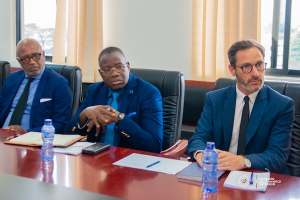
As several contracts linked to the management of foreign trade in the Democratic Republic of Congo approach expiry, Intertek and Bureau Veritas are intensifying lobbying efforts with Congolese authorities.
On May 6, 2026, a delegation from British group Intertek, led by Jeremy Gaspard, the company’s vice president for government and commercial services, was received in Kinshasa by Trade Minister Julien Paluku Kahongya. According to the ministry, the company proposed a public-private partnership with the Congolese state, through the Office congolais de contrôle (OCC), covering product inspection, testing and certification for imports and exports.
The move comes in a sector long dominated by Bureau Veritas BIVAC. For several years, the French group has operated two major programs in the DRC: the import conformity verification program (VOC), on behalf of the OCC, and the foreign trade single-window system (SEGUCE).
Those contracts, whose financial value has not been disclosed publicly, are due to expire this year. The first, awarded in 2006 to the BIVAC subsidiary, expires in November, while the second, signed in 2013 with the BIVAC/Soget consortium, runs out in October. After a renewal and a two-year extension respectively, the government is reportedly considering putting the next concessions out to competitive tender.
According to local media reports, at the last steering committee meeting on the OCC-BIVAC contract in January, Etienne Tshimanga, then director general of the OCC, said “an international tender will be launched in accordance with procurement rules.”
Two months later, Stephane Gaudechon, Bureau Veritas vice president for government contracts, met Prime Minister Judith Suminwa in Abu Dhabi. According to the Prime Minister’s office, discussions focused mainly on the two contracts. “There is a genuine desire to strengthen a 20-year partnership with Bureau Veritas,” Gaudechon said after the meeting.
Persistent criticism
That optimism comes despite persistent criticism from senior Congolese officials over the implementation of the contracts. In 2023, President Felix Tshisekedi asked the Inspection generale des finances (IGF) to assess the execution of the OCC-BIVAC contract, citing shortcomings in the partnership’s implementation.
At the time, some official sources said less than 35% of the contract had been implemented several years after its renewal. Congolese officials also raised concerns over costs considered excessive for the OCC, as well as delays in the delivery of certain equipment and infrastructure.
The foreign trade single-window system has also faced repeated criticism from business operators. Despite progress in digitization, several private sector players continue to point to administrative delays, overlapping procedures and difficulties integrating the various government agencies involved in foreign trade operations.
In November 2025, authorities said 67 out of 77 foreign trade documents had been digitized. In April, Gaudechon told Suminwa that the single-window project was nearing completion.
Those shortcomings have opened the door to new contenders. Already active in the DRC through the Eco-Levy program, which covers environmental certificates for certain imported goods, Intertek now appears to be seeking a broader role in trade inspection and certification activities.
No official tender has yet been launched. But the recent approaches made to Congolese authorities highlight growing competition over infrastructure considered strategic for managing Congo’s trade flows, customs revenues and trade data.
Pierre Mukoko & Ronsard Luabeya
Helios Towers and DRC regulator sign framework for telecom tower energy supply
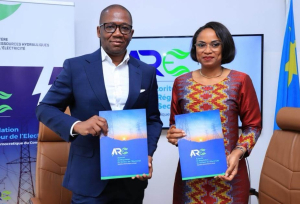
HT DRC Infraco, the operational entity of Helios Towers in the Democratic Republic of Congo, signed a memorandum of understanding with electricity sector regulator Autorité de régulation du secteur de l'électricité (ARE) on May 7, 2026. The agreement, signed by ARE Director General Soraya Aziz Moto and HT DRC Infraco Manager Maixent Bekangba, aims to establish a framework for supplying power to the group’s telecom sites in the country.
According to the ARE, the protocol is designed to facilitate telecom operators’ access to regulated electricity solutions, improve coordination with licensed electricity providers and strengthen tariff transparency. It also provides for collaboration on solutions tailored to off-grid sites or areas facing power supply constraints.
Helios Towers operates nearly 2,800 telecom sites in the DRC, a significant share of which are located in rural areas. In those locations, powering telecom towers relies heavily on generators, batteries or hybrid solar systems to ensure service continuity. The group also plans to invest more than $100 million to expand its infrastructure across 23 provinces, a move expected to increase its energy requirements in a country where electricity access barely exceeds 21%.
The agreement between the ARE and HT DRC Infraco reflects the growing importance of energy in the business model of telecom infrastructure operators in the DRC, a market where mobile internet and mobile money services continue to expand.
According to the latest data from telecom regulator ARPTC, the DRC had 73.9 million active mobile subscriptions in the fourth quarter of 2025, against an estimated population of 112.2 million, representing a penetration rate of 65.9%. Mobile internet now accounts for more than 55% of the sector’s total revenue, while the mobile money adoption rate reached 30.6% at the end of 2025.
Boaz Kabeya
Kinshasa-Brazzaville bridge agreement clears way for concessionaire selection
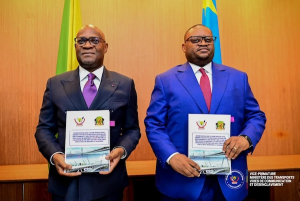
The Democratic Republic of Congo and the Republic of Congo signed a bilateral agreement on May 7 in Kinshasa setting out the tax, customs and non-tax revenue arrangements for the planned road-rail bridge between Kinshasa and Brazzaville.
The document was signed during a ceremony attended by DRC Deputy Prime Minister and Minister of Transport, Waterways and Connectivity Jean-Pierre Bemba and Republic of Congo Deputy Prime Minister for Territorial Planning and Major Works Jean-Jacques Bouya.
According to the DRC Ministry of Transport, the agreement establishes a common framework for taxation and customs procedures related to the project. It aims to eliminate the risk of double taxation and harmonize tariff procedures applicable to goods in transit as well as future toll revenue.
The signing follows technical discussions held in February 2026 in Kinshasa. At the time, officials from both countries said finalizing the framework was a necessary step before relaunching the process to select the concessionaire responsible for developing the project. The selection is expected to pave the way for financial close.
“The project is now moving into the implementation phase,” the Ministry of Transport said after the May 7 ceremony.
Currently estimated at more than $800 million, according to Congolese authorities, the project is being developed by Africa50 alongside the African Development Bank. The lead developer is responsible for structuring the public-private partnership with the future concessionaire.
The project involves the construction of a 1.575-km toll bridge incorporating a railway line, a road and border control posts on both banks of the Congo River. The infrastructure is intended to strengthen trade and passenger flows between Kinshasa and Brazzaville, which currently rely mainly on river crossings for transport links.
Boaz Kabeya
Contrôle de l’import-export : duel à distance entre Intertek et Bureau Veritas en RDC
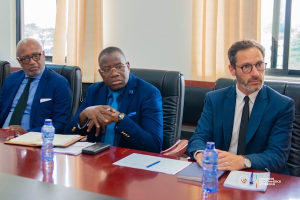
À l’approche de l’échéance de plusieurs contrats liés à la gestion du commerce extérieur en République démocratique du Congo (RDC), les groupes Intertek et Bureau Veritas multiplient les démarches auprès des autorités congolaises.
Le 6 mai 2026, une délégation du groupe britannique Intertek, conduite par Jeremy Gaspard, son vice-président chargé des services gouvernementaux et commerciaux, a été reçue à Kinshasa par le ministre du Commerce extérieur, Julien Paluku Kahongya. Selon le compte rendu officiel, l’entreprise a proposé un partenariat public-privé avec l’État congolais, via l’Office congolais de contrôle (OCC), portant sur « l’inspection, les tests physiques et la certification des produits » à l’importation et à l’exportation.
Cette initiative intervient dans un secteur déjà largement structuré autour de Bureau Veritas BIVAC. Depuis plusieurs années, le groupe français opère en RDC deux dispositifs majeurs : le programme de vérification de conformité des importations (VOC), sous mandat de l’OCC, ainsi que le Guichet unique du commerce extérieur (SEGUCE).
Mais ces contrats, dont la valeur n’est pas connue, arrivent à échéance cette année. Le premier, attribué en 2006 à la filiale BIVAC, s’achève en novembre, tandis que le second, signé en 2013 avec le consortium BIVAC/Soget, arrive à échéance en octobre. Après respectivement une reconduction et une prolongation de deux ans, le gouvernement envisagerait d’ouvrir à la concurrence le processus de sélection du prochain concessionnaire.
Selon la presse locale, lors de la dernière réunion du comité de pilotage du contrat OCC-BIVAC, tenue en janvier, Étienne Tshimanga, alors directeur général de l’OCC, avait indiqué qu’un « appel d’offres international sera lancé conformément aux règles en vigueur ».
En avril 2025, Stéphane Gaudechon, vice-président de Bureau Veritas chargé des contrats gouvernementaux, avait rencontré la Première ministre Judith Suminwa à Abu Dhabi. Selon le compte rendu des services de communication de la Primature, l’entretien a principalement porté sur ces deux contrats. « Il y a une réelle volonté de solidifier un partenariat vieux de 20 ans avec Bureau Veritas », avait indiqué Stéphane Gaudechon au sortir de l’audience.
« Failles »
Cet optimisme est affiché alors que la mise en œuvre des contrats a souvent fait l’objet de critiques de la part des plus hautes autorités du pays. Le président Félix Tshisekedi avait demandé, en 2023, à l’Inspection générale des finances (IGF) d’évaluer l’exécution du contrat liant l’OCC à BIVAC. Il évoquait alors des « failles » dans l’exécution du partenariat, tandis que certaines sources officielles faisaient état d’un taux d’exécution inférieur à 35 % plusieurs années après la reconduction du contrat. Des responsables congolais ont également évoqué des coûts jugés excessifs pour l’OCC, ainsi que des retards dans la mise à disposition de certains équipements et infrastructures.
Le Guichet unique du commerce extérieur a lui aussi fait l’objet de critiques récurrentes de la part d’opérateurs économiques. Malgré les avancées de la dématérialisation, plusieurs acteurs du secteur privé dénoncent encore des lenteurs administratives, des doublons de procédures et des difficultés d’intégration complète entre les administrations impliquées dans le commerce extérieur. En novembre 2025, les autorités indiquaient que 67 des 77 documents du commerce extérieur avaient été numérisés. En avril, Stéphane Gaudechon avait pour sa part assuré à Judith Suminwa que le projet de guichet unique est arrivait « à la fin du processus d’implémentation ».
Ces fragilités créent un contexte favorable à l’émergence de nouveaux prétendants. Déjà présent en RDC à travers le programme Eco-Levy, relatif aux certificats environnementaux sur certains produits importés, Intertek semble désormais chercher à élargir son périmètre vers les fonctions centrales de contrôle et de certification du commerce extérieur.
À ce stade, aucun appel d’offres officiel n’a été lancé. Mais les démarches entreprises auprès des autorités illustrent la bataille de positionnement qui se joue autour d’infrastructures considérées comme stratégiques pour la gestion des flux commerciaux, des recettes et des données du commerce extérieur congolais.
Pierre Mukoko et Ronsard Luabeya
Lire aussi :
Import-export : la RDC discute avec Gaindé 2000 pour accélérer la dématérialisation
Importations en RDC : le contrôle à la source devient obligatoire
Télécoms : Helios s’appuie sur l’ARE pour structurer l’alimentation énergétique de ses sites
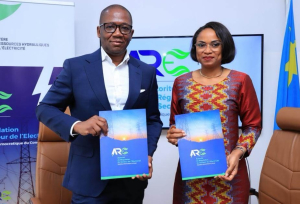
HT DRC Infraco, entité opérationnelle de Helios Towers en RDC, a signé, le 7 mai 2026, un protocole d’accord avec l’Autorité de régulation du secteur de l’électricité (ARE). L’accord, signé par la directrice générale de l’ARE, Soraya Aziz Moto, et le gérant de HT DRC Infraco, Maixent Bekangba, vise à encadrer l’alimentation énergétique des sites télécoms exploités par le groupe dans le pays.
Selon l’ARE, ce protocole doit faciliter l’accès des infrastructures télécoms à des solutions électriques réglementées, améliorer la coordination avec les opérateurs énergétiques agréés et renforcer la transparence tarifaire. Il prévoit aussi une collaboration autour de solutions adaptées aux sites situés hors réseau ou dans les zones confrontées à des difficultés d’approvisionnement électrique.
En RDC, Helios Towers exploite près de 2 800 sites télécoms, dont une part importante en zones rurales. Dans ces localités, l’alimentation des tours repose souvent sur des groupes électrogènes, des batteries ou des solutions solaires hybrides, afin d’assurer la continuité du service. Le groupe prévoit en outre d’investir plus de 100 millions de dollars pour étendre ses infrastructures dans 23 provinces, ce qui devrait accroître ses besoins en énergie dans un pays où le taux d’accès à l’électricité dépasse à peine les 21%.
L’accord entre l’ARE et HT DRC Infraco illustre le poids croissant de l’énergie dans le modèle économique des opérateurs d’infrastructures télécoms en RDC, un marché où l’internet mobile et le mobile money continuent de progresser.
Selon les dernières données de l’ARPTC, la RDC comptait 73,9 millions d’abonnements mobiles actifs au quatrième trimestre 2025, pour une population estimée à 112,2 millions d’habitants, soit un taux de pénétration de 65,9 %. L’internet mobile représente désormais plus de 55 % du chiffre d’affaires total du secteur, tandis que le taux de pénétration de la monnaie mobile atteignait 30,6 % à fin 2025.
Boaz Kabeya
Lire aussi :
Tours télécoms : Eastcastle cherche 180 millions $ pour accélérer son expansion en RDC
Pont Kinshasa-Brazzaville : un accord ouvre la voie à la sélection du concessionnaire
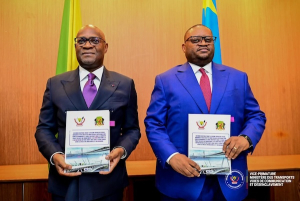
La République démocratique du Congo et la République du Congo ont signé, le 7 mai 2026 à Kinshasa, un accord bilatéral encadrant le régime fiscal, douanier et des recettes non fiscales applicable au projet de pont route-rail entre Kinshasa et Brazzaville.
Le document a été signé lors d’une cérémonie présidée, côté RDC, par le vice-Premier ministre et ministre des Transports, Voies de communication et Désenclavement, Jean-Pierre Bemba, et, côté République du Congo, par le vice-Premier ministre de l’Aménagement du territoire et des Grands travaux, Jean-Jacques Bouya.
Selon le ministère des Transports de la RDC, cet accord fixe un cadre commun pour la fiscalité et les procédures douanières liées au projet. Il vise à éviter les risques de double imposition et à harmoniser les procédures tarifaires applicables aux marchandises en transit ainsi qu’aux futures recettes de péage.
Cette signature intervient après des travaux techniques organisés en février 2026 à Kinshasa. À cette occasion, les responsables des deux pays avaient expliqué que la finalisation de ce cadre constituait une étape nécessaire avant la relance du processus de sélection du concessionnaire chargé du développement du projet. Cette sélection devrait elle-même conduire au closing financier.
« Ce projet structurant entre désormais dans sa phase d’opérationnalisation », indique d’ailleurs le ministère des Transports à l’issue de la cérémonie du 7 mai.
Aujourd’hui estimé à plus de 800 millions de dollars selon les autorités congolaises, le projet est développé par Africa50 aux côtés de la Banque africaine de développement (BAD). C’est au principal développeur qu’il revient de structurer le partenariat public-privé (PPP) avec le concessionnaire qui sera sélectionné.
Le projet prévoit la construction d’un pont à péage de 1,575 km comprenant une voie ferrée, une route ainsi que des postes de contrôle frontalier de part et d’autre du fleuve Congo. Cette infrastructure doit renforcer les échanges commerciaux et les déplacements entre Kinshasa et Brazzaville, actuellement assurés principalement par voie fluviale.
Boaz Kabeya
Lire aussi :
Pont Kinshasa–Brazzaville : un régime fiscal harmonisé pour relancer l’appel d’offres