





Equipe Publication
For Gécamines Trading, U.S.’s Project Vault Opens a Strategic New Market
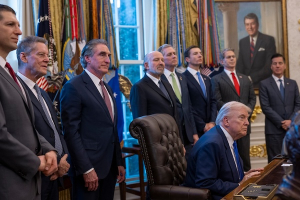
The United States officially launched Project Vault on Feb. 2, 2026. The $12 billion initiative aims to build a strategic stockpile of critical minerals to secure supply chains for industrial and civilian needs.
The program is backed by $1.67 billion in private capital and $10 billion in loans from the Export-Import Bank of the United States.
While full details have not been disclosed, the initiative is intended to shield U.S. industry from supply disruptions amid trade tensions with China. Until November 2025, Beijing had suspended exports of critical minerals such as germanium and gallium to the United States. The materials are essential for semiconductors, solar panels, lasers and night-vision equipment.
These minerals are produced in the Democratic Republic of Congo, notably at the Kipushi mine. The operation is jointly owned by Ivanhoe Mines, which holds a 62% stake, and state-owned miner Gécamines, which owns 38%.
Canadian firm Ivanhoe Mines, partly backed by Chinese capital, said its executive co-chairman Robert Friedland attended the Project Vault launch at the White House alongside Donald Trump.
The company added it is in advanced talks with Gécamines and commodities trader Mercuria to have Gécamines Trading, a dedicated mineral trading subsidiary, direct part of Kipushi’s zinc concentrate output to the United States. The concentrate also contains germanium and gallium.
That portion is currently allocated to Mercuria under an offtake agreement signed in July 2025. The three-year contract covers one-third of the mine’s total production and includes a $20 million loan to Kipushi at a 6% interest rate. The funds are intended to ease bottlenecks and expand concentrator capacity.
Strategic partnership
The remaining two-thirds of production is already committed to CITIC Metal and Trafigura under separate agreements reached in July 2024 and running through 2029.
However, Ivanhoe said in its statement that “Gécamines could be responsible for marketing up to 50% of the concentrate production from the Kipushi mine,” without providing further details. Under this scenario, Gécamines Trading, a joint venture between Gécamines and Mercuria, could become a key channel for exporting Kipushi minerals to the United States.
For 2026, Kipushi’s output is expected to reach between 240,000 and 290,000 tonnes of zinc concentrate, confirming its position as a major player in the global market. The opportunity offered to Gécamines by Project Vault appears significant, as several analyses indicate China controls a large share of active mining assets in the DRC. This has prompted Washington to closely track volumes linked to state holdings.
“The DRC and its state-owned enterprises will use their marketing rights under participation and contract arrangements to provide offtake access to U.S. and allied buyers,” according to the strategic agreement signed on Dec. 4 between Kinshasa and Washington.
As part of its implementation, Gécamines Trading plans to direct around 100,000 tonnes of copper from the Tenke Fungurume Mining (TFM) operation to the United States in 2026. This reflects the share tied to its 20% stake in TFM, a mine controlled 80% by Chinese group CMOC.
Timothée Manoke
Minerais critiques : Project Vault, une opportunité en milliards $ pour Gécamines Trading

Le 2 février 2026, les États-Unis ont lancé officiellement Project Vault, une initiative d’un montant total de 12 milliards de dollars visant à constituer un stock stratégique de minerais critiques afin de sécuriser leur chaîne d’approvisionnement pour les besoins industriels et civils. Le dispositif repose sur 1,67 milliard de dollars de capitaux privés et 10 milliards de dollars de prêts octroyés par l’Export-Import Bank of the United States.
Tous les détails du projet ne sont pas encore publics. On sait néanmoins qu’il vise à protéger l’industrie américaine contre les chocs d’approvisionnement, dans un contexte de tensions commerciales avec la Chine. Jusqu’en novembre 2025, Pékin avait en effet suspendu les exportations vers les États-Unis de minerais critiques tels que le germanium et le gallium, essentiels notamment aux industries des semi-conducteurs, des panneaux solaires, des lasers et des équipements de vision nocturne.
Ces minerais sont présents en République démocratique du Congo (RDC), notamment dans la mine de Kipushi, codétenue par Ivanhoe Mines (62 %) et l’entreprise publique Gécamines (38 %). En annonçant la présence de son co-président exécutif, Robert Friedland, au lancement de Project Vault à la Maison Blanche aux côtés de Donald Trump, l’entreprise canadienne — contrôlée en partie par des capitaux chinois — a indiqué être en discussions avancées avec Gécamines et le négociant Mercuria afin que Gécamines Trading, filiale dédiée au trading des minerais, oriente vers les États-Unis une partie du concentré de zinc de Kipushi, qui contient également du germanium et du gallium.
Jusqu’ici, cette part revient à Mercuria en vertu d’un accord d’achat conclu en juillet 2025. Ce contrat, d’une durée de trois ans, porte sur le tiers de la production totale de la mine et intègre un prêt de 20 millions de dollars accordé à Kipushi, avec un taux d’intérêt de 6 %, destiné à financer les travaux de désengorgement et l’augmentation de la capacité du concentrateur.
Partenariat stratégique
Les deux tiers restants de la production sont déjà attribués à CITIC Metal et Trafigura, conformément à d’autres accords conclus en juillet 2024 et valables jusqu’en 2029. Mais dans son communiqué, Ivanhoe affirme que « Gécamines pourrait être responsable de la commercialisation de jusqu’à 50 % de la production de concentré de la mine de Kipushi », sans plus de détails.
Dans cette perspective, Gécamines Trading — joint-venture entre Gécamines et Mercuria — pourrait devenir un acteur central de l’exportation des minerais issus de Kipushi vers les États-Unis. Pour l’année 2026, la production de la mine est attendue entre 240 000 et 290 000 tonnes de concentré de zinc, confirmant son positionnement parmi les sites majeurs du marché mondial.
L’opportunité offerte à Gécamines par le Project Vault apparaît d’autant plus importante que, selon plusieurs analyses, la Chine contrôle une part significative des mines actives en RDC, poussant Washington à regarder de près les volumes adossés aux participations publiques. « La RDC et ses entreprises publiques utiliseront leurs droits de commercialisation liés à la participation et aux contrats pour fournir un accès à l’offtake aux personnes américaines et alliées », prévoit d’ailleurs l’accord stratégique signé le 4 décembre dernier entre Kinshasa et Washington.
Dans le cadre de la mise en œuvre de cet accord, Gécamines Trading prévoit déjà d’orienter vers les États-Unis environ 100 000 tonnes de cuivre en 2026 provenant de la mine de Tenke Fungurume Mining (TFM). Ce volume correspond à la quote-part liée à sa participation de 20 % dans TFM, une mine contrôlée à 80 % par le groupe chinois CMOC.
Timothée Manoke
Lire aussi :
Cuivre de TFM : Gécamines veut orienter 100 000 tonnes vers les États-Unis en 2026
Ventes des minerais critiques : vers une coentreprise Gécamines-Mercuria-DFC
Zinc : la mine de Kipushi quadruple sa production en 2025 et entre dans le top 5 mondial
Telecom regulator ARPTC announces work on WACS subsea cable after internet disruptions

Investigations to determine the causes of the recent deterioration in internet service quality are scheduled to begin on Feb. 3, 2026, DRC ’s Postal and Telecommunications Regulatory Authority (ARPTC) said in a statement released on Jan. 31.
The operations follow a major technical fault that affected the West Africa Cable System (WACS), an international subsea fibre-optic link, in January. The regulator said work will be carried out in Muanda, in the Democratic Republic of Congo, and in Pointe-Noire, in the Republic of Congo, with the aim of restoring internet services to normal.
ARPTC warned that the operations could lead to further temporary disruptions. It added, however, that the operators involved have implemented redundancy measures to reduce the impact on service continuity.
The regulator said it is closely monitoring the progress of the work and committed to keeping users informed in a timely manner of any steps that may be required depending on developments.
During a Council of Ministers meeting on Jan. 9, 2026, President Felix Tshisekedi instructed the relevant authorities to take the necessary measures to contain recurring disruptions affecting telecommunications networks and systems nationwide.
The malfunctions have affected mobile and fixed-line telephony, internet access, data transmission, digital services, network interconnection, as well as radio broadcasting and digital television.
The head of state also called for stronger regulation, oversight and permanent monitoring mechanisms for network and service quality. He further urged effective coordination between sector ministries, regulatory authorities and specialised technical services.
Ronsard Luabeya
Glencore-Orion CMC partnership brings U.S. backing into DRC mines
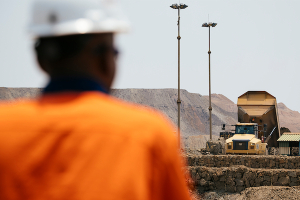
Glencore and the Orion Critical Mineral Consortium (Orion CMC) are signaling plans for closer coordination in the Democratic Republic of Congo (DRC) that go beyond the recently announced capital deal. Orion CMC was established in October 2025 to help supply critical minerals to the United States and its allies.
In a joint statement released Feb. 3, 2026, the two parties said they will also explore opportunities to expand and extend the life of the Mutanda Mining (Mumi) and Kamoto Copper Company (KCC) copper and cobalt mines. These assets are currently valued at about $9 billion, including debt.
Details have not been disclosed at this stage. Potential investments could aim to accelerate production or extend the mining concessions. In its 2025 resources and reserves report published Jan. 29, the Anglo-Swiss group put ore reserves at 107 million tonnes for MUMI and 137 million tonnes for KCC.
The mines are estimated to operate for 22 years in the case of MUMI, until 2047, and 18 years for KCC, until 2043. Current permits expire in 2037 and 2039, respectively. The review is reportedly being conducted alongside the Congolese government and the state-owned company Gécamines, a long-standing partner within KCC.
The statement also mentioned the study of potential acquisitions of additional mining projects and assets in the DRC and more broadly across the African Copperbelt. The wording suggests the possibility of a joint development platform, although no target assets, timelines, or investment budgets have been specified so far.
Proposed stake sale
The announcement follows a non-binding memorandum of understanding on Orion CMC’s proposed purchase of 40% of Glencore’s interests in MUMI and KCC. Glencore currently holds 95% of MUMI, with the state holding 5%, and 70% of KCC, with Gécamines holding 30%.
If completed, the transaction would bring in a third major shareholder. Orion CMC, a consortium led by Orion Resource Partners and backed by the U.S. International Development Finance Corporation (DFC), would hold 38% of MUMI and 28% of KCC. Glencore’s stakes would fall to 57% and 42%, respectively.
The statement said Glencore, as the majority shareholder of both mines, would retain operational control. Orion CMC would have limited governance rights, including the appointment of non-executive directors.
The consortium would also be responsible for marketing its share of output to designated buyers. This would take place within the framework of the strategic partnership on critical minerals signed between the United States and the DRC on Dec. 4 in Washington.
The arrangement reflects a clear division of roles. Glencore remains the industrial operator in the DRC, while Orion CMC provides capital, sales channels, and U.S. institutional backing, particularly through the DFC. On this basis, the two groups are discussing possible joint action, with each party operating on a distinct but coordinated segment of the value chain.
Institutional interest
According to Glencore’s 2025 production report, the Mutanda and KCC mines provided the group with 247.8 thousand tonnes of copper metal and 33.5 thousand tonnes of cobalt in 2025. Based on a 40% share of Glencore’s interests, the maximum portion likely to be marketed by Orion CMC would be about 100 thousand tonnes of copper and 13.4 thousand tonnes of cobalt. However, exports of cobalt remain constrained by quotas introduced by the Congolese government in October 2025.
In light of the strategic agreement between the DRC and the United States on critical minerals, the partnership also carries institutional value for Glencore. The group has operated in the DRC in an often tense environment marked by tax disputes and governance controversies. The entry of a U.S.-backed partner reshapes the dynamics.
On one hand, it brings American political and institutional support into strategic assets, which may help rebalance relations with the Congolese state. On the other, the presence of the DFC implies stricter requirements for compliance, transparency, and traceability. These factors could strengthen the credibility of the arrangement with tax and regulatory authorities.
Unknowns
The separation of roles, with Glencore handling operations and Orion CMC marketing its share, may also improve the clarity of sales flows. This is relevant in a context where transfer pricing and mining taxation remain sensitive issues in the DRC.
Despite these broad plans, the statement remains cautious. Terms such as “will examine” and “will consider” indicate that the parties are still at an early, exploratory stage. The transaction remains subject to audits, final contractual agreements, and regulatory approvals.
No public information yet details specific financial commitments regarding employment, local subcontracting, or an investment program. Similarly, any potential consequences of this cooperation for preliminary discussions between Glencore and Rio Tinto have not been documented at this stage.
Pierre Mukoko
Internet : l’ARPTC annonce des travaux sur le câble sous-marin WACS
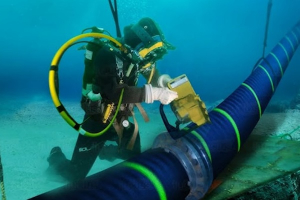
Les opérations d’identification des causes des récentes dégradations de la qualité des services Internet devraient débuter le 3 février 2026, a annoncé l’Autorité de régulation de la poste et des télécommunications du Congo (ARPTC) dans un communiqué publié le 31 janvier 2026.
Ces interventions font suite à une « panne technique générale » ayant affecté, en janvier, la liaison internationale sous-marine à fibre optique West Africa Cable System (WACS). Les travaux seront menés à Muanda, en République démocratique du Congo (RDC), et à Pointe-Noire, en République du Congo, avec pour objectif le « rétablissement normal » des services Internet, précise le régulateur.
L’ARPTC avertit que ces opérations pourraient occasionner de nouvelles perturbations temporaires. Elle indique toutefois que les opérateurs concernés ont mis en place des mesures de redondance afin de limiter l’impact sur la continuité des services.
Le régulateur dit suivre de près l’évolution des travaux et s’engage à informer les usagers en temps utile des dispositions à prendre en fonction de la situation.
Lors du Conseil des ministres du 9 janvier 2026, le président de la République, Félix Tshisekedi, a instruit les autorités compétentes de prendre les mesures nécessaires afin de contenir les perturbations récurrentes affectant les réseaux et systèmes de télécommunications sur l’ensemble du territoire national.
Ces dysfonctionnements ont concerné notamment la téléphonie mobile et fixe, l’Internet, la transmission de données, les services numériques, l’interconnexion des réseaux, ainsi que la radiodiffusion et la télévision numérique.
Le chef de l’État a également demandé le renforcement des mécanismes de régulation, de contrôle et de suivi permanent de la qualité des réseaux et des services, ainsi qu’une coordination effective entre les ministères sectoriels, les autorités de régulation et les services techniques spécialisés.
Ronsard Luabeya
Lire aussi :
Internet : le régulateur attribue les perturbations en RDC à une panne sur le câble WACS
Télécoms : Tshisekedi demande des sanctions contre les opérateurs défaillants
Cuivre-cobalt : ce que peut changer le tandem Glencore–Orion en RDC
Glencore et le consortium Orion Critical Mineral Consortium (Orion CMC), créé en octobre 2025 pour contribuer à l’approvisionnement des États-Unis et de leurs alliés en minerais critiques, laissent entrevoir une logique d’action coordonnée en République démocratique du Congo (RDC), au-delà de la seule opération capitalistique annoncée. Dans un communiqué conjoint publié le 3 février 2026, les deux parties indiquent qu’elles examineront également des « opportunités d’extension et de développement » pour les mines de cuivre et de cobalt de Mutanda Mining (Mumi) et Kamoto Copper Company (KCC), aujourd’hui valorisées à environ 9 milliards de dollars, dette comprise.
Les contours de ce qui est envisagé ne sont pas précisés à ce stade. Il pourrait s’agir d’investissements visant à accélérer la production ou prolonger la durée de la concession. Dans son rapport 2025 sur les ressources et réserves, publié le 29 janvier, le groupe anglo-suisse estime les réserves en minerai de MUMI et de KCC respectivement à 107 millions et 137 millions de tonnes. La durée de vie des mines est évaluée à 22 ans (jusqu’en 2047) pour MUMI et 18 ans (jusqu’en 2043) pour KCC, alors que les permis expirent respectivement en 2037 et 2039. Ces réflexions seraient menées conjointement avec le gouvernement congolais et la société publique Gécamines, qualifiée de « partenaire historique » au sein de KCC.
Le communiqué mentionne également l’étude d’éventuelles acquisitions de projets et d’actifs miniers supplémentaires, en RDC et plus largement dans la ceinture cuprifère africaine. La formulation suggère une logique de plateforme commune de développement, sans qu’aucun actif cible, calendrier ou enveloppe d’investissement ne soit précisé à ce stade.
Entrée envisagée au capital
L’annonce s’inscrit dans le cadre d’un protocole d’accord non contraignant portant sur l’entrée envisagée d’Orion CMC à hauteur de 40 % dans les intérêts détenus par Glencore au sein de MUMI et KCC. À ce jour, Glencore détient 95 % de MUMI (contre 5 % pour l’État) et 70 % de KCC (Gécamines détenant 25 % et l'Etat 5 %). Si l’opération aboutit, la nouvelle géographie du capital introduirait un troisième pôle : Orion CMC — consortium mené par Orion Resource Partners et soutenu par la U.S. International Development Finance Corporation (DFC) — détiendrait 38 % de MUMI et 28 % de KCC, tandis que les participations de Glencore se réduiraient respectivement à 57 % et 42 %.
Le communiqué précise que, Glencore, actionnaire majoritaire des deux mines, conserverait leur gestion opérationnelle, tandis qu’Orion CMC disposerait de droits de gouvernance limités, notamment la nomination d’administrateurs non exécutifs. Le consortium serait en outre chargé de la commercialisation du volume de production correspondant à sa participation, auprès d’« acheteurs désignés », dans le cadre du partenariat stratégique entre les États-Unis et la RDC sur les minerais critiques, signé le 4 décembre dernier à Washington.
Cette articulation dessine une complémentarité fonctionnelle : Glencore demeure l’opérateur industriel en RDC, tandis qu’Orion CMC apporte capital, relais commerciaux et adossement institutionnel américain, notamment via la DFC. C’est sur cette base que les deux groupes évoquent une possible action en tandem, chacun intervenant sur un segment distinct — mais coordonné — de la chaîne de valeur.
Intérêt institutionnel
Selon le rapport de production 2025 de Glencore, les mines de Mutanda et KCC ont apporté au groupe 247,8 milliers de tonnes de cuivre métal et 33,5 milliers de tonnes de cobalt en 2025. Rapportée à une participation de 40 % dans les intérêts de Glencore, la quote-part maximale susceptible d’être commercialisée par Orion CMC s’établirait à environ 100 milliers de tonnes de cuivre et 13,4 milliers de tonnes de cobalt. Mais l’exportation de ce dernier produit reste limitée par les quotas à l’exportation instaurés par le gouvernement congolais depuis octobre 2025.
À la lumière de l’accord stratégique entre la RDC et les États-Unis sur les minerais critiques, ce tandem présente aussi un intérêt institutionnel pour Glencore. Le groupe a opéré en RDC dans un environnement parfois tendu, marqué par des différends fiscaux et des controverses de gouvernance. L’entrée d’un partenaire soutenu par les États-Unis modifie le cadre de référence.
D’une part, elle introduit un adossement politique et institutionnel américain dans des actifs stratégiques, ce qui peut contribuer à rééquilibrer les relations avec l’État congolais. D’autre part, la présence de la DFC implique des exigences accrues en matière de conformité, de transparence et de traçabilité, susceptibles de renforcer la crédibilité du dispositif vis-à-vis des autorités fiscales et réglementaires.
Inconnues
La séparation des rôles — Glencore à l’exploitation, Orion CMC à la commercialisation de sa quote-part — peut également améliorer la lisibilité des flux commerciaux, dans un contexte où la question des prix de transfert et de la fiscalité minière demeure sensible en RDC.
Malgré cette feuille de route esquissée, le communiqué demeure prudent. Les termes employés — « examineront », « envisageront » — confirment que les parties se situent au stade de l’exploration stratégique. La transaction reste conditionnée aux audits, à la finalisation des accords contractuels et aux autorisations réglementaires.
Surtout, aucun élément public ne détaille encore d’engagements chiffrés sur l’emploi, la sous-traitance locale ou un programme d’investissements. De même, les conséquences éventuelles de cette coopération sur les discussions préliminaires entre Glencore et Rio Tinto ne sont pas documentées à ce stade.
Pierre Mukoko
Lire aussi :
Cobalt : comment Glencore ajuste sa stratégie en RDC face aux quotas à l’exportation
Fusion Rio Tinto–Glencore : les mines Kamoto et Mutanda au cœur des enjeux en RDC
Cuivre et cobalt : Glencore dément tout projet de vente d’actifs en RDC, mais…
Gouvernance minière en RDC : ce que révèle le témoignage de Dan Gertler
DRC, UAE sign comprehensive economic agreement, target $10 billion trade by 2030
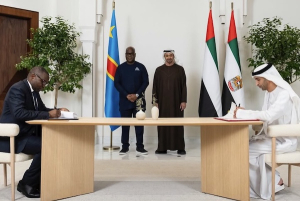
The Democratic Republic of Congo (DRC) and the United Arab Emirates (UAE) signed a Comprehensive Economic Partnership Agreement (CEPA) on Feb. 2 in Abu Dhabi, alongside three memorandums of understanding.
The signing ceremony was attended by Congolese President Felix Tshisekedi and UAE President Sheikh Mohamed bin Zayed Al Nahyan.
Congolese officials said the agreement aims to boost investment in key sectors and deepen economic cooperation. Through the partnership, Kinshasa and Abu Dhabi hope to double bilateral trade to $10 billion by 2030, up from $5 billion.
The target reflects strong growth in recent years. Data from the Congolese Ministry of Foreign Trade show trade between the two countries rose from $1.2 billion in 2020 to $4.5 billion in 2024.
The Congolese presidency said the CEPA will open the Emirati market to around 6,000 Congolese products, cut customs duties for Congolese businesses, secure commercial transactions and strengthen efforts to combat smuggling.
A free trade agreement had been under discussion for several months and appears to have been incorporated into the CEPA. Both sides also plan to establish joint monitoring committees to oversee implementation.
Memorandums of understanding
The signing was followed by three memorandums of understanding.
The first, signed with the National Transport Office (ONATRA), concerns the Banana deep-water port project in Moanda, in Kongo Central province. Details of the agreement were not disclosed.
The port, currently under construction, is already being developed in partnership with Emirati logistics group DP World. It is intended to provide the DRC with a strategic maritime hub. The facility is expected to include a 600-metre quay, a 30-hectare storage area and capacity for around 450,000 containers, enabling large vessels to dock directly.
The second memorandum focuses on mining. It aims to strengthen cooperation on the traceability and security of critical mineral supply chains, supported by coordinated investments.
The third agreement covers diplomatic cooperation. It provides for closer exchanges between the DRC Diplomatic Academy and the UAE’s Anwar Gargash Diplomatic Academy, including knowledge-sharing, joint training and research programmes, and the organisation of joint events.
The new framework builds on growing commercial ties between the two countries. In 2023, the DRC and the UAE signed a partnership aimed at ensuring a more transparent and responsible trade in Congolese gold.
That agreement led to the creation of Primera Gold DRC SA, later renamed DRC Gold Trading, which is tasked with collecting and exporting artisanal gold.
The Ministry of Foreign Trade said the company exported around five tonnes of gold in 2023, more than the DRC had officially recorded over the previous 15 years combined. Exports in 2024 are estimated at between seven and nine tonnes, according to the same source.
Ronsard Luabeya
DRC orders mining firms to prove environmental rehabilitation funding by Feb. 16
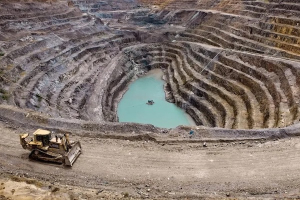
The Congolese government has instructed all mining companies operating in the Democratic Republic of Congo (DRC) to provide evidence of financial guarantees for environmental rehabilitation by Feb. 16, 2026.
The directive was set out in a Ministry of Mines letter dated Jan. 30 and applies to all active mining and quarrying projects licensed up to Dec. 31, 2025.
The ministry said affected companies must submit approved environmental management plans and documents confirming that the required financial guarantees have been put in place, in line with the Mining Code and its implementing regulations.
Under Congolese law, holders of mining or quarrying rights must establish a financial guarantee before operations begin. The security is intended to cover the costs of site rehabilitation and closure and is calculated based on the project’s environmental management plan as approved by authorities.
The guarantee must remain available for the state to draw on if an operator fails to meet its obligations.
Mining legislation allows the security to take the form of a bank guarantee, cash deposit, insurance policy or any other mechanism considered equivalent and accepted by regulators. It must be maintained throughout the life of the project and revised as work progresses and environmental impacts evolve.
Low compliance reported
The ministry’s move follows reports of weak compliance noted by government officials and development partners. During a workshop held in July 2025 in Lubumbashi on financial guarantees for environmental rehabilitation, participants highlighted a wide gap between legal requirements and their enforcement by operators.
Of 93 mining companies reviewed, only 10 had provided information on the establishment of such guarantees, pointing to limited compliance with a requirement central to the country’s environmental protection framework.
The Lubumbashi discussions also warned that the absence of effective financial guarantees leaves the environment and local communities exposed to long-term risks.
Jennyfer Imperator, deputy head of mission at the Netherlands embassy, who attended the workshop, said such guarantees ensure damage can still be repaired after operators leave, offering affected communities a safeguard.
Environmental rehabilitation is part of a broader pattern of shortcomings in mining companies’ social and financial obligations.
A report by the Court of Auditors published in June 2025 found that between 2018 and 2023, local communities missed out on nearly $198 million because of non-payment, partial payment or under-reporting of the mandatory minimum contribution of 0.3% of turnover intended to fund community projects.
The companies cited included Kamoa Copper (Ivanhoe Mines and Zijin Mining), Kamoto Copper Company (Glencore), Sicomines (Crec-Sinohydro-Zhejiang), and Tenke Fungurume Mining (CMOC). The Court of Auditors recommended corrective measures and sanctions that could include the suspension of operations, and noted a lack of effective action by oversight bodies during the period under review.
Boaz Kabeya
RDC–Émirats : un accord économique global pour viser 10 milliards $ d’échanges d’ici 2030
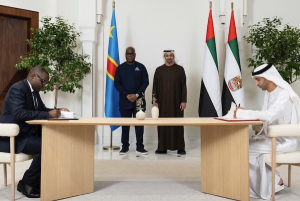
La République démocratique du Congo (RDC) et les Émirats arabes unis (EAU) ont signé, le 2 février 2026 à Abou Dhabi, un accord de partenariat économique global (APEG), assorti de trois mémorandums d’entente. La cérémonie s’est tenue en présence du président congolais Félix Tshisekedi et de son homologue émirati, Son Altesse Cheikh Mohamed ben Zayed Al Nahyane.
Les autorités congolaises indiquent que cet accord vise à « promouvoir des intérêts économiques partagés, en favorisant les investissements dans des secteurs jugés prioritaires ». À travers ce partenariat, Kinshasa et Abou Dhabi ambitionnent de doubler le flux des échanges commerciaux, pour le porter de 5 milliards à 10 milliards de dollars américains d’ici 2030.
Cette projection s’appuie sur la dynamique des échanges bilatéraux observée ces dernières années. D’après les données du ministère congolais du Commerce extérieur, les volumes d’échanges entre les deux pays sont passés de 1,2 milliard de dollars en 2020 à 4,5 milliards de dollars en 2024.
Selon la présidence congolaise, l’APEG prévoit notamment l’ouverture du marché émirati à environ 6 000 produits d’origine congolaise, la réduction des droits de douane en faveur des opérateurs économiques congolais, la sécurisation des transactions commerciales ainsi que le renforcement de la lutte contre la contrebande.
Depuis plusieurs mois, un accord de libre-échange entre les deux pays était en négociation. Il semble avoir été intégré dans l’APEG. Pour faciliter la mise en œuvre du partenariat, les deux parties ont également prévu la création de comités mixtes de suivi.
Mémorandums d’entente
La signature de l’accord a été suivie de trois mémorandums d’entente. Le premier, conclu avec l’Office national des transports (ONATRA), concerne le projet du port en eaux profondes de Banana, situé à Moanda, dans la province du Kongo Central. Les aspects couverts par ce document ne sont pas détaillés. Le projet, en cours de réalisation, fait déjà l’objet d’un partenariat entre la RDC et le groupe émirati DP World. Il vise à doter le pays d’une infrastructure maritime stratégique. Le futur port doit comprendre un quai de 600 mètres, une zone de stockage de 30 hectares et une capacité estimée à environ 450 000 conteneurs, permettant un accès direct à la mer pour les grands navires.
Le deuxième protocole d’accord porte sur le secteur minier. Il vise à renforcer la coopération entre la RDC et les EAU en matière de traçabilité et de sécurisation des chaînes d’approvisionnement en minerais critiques, adossée à des investissements coordonnés.
Le troisième mémorandum concerne la coopération diplomatique. Il prévoit le renforcement des échanges entre l’Académie diplomatique de la RDC et l’Académie diplomatique Anwar Gargash des Émirats arabes unis, à travers le partage de connaissances, la coordination des programmes de formation et de recherche, ainsi que l’organisation d’événements conjoints.
Ce nouveau cadre s’inscrit dans la continuité des relations commerciales entre les deux pays. En 2023, la RDC et les EAU avaient déjà conclu un partenariat visant un transfert plus transparent et responsable de l’or congolais. Cet accord avait conduit à la création de Primera Gold DRC SA, devenue par la suite DRC Gold Trading, chargée de la collecte et de l’exportation de l’or artisanal.
Selon le ministère du Commerce extérieur, l’entreprise a exporté en 2023 environ 5 tonnes d’or, un volume supérieur à celui enregistré par la RDC au cours des quinze années précédentes. En 2024, les exportations sont estimées entre 7 et 9 tonnes, selon la même source.
Ronsard Luabeya
Lire aussi :
Ports, routes, mines… : ces secteurs visés par les Émirats arabes unis en RDC
Accord de libre-échange avec les Émirats : la RDC vise 3 milliards $ d’exportations d’ici 2030
Étain : l’Émirati IRH conclut un deal à 367 millions $ pour prendre le contrôle de Bisie
L’Émirati NG9 Holding intéressé par les projets de Buenassa Resources et Kipay Energy en RDC
Buenassa puts $1.5bn bid on Chemaf before Washington critical minerals summit
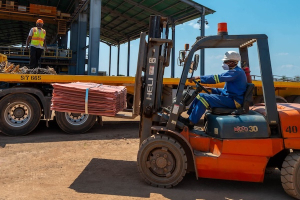
Buenassa has put forward a $1.5 billion offer to acquire Chemaf, a copper and cobalt producer in the Democratic Republic of Congo. The company presents the bid as the upstream component of a broader $3.5 billion industrial roadmap unveiled on January 29, just days ahead of the U.S.-organized Washington summit on critical minerals scheduled for February 4.
Buenassa said the $1.5 billion would be used to stabilize the asset and restructure its debt. The stated goal is to complete the Etoile II and Mutoshi industrial units to meet existing obligations and secure a reliable supply of ore for its planned refinery.
The second pillar of the roadmap centers on refinery construction. Buenassa has allocated $700 million to the first phase and now $1.3 billion to the second phase, revised down from an initial estimate of $2 billion. While the company did not explain the reasons for the revision, it maintained its production targets. Phase one is expected to deliver 30,000 tons of copper, in LME-grade cathodes, and 5,000 tons of cobalt, in sulfate and high-purity metal, per year. Phase two would lift output to 120,000 tons of copper and 20,000 tons of cobalt annually.
Buenassa Chief Executive Officer Eddy Kioni presented vertical integration as a response to market instability. He said it offers the most effective way to offset supply and price volatility that has historically discouraged Western investment. He added that the proposed structure is designed to ensure full transparency and prevent financial or risk-related conflicts between assets.
Employment, subcontracting
Buenassa Resources, the subsidiary leading the industrial project, said the plan would provide clarity for more than 3,000 direct Chemaf employees and thousands of subcontractors, according to its board chairman, former prime minister Samy Badibanga. He also said the refining complex could create around 5,000 jobs. By anchoring the project within the DRC’s industrial base, he said, the company aims to secure a sustainable future for workers and the surrounding region.
Buenassa highlighted a structure it says would improve the project’s bankability, supported by the Congolese state, which holds a 10% stake in Buenassa Resources, and by several partners. The company said it is working with consulting firm Roland Berger on an acquisition audit and debt rescheduling.
On the engineering side, Buenassa said a consortium made up of UK-based Bara Consulting and South Africa’s MET63 would act as owner’s engineer for the refinery, while also contributing to the management of upstream operations.
On financing and institutional engagement, the company cited intensified discussions with U.S. institutions, including the U.S. International Development Finance Corporation. It also named Rawbank and Nigeria’s United Bank for Africa as banking partners. Buenassa said it is seeking a partnership with a major industrial group from the Gulf and a large U.S. trading house to strengthen its commercial capacity.
Washington summit
Buenassa explicitly framed its announcement around the Washington critical minerals summit, which President Félix Tshisekedi and members of his government are expected to attend. The Financial Times, citing sources close to the matter, reported that the sale of Chemaf, described as an early test of the DRC–U.S. strategic partnership signed on December 4, could reach a turning point during the event.
Against this backdrop, rival bidders are intensifying their efforts. Africa Intelligence reported that Virtus Minerals recently signed a share purchase agreement with Zedra Skye Trustees, presented as representing nearly 95% of Chemaf shareholders. The U.S. company is said to have offered to take over Chemaf’s debts, estimated at more than $900 million. It is also considering outsourcing operations to India’s Lloyds Metals and Energy, described by the publication as having limited experience in copper-cobalt projects, particularly in Africa.
Securing financing remains a central issue. On this front, Virtus Minerals is said to have approached New York-based investment fund Orion Resource Partners and Anglo-Swiss trading group Glencore. As with Buenassa, however, Africa Intelligence reported that no binding agreement had been signed so far.
Even with a share purchase agreement in place, Virtus Minerals would still need approval from the Congolese government to complete the acquisition. International media reports say the company, founded by former U.S. security officials, benefits from support from the Trump administration. In Kinshasa, however, its offer has raised concerns. Beyond financing questions, it is seen as offering limited safeguards for local interests.
A delicate arbitration
Buenassa, for its part, says it is seeking to balance U.S. and Congolese interests. In addition to pledging to preserve jobs and subcontracting arrangements, the Congolese company presents its project as aligned with the government’s objective of processing minerals locally to capture more value.
Buenassa also positions itself as the operational arm of the DRC–U.S. critical minerals partnership. It has committed to reserving its production for the U.S. market in order to help build a secure supply chain outside Chinese influence. The company also said it is open to the formation of a DRC–U.S. consortium, involving players such as Gécamines and Buenassa, which it presents as the most realistic option given the financial, operational, and security challenges facing the sites.
The strategic agreement signed on December 4 grants U.S. companies a right of first offer on critical minerals deposits. It also states that if no U.S. bid is selected after nine months, projects may be opened to allied partners, including Congolese firms. Kinshasa must now arbitrate the Chemaf case without weakening its relationship with Washington, which it also sees as a key partner amid persistent security challenges in the east of the country.
Pierre Mukoko