





Equipe Publication
Télécoms : Kinshasa et Libreville veulent développer le roaming mobile
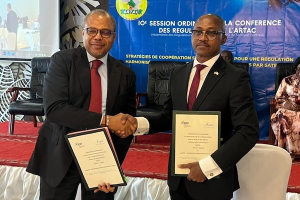
La République démocratique du Congo et le Gabon envisagent de développer le roaming mobile entre leurs territoires. Selon l’Agence congolaise de presse (ACP), les deux pays ont signé, le 19 février 2026, un protocole d’accord à ce sujet, en marge de la 10ᵉ session ordinaire de la conférence des régulateurs tenue à Kinshasa.
L’objectif est de faciliter l’utilisation du téléphone mobile (appels, SMS et internet) dans l’autre pays en s’appuyant sur un réseau partenaire, sans changer de numéro. D’après l’ACP, le président de l’Autorité de régulation de la poste et des télécommunications du Congo (ARPTC), Christian Katende, a indiqué que cette coopération vise notamment à améliorer la mobilité des usagers et à réduire le coût des communications transfrontalières, dans la perspective d’une interconnexion plus intégrée entre populations.
Le protocole a été paraphé par les responsables des régulateurs des deux pays : l’ARPTC pour la partie congolaise et l’ARCEP pour la partie gabonaise, selon les informations reprises par des médias congolais.
À ce stade, aucun calendrier public n’a été communiqué sur la mise en œuvre opérationnelle. La concrétisation d’un roaming à coût réduit implique généralement des ajustements techniques et tarifaires entre opérateurs, pouvant aller d’une baisse des frais d’itinérance à des grilles de tarifs harmonisées, selon les modalités retenues par les parties.
Cette initiative s’inscrit dans une dynamique sous-régionale plus large. En Afrique centrale, la CEMAC a relancé en mars 2025 le chantier du “free roaming” (itinérance sans surcoût) et appelé à lever les blocages à son opérationnalisation, même si les modalités et le calendrier restent variables selon les pays et les opérateurs.
Ronsard Luabeya
Lire aussi :
SADC : régulateurs et opérateurs poussent pour une réduction des coûts du roaming
DRC Central Bank Turns to Gold in Push to Support Franc, Cut Dollar Dependence
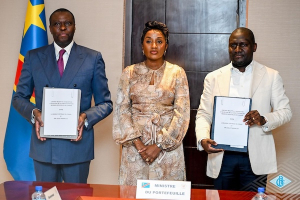
The Democratic Republic of Congo's central bank has moved to add gold to its official reserves, signing an agreement on Feb. 20 with DRC Gold Trading, the state-owned company responsible for collecting and exporting artisanal gold.
Under the deal, the Central Bank of the Congo (BCC) will serve as the primary buyer of gold produced by the country's artisanal miners through DRC Gold Trading, Governor André Wameso said at the signing ceremony.
The project is designed to “correct a major historical anomaly”: the fact that a leading gold producer holds no physical gold in its vaults. For the BCC, the initiative also aims to reinforce the stability of the Congolese franc and strengthen the country's financial sovereignty, against a backdrop of rising gold prices and a broader push to diversify reserve assets.
The move is consistent with the priorities Wameso has pursued since his appointment as central bank governor in July 2025: reducing the country's structural dependence on the dollar and restoring confidence in the Congolese franc. Since September 2025, the national currency has appreciated 19%.
The financial terms of the BCC-DRC Gold Trading partnership, including the payment currency, purchase price, volumes, timeline, delivery arrangements, storage, auditing and transparency mechanisms, have not been publicly disclosed. Those details are critical to assessing Wameso’s strategy.
Challenges
The BCC said that holding monetary gold will protect its reserves against inflation and geopolitical shocks. Described as a safe-haven asset with no counterparty risk, gold would help reduce the reserves’ exposure to fiat currency depreciation and bolster confidence in the national currency. The extent of that effect will depend, in part, on gold’s eventual share of total reserves.
According to several monetarists, the project’s impact on franc stability will also hinge on the purchasing framework, particularly the payment currency. If gold is purchased in Congolese francs, the operation could support use of the national currency, but it would strengthen the franc only if the BCC prevents those purchases from generating uncontrolled monetary expansion. If the liquidity injected into the economy is not subsequently absorbed or offset, the operation could stoke inflation and increase demand for dollars. Conversely, if gold is purchased in dollars, the arrangement could enhance the appeal of the official channel in a heavily dollarized sector, but it could also strain foreign currency liquidity if payments draw down foreign exchange reserves.
Wameso must also contend with competition from informal supply networks. To draw gold away from those channels, the official buyer must offer sufficiently attractive pricing and payment terms while guarding against the re-labeling of smuggled gold. For several players in the sector, payments in Congolese francs are widely seen as a drawback.
In 2025, the DRC channeled 2.3 metric tons of artisanal gold through official channels, according to official statistics described as preliminary and incomplete. For 2026, DRC Gold Trading is targeting 15 to 18 metric tons of artisanal gold per year and more than $2 billion in export revenues. To establish itself as the primary buyer, the BCC must also address a liquidity challenge: balancing foreign exchange interventions, which involve selling dollars, buying francs and meeting priority public import needs, with gold purchases.
Pierre Mukoko & Ronsard Luabeya
Stabilisation du franc congolais : ce que peut apporter une réserve d’or
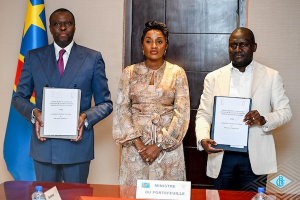
La Banque centrale du Congo (BCC) veut désormais intégrer l’or dans ses réserves officielles. Elle a conclu, le 20 février 2026, un contrat avec DRC Gold Trading, l’entreprise publique spécialisée dans la collecte et l’exportation de l’or artisanal. Avec cet accord, la Banque centrale se positionne comme « le principal off-taker (acheteur) de l’or produit par nos creuseurs artisanaux au travers de la société DRC Gold », a précisé le gouverneur André Wameso lors de la signature de la convention de partenariat.
Le projet devrait « corriger une anomalie historique majeure » : l’absence totale d’or physique dans les coffres d’un pays producteur de premier plan. Au-delà, pour la BCC, l’initiative vise à renforcer la stabilité du franc congolais et la souveraineté financière du pays, dans un contexte de hausse des prix de l’or et de recherche de diversification des actifs de réserve.
La démarche s’inscrit dans la continuité des priorités que s’est fixées André Wameso depuis sa nomination à la tête de la Banque centrale, en juillet 2025 : réduire la dépendance structurelle au dollar et restaurer la confiance dans le franc congolais. Depuis septembre 2025, la monnaie nationale s’est appréciée de 19 %.
À ce stade, les termes financiers du partenariat BCC–DRC Gold Trading (devise de paiement, prix d’achat, volumes, calendrier, modalités de livraison, stockage, audit et mécanismes de transparence) n’ont pas été détaillés publiquement. Ces éléments sont pourtant déterminants pour mieux cerner la stratégie d’André Wameso.
Contraintes
Selon la BCC, la détention d’or monétaire protègera ses réserves contre l’inflation et les chocs géopolitiques. Présenté comme une valeur refuge sans risque de contrepartie, l’or contribuerait ainsi à limiter l’exposition des réserves à la dépréciation des monnaies fiduciaires et à soutenir la confiance dans la monnaie nationale. Mais l’effet dépendra notamment de la part de l’or monétaire dans les réserves.
Selon plusieurs monétaristes, l’impact du projet sur la stabilité du franc congolais dépend aussi du schéma d’achat, notamment de la devise de paiement. Si l’or est acheté en francs congolais, l’opération peut soutenir l’usage de la monnaie nationale, mais elle ne contribuera à son renforcement que si la BCC évite que ces achats ne se traduisent par une création monétaire non maîtrisée : si l’argent injecté dans l’économie n’est pas ensuite absorbé ou compensé, l’opération peut alimenter l’inflation et accroître la demande de dollars. À l’inverse, si l’or est acheté en dollars, le dispositif peut renforcer l’attractivité du canal officiel dans une filière très dollarisée, mais il peut aussi peser sur la liquidité en devises si les paiements se font au détriment des réserves de change.
André Wameso doit aussi composer avec une autre contrainte : la concurrence des filières parallèles. Pour détourner l’or de ces circuits, l’acheteur officiel doit proposer un prix et des modalités de paiement suffisamment attractifs, tout en évitant la « re-labellisation » d’or de contrebande. Pour plusieurs acteurs de la filière, des paiements en francs congolais sont plutôt perçus comme un handicap.
En 2025, la RDC a canalisé dans le circuit officiel 2,3 tonnes d’or artisanal, selon les statistiques officielles présentées comme « provisoires et partielles ». Pour 2026, DRC Gold Trading vise 15 à 18 tonnes d’or artisanal par an et plus de 2 milliards de dollars de recettes d’exportation. Pour se positionner comme principal acheteur, la BCC doit donc aussi relever le défi de la liquidité : arbitrer entre les interventions sur le marché des changes (vendre des dollars, acheter des francs, payer des importations publiques urgentes) et l’achat d’or.
Pierre Mukoko et Ronsard Luabeya
Lire aussi :
BCC : nouvelle baisse des taux, un test de confiance pour le franc congolais
Transfert d’argent : la BCC pousse pour l’usage du franc congolais
Or artisanal : DRC Gold Trading vise plus de 2 milliards $ de recettes en 2026
DRC miner SACIM completes first Antwerp diamond sale in over a decade
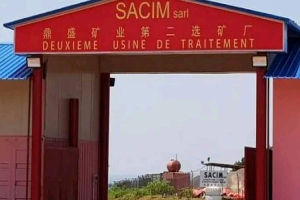
Anhui Foreign Economic Construction Ltd Congo Corp (SACIM) has completed its first public sale of 288,000 carats of industrial diamonds in Antwerp, Belgium, the Consulate General of the Democratic Republic of Congo in the city said.
The sale was held from Feb. 16 to Feb. 20, 2026, with technical support from Belgian firm Samir Gems, active in the diamond and jewelry trade, and the Antwerp World Diamond Centre (AWDC). A total of 67 international companies took part, with leading buyers from China, India, the United States and Italy.
The transaction marks the return of Congolese industrial diamonds to the Antwerp market after more than a decade, the Consulate said. However, the interruption did not affect all exports. Official statistics show Belgium among the importers of Congolese industrial diamonds in 2024 and 2025, with 3.96 million and 1.7 million carats respectively.
Following the sale, Sacim, Samir Gems and the AWDC agreed on an annual schedule of public sales and a framework for technical and institutional support aimed at strengthening the long-term presence of Congolese diamonds in Antwerp.
The sale comes eight months after the liberalization of diamond trading by Congolese producers. In June 2025, then-Minister of Mines Kizito Pakabomba repealed a 2022 decree that regulated mineral sales through the Center for Expertise, Evaluation and Certification of Precious and Semi-Precious Mineral Substances (CEEC). The framework limited producers to a restricted list of buyers, a system that could influence prices. As a major player in the sector, Sacim was among the companies most affected.
The terms of the Antwerp sale were not disclosed. Official 2025 mining statistics nonetheless show an improvement in Sacim’s average sales price. In 2024, when the sector’s average price stood at $9.63 per carat, Sacim recorded $11.38. In 2025, the company maintained an average price of $11 while the sector average fell to $7.4 per carat. Natural diamond prices have been declining for several years.
According to official data, exports by Sacim, jointly owned by China’s Anhui Foreign Economic Construction Corporation (AFECC) and the Congolese state, were halved, falling from 2,887,100.25 carats in 2024 to 1,151,865.58 carats in 2025. The company accounted for 13.5% of national output, producing just over 1.1 million carats.
Ronsard Luabeya
Diamants : la Sacim reprend les ventes à Anvers après plus de 10 ans d’arrêt
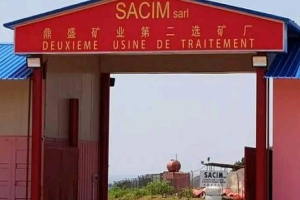
La Société Anhui Congo d’investissement minier (Sacim) a réalisé une première vente publique de 288 000 carats de diamants industriels à Anvers, en Belgique. L’information a été confirmée par le Consulat général de la République démocratique du Congo basé dans la ville.
Organisée du 16 au 20 février 2026, la vente a bénéficié de la coordination technique de la société belge Samir Gems, active dans le négoce de diamants et de bijoux, ainsi que de l’Antwerp World Diamond Centre (AWDC). Au total, 67 entreprises internationales ont pris part à l’opération. Les principaux acheteurs provenaient de Chine, d’Inde, des États-Unis et d’Italie.
Selon le Consulat, cette transaction marque le « retour des diamants industriels congolais sur le marché anversois après plus de dix ans d’interruption ». Mais cette interruption ne concernerait pas l’ensemble du pays : la Belgique apparaît, par exemple, parmi les importateurs de diamants industriels congolais dans les statistiques officielles de 2024 et 2025, avec respectivement 3,96 millions et 1,7 million de carats.
Le Consulat précise qu’une réunion technique entre les responsables de la Sacim, Samir Gems et l’AWDC a permis d’établir un calendrier annuel des prochaines ventes publiques, assorti d’un dispositif d’accompagnement technique et institutionnel destiné à consolider durablement la présence des diamants congolais sur ce marché stratégique.
Cette opération intervient huit mois après la libéralisation de la commercialisation des diamants par les producteurs congolais. En juin 2025, le ministre des Mines d’alors, Kizito Pakabomba, avait abrogé l’arrêté ministériel de 2022 qui encadrait les ventes de substances minérales supervisées par le Centre d’expertise, d’évaluation et de certification des substances minérales précieuses et semi-précieuses (CEEC).
Ce cadre limitait les producteurs à une liste restreinte d’acheteurs, susceptible d’influencer les prix. Acteur majeur du secteur diamantifère congolais, la Sacim se considérait parmi les entreprises les plus affectées par ce dispositif.
Les conditions de la vente d’Anvers n’ont pas été publiées. Mais les statistiques minières officielles de 2025 montrent une amélioration du prix moyen de vente enregistré par la Sacim : en 2024, alors que le prix moyen se situait à 9,63 dollars le carat, la Sacim affichait un prix moyen de 11,38 dollars. En 2025, la société est parvenue à se maintenir à 11 dollars alors que le prix moyen est tombé à 7,4 dollars le carat. Il faut dire que les prix des diamants naturels sont en baisse continue depuis plusieurs années.
Selon les données officielles, les exportations de la Sacim, détenue à parts égales par le groupe chinois Anhui Foreign Economic Construction Corporation (AFECC) et l’État congolais, ont néanmoins été divisées par deux, passant de 2 887 100,25 carats en 2024 à 1 151 865,58 carats en 2025. L’entreprise n’a contribué qu’à hauteur de 13,5 % à la production nationale totale, avec à peine 1,1 million de carats produits.
Ronsard Luabeya
Lire aussi :
Dotation communautaire : la SACIM menacée de suspension pour 700 000 $ d’impayés
SACIM : le coup de pression de Ngoyi Kasanji pour plus de résultats
Diamants : la commercialisation de nouveau libéralisée en RDC
Diamant : la RDC dans la coalition africaine contre la montée du synthétique
Diamant : la production de la RDC chute de 26 % au premier trimestre 2025
Tshopo exports 125 kg of artisanal gold in five months, makes first official statistics appearance
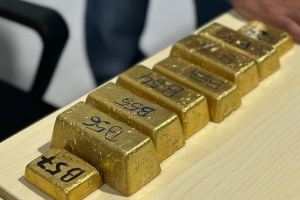
Tshopo province, in north-central Democratic Republic of Congo, has recorded its first official exports of artisanal gold, according to 2025 mining statistics released on Feb. 3.
The data, described as “provisional and partial,” show that Tshopo exported 125.26 kilograms of gold over five months. The figures may reflect the launch of DRC Gold Trading’s operations in the province. The state-owned company, which channels and exports Congolese artisanal gold, now lists Kisangani, the provincial capital, among its operational locations, though it has not disclosed when the branch opened.
Governor Paulin Lendongolia Lebabonga announced plans for the office as early as June 2025, saying it would help tighten oversight of gold trading, curb fraud and secure revenue for the province. Provincial authorities said transactions should go through licensed trading houses and be integrated into the formal banking system.
Mining Data
The move comes amid wider regulatory problems in the province’s mining sector. In January 2025, the provincial government suspended mining activities to compel companies to register with the authorities. Of 142 companies identified as operating in the province, the provincial mines minister said only one was compliant at the time, with the others accused of operating outside legal requirements.
Actualité.cd reported in February 2025 that civil society groups across several territories had flagged the presence of foreign nationals operating illegally and partnering with local cooperatives.
According to the Ministry of Mines, Tshopo has four active artisanal gold cooperatives, two of which are officially listed as “in production.” Despite being listed as active, the province had not appeared in national mining statistics before 2025.
Some buying houses reported monthly volumes of around 10 grams, figures considered too low to cover their operating costs. Provincial authorities suspect that part of the gold output is bypassing formal channels and being smuggled to Uganda, a country frequently cited as a transit hub in regional gold trafficking networks.
Timothée Manoke
Or artisanal : 125 kg exportés en cinq mois, la Tshopo entre dans le circuit officiel

La province de la Tshopo, située au centre-nord de la République démocratique du Congo, devient officiellement exportatrice d’or issu de l’exploitation artisanale. Elle figure dans les statistiques minières de 2025, publiées le 3 février dernier.
Selon ces données, présentées comme « provisoires et partielles », la Tshopo aurait exporté à elle seule un total de 125,26 kilogrammes d’or en l’espace de cinq mois. Ces résultats pourraient s’expliquer par l’implantation dans la province de DRC Gold Trading, l’entreprise publique chargée de canaliser et d’exporter l’or artisanal congolais. Ses communications mentionnent désormais Kisangani, chef-lieu de la province, parmi les localités où elle dispose d’une implantation opérationnelle, sans toutefois préciser la date exacte d’ouverture de cette succursale.
L’installation de ce bureau avait été annoncée dès juin 2025 par le gouverneur Paulin Lendongolia Lebabonga, dans un contexte de volonté affichée d’encadrer strictement la commercialisation de l’or, de lutter contre la fraude et d’assurer des recettes à la province. Les autorités provinciales avaient alors mis en avant la nécessité de faire transiter les transactions par des comptoirs agréés et de bancariser les opérations.
Cette évolution intervient dans un secteur minier provincial marqué par des dysfonctionnements. En janvier 2025, le gouvernement provincial avait annoncé la suspension des activités minières afin d’obliger les entreprises à se faire enregistrer auprès des services compétents. Sur 142 sociétés identifiées comme opérant dans la province, le ministre provincial des Mines indiquait qu’une seule était en ordre à cette date, les autres étant accusées d’opérer sans respecter les exigences légales.
Selon Actualité.cd, des membres de la société civile dans différents territoires de la province ont également signalé, en février 2025, la présence d’exploitants de nationalités étrangères opérant dans l’illégalité et nouant des partenariats avec des coopératives locales.
Pourtant, selon les données du ministère des Mines, la Tshopo compte quatre coopératives actives dans la filière aurifère artisanale, dont deux disposent du statut « en production ». Malgré cette activité déclarée, la province restait absente des statistiques nationales officielles jusqu’en 2025.
Par ailleurs, certaines maisons d’achat déclaraient des volumes mensuels de l’ordre de 10 grammes, des niveaux jugés peu cohérents avec les coûts de fonctionnement affichés. Les autorités provinciales soupçonnent qu’une partie des flux aurifères échappe au circuit formel et soit exportée illicitement vers l’Ouganda, un pays régulièrement cité dans les circuits régionaux de contrebande d’or.
Timothée Manoke
Lire aussi :
Haut-Katanga : DRC Gold Trading exporte plus de 20 kg d’or artisanal en quelques jours
Or artisanal : DRC Gold Trading vise plus de 2 milliards $ de recettes en 2026
DRC orders payroll audit amid rising wage bill pressures
The Democratic Republic of Congo has ordered an audit of the civil service payroll, according to the minutes of a Council of Ministers meeting held on Feb. 20, 2026.
The government said the audit is intended to safeguard public finances and ensure it can continue funding its priorities, including the regular and timely payment of salaries. The aim is to secure long-term payroll stability and prevent delays that could undermine social stability.
A Rapidly Expanding Wage Bill
The public wage bill has risen sharply in recent years. In a January 2026 report, the International Monetary Fund said salaries for military and police personnel were doubled at the start of 2025, alongside the recruitment of new security forces. Additional spending pressures came from the education and health sectors, as well as the hiring of 2,500 magistrates later in the year.
As a result, the wage bill is estimated to have exceeded its budgeted level by around 19% in 2025. Between 2021 and 2025, it more than doubled in nominal terms and rose 46% in real terms, now accounting for more than 50% of tax revenues.
To curb the increase, the Ministry of Public Service said in August 2025 it was preparing a biometric registration of employees under the central government’s supplementary budget, aimed at tightening control over staffing levels and payroll costs.
On Dec. 18, 2025, Public Service Minister Jean-Pierre Lihau announced the retirement of 2,000 eligible employees. He said that from January 2026, at least 30,000 employees would be retired each year.
Wage Bill Targets and Pay Reform
In the original 2025 budget, the government allocated $3.4 billion for salaries. Following the doubling of military and police pay, the wage bill is now expected to reach $4 billion, equivalent to 23.3% of total expenditure and 4.8% of GDP. The government aims to keep the wage bill below 5% of GDP over the medium term.
To support that target, it announced plans in December 2025 to adopt a new pay policy, developed in consultation with unions, to improve equity and efficiency in public sector remuneration, reduce unjustified disparities and limit hiring to essential positions.
The minutes of the Feb. 20 meeting state that the payroll audit is part of a broader effort to strengthen fiscal consolidation and budget discipline, rather than a short-term response.
The Prime Minister will coordinate the audit, with support from the General Inspectorate of Finance and other oversight bodies. The Deputy Prime Minister in charge of the Budget will ensure staffing levels on the payroll match those approved in the budget. Results are expected within 30 days.
Boaz Kabeya
Fonction publique : un audit de la paie annoncé après une hausse de la masse salariale
Le gouvernement vient de décider de réaliser un audit de l’état liquidatif de la paie des agents et fonctionnaires de la République démocratique du Congo (RDC). Selon le compte rendu du Conseil des ministres du 20 février 2026, cette démarche vise à « garantir la soutenabilité de nos finances publiques et assurer la continuité des opérations financières de l'État à travers le financement des priorités du gouvernement et des responsabilités de celui-ci, dont notamment le paiement régulier, dans les délais, des salaires des agents et fonctionnaires de l'État ». L’objectif annoncé est de sécuriser durablement les paiements, tout en protégeant les agents contre les retards et les dysfonctionnements préjudiciables à la stabilité sociale.
La masse salariale publique a connu une croissance rapide ces dernières années. Comme le note le rapport du FMI de janvier 2026, « les salaires des militaires et de la police ont été doublés au début de l’année 2025, parallèlement au recrutement de nouveaux éléments des forces de sécurité. Des pressions supplémentaires sont apparues dans les secteurs de l’éducation et de la santé, ainsi qu’avec le recrutement de 2 500 magistrats plus tard dans l’année. En conséquence, la masse salariale devrait dépasser le niveau budgétisé d’environ 19 % en 2025 ». Entre 2021 et 2025, le FMI relève que la masse salariale a plus que doublé en termes nominaux et augmenté de 46 % en termes réels, représentant désormais plus de 50 % des recettes fiscales.
Pour contenir cette hausse, le ministère de la Fonction publique avait annoncé en août 2025 qu’il préparait le lancement de l’identification biométrique des agents émargeant au budget annexe du pouvoir central, en vue de renforcer la maîtrise des effectifs et de la masse salariale.
Dans cette optique, le ministre de la Fonction publique, Jean-Pierre Lihau, avait annoncé le 18 décembre 2025 la signature des actes de mise à la retraite de 2 000 agents éligibles. Il avait également souligné qu’au-delà de cette première vague, à partir de janvier 2026, au moins 30 000 agents seraient mis à la retraite chaque année.
Dans la loi de finances initiale de 2025, la RDC prévoyait 3,4 milliards de dollars pour le paiement des salaires. Mais avec le doublement des rémunérations des militaires et policiers, cette masse salariale était désormais attendue à 4 milliards de dollars, soit 23,3 % des dépenses globales et 4,8 % du PIB. Le gouvernement s’était donc fixé pour objectif de maintenir la masse salariale en dessous de 5 % du PIB à moyen terme.
Pour atteindre cet objectif, le gouvernement avait annoncé prévoir d’adopter une nouvelle politique salariale en décembre 2025, élaborée en concertation avec les partenaires sociaux afin d’améliorer l’efficacité et l’équité dans la rémunération des agents publics, réduire les disparités non justifiées et limiter les recrutements au strict nécessaire.
Le compte rendu du Conseil des ministres du 20 février 2026 précise que l’audit de l’état liquidatif « ne s'agit ni d'une mesure isolée ni d'une réaction conjoncturelle, mais de la continuité d'une orientation constante en faveur de l'assainissement et de la discipline budgétaire ».
La coordination de l’audit est confiée à la Première ministre, avec le concours de l’Inspection générale des finances et des services de contrôle, tandis que le vice-Premier ministre chargé du Budget veillera à la stricte concordance entre effectif budgétaire et effectif rémunéré. Les résultats sont attendus dans un délai de 30 jours.
Boaz Kabeya
Lire aussi :
Fonction publique : 2 000 agents mis à la retraite, 30 000 départs attendus en 2026
Fonction publique : la RDC veut maîtriser une masse salariale attendue à 4 milliards $ en 2025
DR Congo Launches Gold-Backed Token Pre-Sale Amid Legal, Liquidity Questions
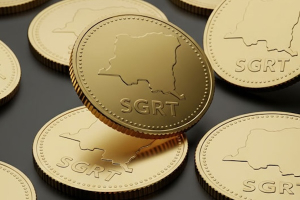
The Sovereign Gold Reserve Token (SGRT) is already in pre-sale on the WinstantGold platform, Bankable observed on Feb. 22, 2026. Its official launch is scheduled later this year in Kinshasa.
The SGRT is a gold-backed crypto asset issued by the Fonds social de la République démocratique du Congo (FSRDC), a public institution under the presidency responsible for reconstruction, poverty reduction and improving living standards.
To achieve those goals, the FSRDC, coordinated by Philippe Ngwala Malemba, a social development expert who spent 10 years at the African Development Bank, is relying on the AXIS program (Asset-eXchange-Impact-Sovereign) to fund sustainable local development. The program aims to convert local resources, such as artisanal gold or forest carbon, into digital assets that can be sold to investors to raise funds without resorting to conventional borrowing.
The SGRT is the first in a planned series of crypto assets. According to the promoters, each SGRT purchased corresponds to one gram of gold yet to be produced. The token would be guaranteed by the state, with four grams of "sovereign underground gold" pledged as collateral, based on the principle that unextracted gold remains state property under the country's laws. How that commitment would be legally structured remains unclear.
Legal tender?
Although the token's value is tied to that of gold, its sale price has not been disclosed at this stage. The acquisition cost will, however, include a government issuance tax equivalent to 3% of the SGRT purchase price, as set out in the AXIS program white paper published last December. For the pre-sale, promoters are promising discounts of "up to 35% below intrinsic value."
According to promotional materials, purchasing an SGRT also entitles the buyer to a bonus token: the FCRT (Forest Carbon Reserve Token), which purportedly represents "carbon credits generated by ethical gold extraction and sustainable practices in the DRC." A promotional video states that "FCRT holders receive a share of revenues generated by the sale of carbon credits, creating a potential income stream," with a promised annual return of 20% to 50%. That promise, however, assumes the promoters can overcome the difficulties of accessing carbon credit markets, which African countries have repeatedly flagged as a persistent obstacle.
The AXIS program's website also states that "the SGRT and FCRT are both recognized as legal tender by the Democratic Republic of Congo." No confirmation of that legal status from the Central Bank of Congo (BCC) has been identified. The white paper, which assigns the BCC a central supervisory role, recommends the adoption of "a specific directive" to govern the convertibility, circulation and interoperability of the SGRT with the banking system and electronic currencies.
Liquidity challenge
According to the white paper, SGRT issuance is capped at 50 million tokens and is expected to unfold over five years. From the sixth year, a second crypto asset would be issued, backed by extracted, refined and certified gold: the SGCT (Secured GoldConnect Token). The SGRT tokens would then be progressively converted into SGCT at a rate of 10% of the total stock per year over a 10-year period. The project is designed to run for 15 years, which is also the duration of the public-private partnership underpinning it.
That PPP, announced on June 28, 2025, links the FSRDC to Phoenix Capital. Based in Sint Maarten, Netherlands, Phoenix Capital describes itself as a company specializing in the tokenization of natural assets, without disclosing any prior track record. Chaired by Alain Lemieux, it signed a partnership with Winstant Ltd for the development of WinstantGold, the platform for issuing and managing the AXIS program's crypto assets. Led by Hervé Lacorne, Winstant Ltd describes itself as a Hong Kong-based startup incubator specializing in financial technology, regulatory technology and biotechnology solutions.
Under the proposed structure, the funds raised through the sale of the initial tokens are intended to finance the production of gold and community carbon certificates, which would in turn serve as backing for the SGCT and FCRT tokens respectively. The arrangement raises questions about liquidity, particularly as no clear buyback mechanism is outlined. To recoup an investment, token holders would need to resell their tokens to third parties or use them for payments. Phoenix Capital says it has made millions of dollars’ worth of international purchases using SGRT.
Custodian undisclosed
Gold would be produced through the Goldconnect initiative, which is intended to organize, trace and formalize artisanal gold in Congo. The initiative would draw on more than 300 gold mining cooperatives supervised by the Service d'assistance et d'encadrement des mines artisanales et de petite échelle (SAEMAPE) under the partnership between the FSRDC and Phoenix Capital. Operations would take place in artisanal mining zones made available by the state. A framework agreement was signed on Feb. 19 between the Ministry of Mines and the FSRDC.
Backing a single token would require the production of four grams of gold. "According to Goldconnect's ethical extraction cost model, producing one gram of gold requires approximately three grams of underground reserves," the white paper states. Over 15 years, the Goldconnect initiative would therefore need to produce at least 200 metric tons of gold, equivalent to more than 13.5 metric tons per year, compared with a peak of five metric tons in official artisanal production to date.
After extraction, the gold intended for backing would need to be refined to a purity level consistent with international market standards, cast into bars, and then stored with a custodian based in Dubai whose name has not been disclosed.
Pierre Mukoko