





Equipe Publication
Batteries : la RDC mise sur l’ITC pour arrimer sa stratégie aux marchés internationaux
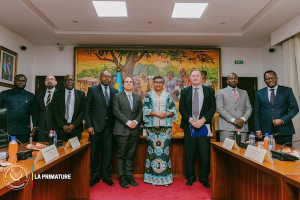
Le 24 février 2026, la Première ministre Judith Suminwa Tuluka a reçu les responsables du Conseil congolais de la batterie (CCB), chef d’orchestre de la stratégie nationale « batteries », et du Centre du commerce international (ITC). Au centre de l’audience : « un partenariat stratégique visant à développer des chaînes locales de transformation des minerais destinés aux batteries ».
Selon la communication officielle diffusée à l’issue de la rencontre, l’initiative prévoit un appui technique de l’ITC et l’accès à son réseau international pour accompagner la transformation locale, en identifiant des partenariats public-privé et des marchés cibles. Le projet est présenté comme transversal, mobilisant l’énergie, les mines, l’industrie, les infrastructures et le commerce.
Derrière ce cadrage, Kinshasa cherche à réduire la distance entre ses minerais et les marchés. Le recours à l’ITC — agence onusienne spécialisée dans l’appui au commerce et l’intégration des pays en développement dans les chaînes de valeur — suggère une approche centrée sur l’accès aux débouchés, aux standards et aux réseaux de partenaires, alors que la stratégie « batteries » peine encore à se traduire en investissements industriels finalisés.
Défis de pilotage interministériel
En mars 2025, le ministre de l’Industrie et du Développement des PME de l’époque, Louis Watum Kabamba, avait lancé les travaux d’aménagement de la Zone économique spéciale (ZES) de Musompo (Lualaba), destinée à accueillir des activités allant des précurseurs aux batteries, avec une possible extension vers l’assemblage. La zone couvre plus de 900 hectares. Les travaux sont évalués à plus de 200 millions de dollars, et un objectif d’environ 2 milliards de dollars d’investissements privés est avancé, avec 25 000 emplois directs et 60 000 indirects attendus.
Mais la dynamique d’exécution reste lente. En novembre 2025, lors d’un échange avec le ministre des Mines actuel — Louis Watum Kabamba — à l’occasion du forum Makutano, le directeur général d’Arise IIP, développeur impliqué dans plusieurs ZES en RDC dont Musompo, a regretté un ralentissement du dossier. « Après le départ du ministre (de la tête du ministère de l’Industrie en août dernier), on a l’impression que les choses se sont un petit peu effritées », avait affirmé Romain Deniel.
Ce dernier a rappelé que la mise en place d’une zone économique spéciale « nécessite l’intervention de quatre, cinq, parfois six ministères » et suppose donc « une coordination importante ». Il a ajouté qu’au-delà du montage administratif, la chaîne de valeur des batteries est un segment « très stratégique » qui requiert aussi « l’assentiment des opérateurs qui sont présents », car le projet est susceptible d’« avoir un impact sur la chaîne de valeur ».
Levier ITC
Cette séquence résume un point central : la transformation locale ne dépend pas seulement de la volonté politique ou des études techniques, mais de la capacité de l’État à maintenir un pilotage interministériel stable — mines, énergie, industrie, finances, infrastructures — et à composer avec les équilibres d’un secteur minier déjà structuré autour de chaînes d’exportation et d’acteurs dominants. Les arbitrages portent autant sur l’accès à l’énergie et aux infrastructures que sur les incitations fiscales, les exigences de contenu local, les conditions d’approvisionnement et la place des opérateurs existants dans le futur modèle industriel.
Dans ce contexte, la coopération annoncée avec l’ITC apparaît comme un levier complémentaire : pendant que les projets industriels cherchent encore leur vitesse de croisière, Kinshasa tente de sécuriser un autre maillon critique — l’accès aux marchés et aux partenaires. L’ITC pourrait contribuer à clarifier les débouchés, les normes et les exigences de traçabilité, à identifier des partenaires industriels ou financiers, et à structurer des chaînes de valeur compatibles avec les attentes des marchés internationaux. L’enjeu, pour la RDC, est d’éviter que la stratégie « batteries » reste cantonnée à des annonces de zones industrielles et de l’arrimer à des opportunités commerciales et industrielles concrètes.
Reste une inconnue majeure : le contenu opérationnel de ce partenariat. La communication officielle évoque un appui technique et un accès au réseau international de l’ITC, mais ne précise ni calendrier, ni livrables, ni volumes, ni segments industriels visés (raffinage, précurseurs, composants, assemblage).
Pierre Mukoko et Boaz Kabeya
Lire aussi :
Véhicules électriques : la RDC lance l’aménagement de sa zone économique spéciale
Le FPI sollicité pour rejoindre le capital des ZES de Kin-Malebo, Musompo et Banana
ZES Kin-Malebo : 80 % des travaux de la première phase déjà réalisés
DRC suspends livestock imports from South Africa over foot-and-mouth outbreak

The Democratic Republic of Congo’s Ministry of Fisheries and Livestock has suspended imports of cattle and other cloven-hoofed animals from South Africa, along with certain related products, citing a resurgence of foot-and-mouth disease, according to a post on its Facebook page.
Foot-and-mouth disease is a highly contagious transboundary animal disease that can severely disrupt livestock production and trade in animals and animal products. In southern Africa, Zambia also announced biosecurity measures, closing its border in mid-February 2026 to livestock imports from South Africa.
The ministry said all import permits for cattle, other cloven-hoofed animals and related products, including meat, milk, hides and animal feed, have been canceled. Existing permits have been suspended until further notice.
Veterinary services have been instructed to strictly enforce the measures, with reinforced checks at border crossings. The ministry also announced an awareness campaign targeting livestock farmers along the border between the Democratic Republic of Congo and Zambia.
It said it is closely monitoring the outbreak in South Africa, where several cases have been reported in recent weeks.
In South Africa, authorities have stepped up vaccination campaigns among cattle. Local vaccine production is set to begin in March 2026, with an initial target of 20,000 doses per week, rising to 200,000 doses per week in 2027, to reduce reliance on imports and strengthen the country’s animal health response.
Ronsard Luabeya
Fièvre aphteuse : la RDC suspend les importations de bovins d’Afrique du Sud

Le ministère congolais de la Pêche et de l’Élevage indique, dans une publication sur sa page Facebook, avoir suspendu, jusqu’à nouvel ordre, les importations de bovins et d’autres ongulés domestiques, ainsi que de certains produits dérivés, en provenance d’Afrique du Sud, en raison de la recrudescence de la fièvre aphteuse.
Maladie animale transfrontalière très contagieuse, la fièvre aphteuse perturbe fortement la production et le commerce des animaux et de leurs produits. En Afrique australe, des mesures de biosécurité ont également été annoncées par la Zambie, qui a fermé sa frontière au bétail en provenance d’Afrique du Sud à la mi-février 2026.
Selon le ministère, tous les permis d’importation de bovins, d’autres ongulés domestiques ainsi que de leurs produits dérivés (viande, lait, peaux, aliments pour bétail) sont annulés, et les autorisations en cours suspendues jusqu’à nouvel ordre.
Les services vétérinaires ont été instruits de veiller à l’application stricte de ces dispositions, tandis que des contrôles renforcés seront déployés aux postes frontaliers. Une campagne de sensibilisation est également annoncée auprès des éleveurs installés le long des frontières entre la RDC et la Zambie.
Le ministère indique suivre de près l’évolution de l’épizootie en Afrique du Sud, où plusieurs foyers auraient été signalés ces dernières semaines.
En Afrique du Sud, les autorités ont intensifié les campagnes de vaccination au sein du cheptel bovin. Une production locale de vaccins est annoncée, avec un objectif initial de 20 000 doses par semaine à partir de mars 2026, avant une montée en capacité à 200 000 doses hebdomadaires en 2027, afin de réduire la dépendance aux importations et de renforcer la riposte sanitaire nationale.
Ronsard Luabeya
DRC Announces Water Project for Two Northwest Provinces
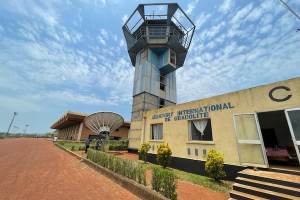
The Democratic Republic of Congo's Ministry of Rural Development has announced a drinking water project targeting the provinces of Mongala, Nord-Ubangi and Sud-Ubangi.
State Minister Grégoire Mutshail Mutomb said the program includes the construction of modern water supply networks and public standpipes designed to serve communities within a five- to 10-kilometer radius, according to the Congolese Press Agency (ACP).
The ACP reported that the minister also identified infrastructure gaps in Gbadolite and announced plans to extend water systems to nearby areas. Additional studies will be conducted, while the national water utility Regideso is expected to undergo modernization to support sustainable service delivery.
Regional context: PREDIRE program and PDL-145
The announcement comes as authorities promote the regional PREDIRE program, which supports infrastructure development and transboundary water resource management in the Ubangi River basin. The African Development Bank (AfDB) says the program covers Nord-Ubangi, Sud-Ubangi and Mongala in the DRC, as well as the Greater Bangui area in the Central African Republic, targeting direct beneficiaries across the region. The ACP said both initiatives fall under the PDL-145 Territories program, which aims to expand access to basic services.
Neither the ACP nor official communications specify the project’s budget, financing sources or implementation timeline, including its start date, duration or phases. Authorities have not disclosed the list of targeted communities by province or the number of planned facilities, such as standpipes, network length, pumping stations or reservoirs.
Operational details also remain unclear, including Regideso’s role in ownership, maintenance and tariff setting, as well as expected service standards and oversight mechanisms. The relationship between the announced project and PREDIRE, including their respective geographic scopes, coordination framework and whether financing is shared or separate, has not been explained.
Boaz Kabeya
DRC Plans Central Bank-Linked System to Curb Gold Smuggling
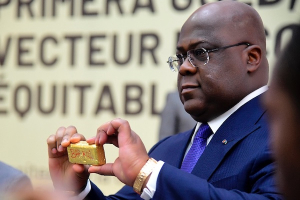
The Democratic Republic of Congo is seeking to regain control over gold flows that are escaping official oversight. Confronted with widespread smuggling and significant revenue losses, the government plans to restructure the sector to channel a larger share of artisanal and semi-industrial production through formal systems.
One of the four main pillars of the strategy presented by President Félix-Antoine Tshisekedi at the Feb. 20, 2026 Cabinet meeting is the creation of a national gold traceability and centralized transaction system. The platform would link licensed trading houses to the Central Bank of Congo (BCC) and the mining administration, with the aim of securing transactions, centralizing payments within the formal banking system, and providing real-time visibility into traded volumes.
Connecting trading houses to the BCC could also allow authorities to better assess the volumes actually handled by these entities. In Tshopo province in June 2025, Governor Paulin Lendongolia Lebabonga questioned declarations by certain trading houses reporting monthly purchases of around 10 grams — volumes unlikely to cover their operating costs. “If you tell us you bought 10 grams a month, how do you pay your rent?” he said in Kisangani, according to remarks reported by the Agence congolaise de presse (ACP).
According to the presidency, a significant share of gold production bypasses official channels due to the dominance of artisanal mining and the country’s porous borders, which facilitate cross-border smuggling.
Uganda’s Export Puzzle
Uganda’s gold export data has drawn sustained attention in Congolese media in recent weeks. According to Bank of Uganda figures, gold export revenues rose from roughly $1.25 billion in 2019 to nearly $6.4 billion in 2025, making gold the country’s leading export earner. Commenting on those figures in an interview with East African outlet CEO, Bank of Uganda Deputy Governor Augustus Nuwagaba said: “It may not be ours,” referring to the origin of the exported gold.
Uganda, whose domestic gold mining sector remains relatively limited, is frequently cited in regional smuggling networks. The Daily Monitor, drawing in part on a 2017 report by Uganda’s Financial Intelligence Authority on gold and timber fraud, reported that gold originating in the DRC is repackaged and exported as Ugandan. In a separate 2021 article, the same outlet noted that Uganda produced about 2.9 tonnes of gold while exporting more than 30 tonnes, underscoring a substantial gap between declared production and export volumes.
On the Congolese side, the state-owned company responsible for channeling and exporting artisanal gold estimates that more than 50 tonnes per year escapes state oversight, highlighting the scale of the challenge.
Building Official Gold Reserves
Traders often cite higher prices available in Uganda as a reason for selling across the border. To address this, the second pillar of the presidential strategy proposes economic incentives to make official channels more attractive than the parallel market. Measures under consideration include targeted tax adjustments, a pricing mechanism indexed to international benchmarks, and prompt, transparent payments to producers.
The remaining pillars focus on tighter controls at key exit points and stronger regional cooperation, particularly through enhanced customs information sharing.
If effectively implemented, the strategy could also support the BCC’s objective of incorporating gold into its official reserves.
Timothée Manoke
Or : Tshisekedi veut connecter les comptoirs à la BCC pour freiner la contrebande
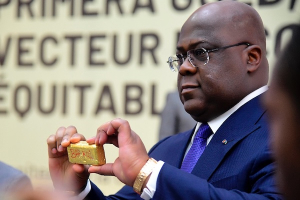
La République démocratique du Congo (RDC) veut capter le flux de l’or qui lui échappe. Face à l’ampleur de la contrebande et aux pertes de recettes qui en découlent, le gouvernement entend réorganiser la filière aurifère afin d’intégrer une part plus importante de la production artisanale et semi-industrielle dans le circuit officiel.
Parmi les quatre axes principaux de la stratégie présentée par le président de la République, Félix-Antoine Tshisekedi, lors du Conseil des ministres du 20 février 2026, figure la mise en place d’un système national de traçabilité et de centralisation des flux. Celui-ci interconnectera les comptoirs agréés à la Banque centrale du Congo (BCC) ainsi qu’à l’administration minière, avec pour objectif de sécuriser les transactions, de centraliser les paiements dans le circuit bancaire officiel et de disposer d’une visibilité en temps réel sur les volumes commercialisés.
L’interconnexion des comptoirs avec la BCC pourrait également permettre à l’État de mieux apprécier les quantités réellement traitées par ces structures. Dans la province de la Tshopo, en juin 2025, le gouverneur Paulin Lendongolia Lebabonga s’était étonné que certains comptoirs déclarent des volumes mensuels de l’ordre de 10 grammes, des niveaux jugés peu cohérents au regard des coûts de fonctionnement. « Si vous nous dites que vous avez acheté 10 grammes par mois, comment payez-vous vos loyers ? », avait-il déclaré à Kisangani, selon des propos rapportés par l’Agence congolaise de presse (ACP).
Pour le chef de l’État, une part importante de la production échappe aux circuits officiels en raison de la prédominance de l’exploitation artisanale et de la porosité des frontières du pays, qui facilitent les sorties frauduleuses du métal jaune.
Révélateur ougandais
Il y a quelques semaines, les statistiques d’exportation d’or de l’Ouganda voisin ont animé la sphère médiatique congolaise. Selon les données de la Bank of Uganda, les revenus d’exportation d’or sont passés d’environ 1,25 milliard de dollars en 2019 à près de 6,4 milliards de dollars en 2025, faisant de l’or la première source de recettes d’exportation du pays. Commentant ces chiffres lors d’un entretien accordé au média est-africain CEO, le vice-gouverneur de la Bank of Uganda, Augustus Nuwagaba, déclarait : « Il se peut qu’il ne soit pas à nous », en référence à l’origine de l’or exporté.
L’Ouganda, dont l’exploitation aurifère n’est pas considérée comme particulièrement développée, est souvent cité dans les circuits régionaux de contrebande d’or. Selon le média ougandais Daily Monitor, s’appuyant notamment sur un rapport de 2017 de la Financial Intelligence Authority of Uganda (FIA) sur la fraude à l’or et au bois, de l’or en provenance de la RDC serait reconditionné puis exporté comme d’origine ougandaise. Un autre article publié en 2021 par le même média indiquait que l’Ouganda aurait produit environ 2,9 tonnes d’or tout en exportant plus de 30 tonnes, mettant en évidence un écart significatif entre production déclarée et volumes exportés.
Du côté congolais, l’entreprise publique chargée de la canalisation et de l’exportation de l’or issu de l’exploitation artisanale estime à plus de 50 tonnes par an la quantité d’or qui échapperait au contrôle de l’État, ce qui illustre l’ampleur du phénomène.
Levier pour la réserve d’or
Parmi les raisons avancées par certains commerçants pour justifier la vente de leur or en Ouganda figure l’attractivité des prix proposés de l’autre côté de la frontière. Pour y répondre, le deuxième axe de la stratégie présidentielle prévoit l’instauration d’incitations économiques rendant le circuit officiel plus attractif que le marché parallèle, à travers un ajustement ciblé de la fiscalité, un mécanisme de prix indexé sur le cours international et des paiements rapides et transparents aux producteurs.
Les deux autres axes portent, d’une part, sur le renforcement ciblé des contrôles aux points de sortie stratégiques et, d’autre part, sur la consolidation de la coopération régionale, notamment par l’échange d’informations douanières.
Si cette stratégie est mise en œuvre avec succès, elle pourrait aussi constituer un levier pour la BCC, qui veut désormais intégrer l’or dans ses réserves officielles.
Timothée Manoke
Lire aussi :
Stabilisation du franc congolais : ce que peut apporter une réserve d’or
Or artisanal: DRC Gold Trading vise plus de 2 milliards $ de recettes en 2026
Or artisanal : 125 kg exportés en cinq mois, la Tshopo entre dans le circuit officiel
Eau potable : fontaines et réseaux annoncés dans la Mongala et les Ubangi
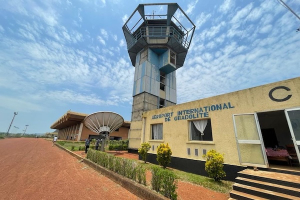
Un projet d’adduction d’eau potable visant les provinces de la Mongala, du Nord-Ubangi et du Sud-Ubangi a été annoncé par le ministère du Développement rural. Selon l’Agence congolaise de presse (ACP), le ministre d’État Grégoire Mutshail Mutomb a indiqué que le programme prévoit des réseaux modernes d’approvisionnement et l’implantation de fontaines publiques, avec une capacité de desserte de localités situées dans un rayon de 5 à 10 kilomètres.
L’ACP rapporte également que le ministre a évoqué des « insuffisances » à Gbadolite et annoncé l’extension des infrastructures aux territoires environnants. Des études complémentaires doivent être réalisées, tandis que la Regideso est appelée à être modernisée pour assurer un service durable.
Cette annonce s’inscrit dans un contexte où les autorités mettent en avant, en parallèle, le programme régional PREDIRE (appui aux infrastructures et valorisation des ressources en eau transfrontalières) dans le bassin de l’Oubangui. La Banque africaine de développement (BAD) présente ce programme comme couvrant notamment le Nord-Ubangi, le Sud-Ubangi et la Mongala côté RDC, ainsi que le Grand Bangui côté République centrafricaine, avec un objectif de bénéficiaires directs chiffré à l’échelle régionale. L’ACP rappelle enfin que ces initiatives s’inscrivent dans l’esprit du PDL-145 territoires, destiné à améliorer l’accès aux services de base.
Ce qui reste à clarifier à ce stade : ni l’ACP ni les communications disponibles ne détaillent le budget du projet annoncé, ses sources de financement, son calendrier (démarrage effectif, durée, phasage), la liste précise des localités ciblées par province, ni la quantification des ouvrages (nombre de fontaines, kilomètres de réseau, stations, réservoirs).
Les modalités d’exploitation doivent aussi être précisées : rôle exact de la Regideso (maîtrise d’ouvrage, maintenance, tarification), niveau de service attendu et mécanisme de suivi. Enfin, l’articulation opérationnelle entre le projet annoncé et PREDIRE (périmètres respectifs, coordination, financement commun ou non) mérite d’être explicitée pour éviter de confondre deux volets potentiellement distincts.
Boaz Kabeya
BCC to introduce Bloomberg FXGO in bid to improve FX price transparency
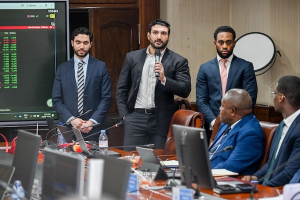
The Central Bank of the Congo (BCC) said it will launch Bloomberg FXGO DRC, an electronic foreign exchange trading platform developed by Bloomberg to organize interbank FX trading. The system is expected to go live within two months, according to a BCC statement.
On Feb. 24, 2026, Governor André Wameso met with representatives of Bloomberg UK and commercial banks operating in the Democratic Republic of Congo to review progress on the project. The meeting included a presentation of the B-Match module, an anonymous order book designed to match buy and sell orders.
The BCC said a six-week beta phase is underway, during which participating banks are testing the system’s robustness, reliability and performance before its full rollout.
In its final configuration, the platform will include real-time monitoring tools, giving the central bank greater oversight of transactions and improved visibility into price formation. The stated aim is to enhance market transparency and support financial stability.
Globally, Bloomberg FXGO provides continuous foreign exchange trading and request-for-quote (RFQ) services covering spot transactions and a range of derivatives, according to the company. The BCC has not specified which features will be introduced in Congo, but it emphasized that interbank trading will be organized through the B-Match module.
In an interview with Radio Top Congo in October 2025, Wameso said the initiative seeks to address dysfunctions in the foreign exchange market, including wide disparities in quoted rates and limited transparency in price discovery between buyers and sellers.
He said connecting commercial banks to the Bloomberg platform should lead to more consistent pricing and more efficient rate formation for market participants.
Ronsard Luabeya
Eastern Congo conflict pushes SMICO, FINCA into losses in H1 2025
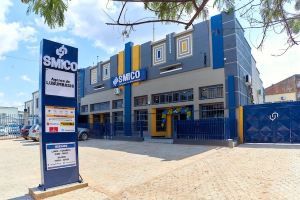
The effects of the war in eastern Democratic Republic of Congo are now reflected in the financial statements of institutions operating in the region. Pillar III reports for the first half of 2025 published by SMICO and FINCA RDC show a sharp reversal in profitability, with both moving from profit to loss.
At SMICO, net income fell from 6.01 billion Congolese francs (CDF) in 2024 to negative 1.29 billion CDF at the end of June 2025. This represents a decline of approximately 121 percent. Net financial income decreased from 29.12 billion to 12.47 billion CDF, a drop of 57 percent.
This contraction comes amid a deteriorating security situation. Since the seizure of Goma in late January 2025 and Bukavu in mid-February 2025 by AFC/M23 rebels, economic activity has been heavily disrupted in these areas. SMICO indicates that two branches have remained closed since these events and that the Uvira branch is partially operational. The institution operates a total of ten branches across eight provinces.
Portfolio quality has deteriorated significantly. The 30-day portfolio-at-risk (PAR 30) reached 13.65 percent, compared with 3.69 percent at the end of 2024. Gross loans under litigation amount to 16.35 billion CDF. Meanwhile, customer deposits, including savings and demand deposits, fell from 110.49 billion to 86.00 billion CDF, a drop of 22 percent.
The report also states that SMICO drew on a new financing line to support its operations. Regulatory capital increased between March and June 2025 due to partner support, allowing the institution to partially absorb the shock.
At FINCA RDC, the trend is similar. Net income declined from 15.99 billion CDF in 2024 to negative 139 million CDF at the end of June 2025, a decrease of approximately 101 percent. Net financial income fell from 116.26 billion to 56.42 billion CDF.
FINCA, which operates 23 branches and more than 1,700 banking agents, says it has closed its Goma and Bukavu branches for security reasons while transferring its liquidity to partner banks. Unlike SMICO, customer deposits remain relatively stable at 214.68 billion CDF, compared with 215.39 billion CDF in 2024.
Signs of resilience
However, portfolio quality has deteriorated sharply. The volume of loans classified as 30-day portfolio-at-risk increased from 13.20 billion to 37.06 billion CDF. This led to higher provisioning and increased pressure on profitability.
It should be noted that the comparison places full-year 2024 figures alongside half-year data as of June 2025, which mechanically amplifies the percentage change. Nevertheless, the shift into loss reflects a genuine shock, particularly through rising credit risk and operational disruptions.
Beyond these two institutions, the security situation has led to the suspension of financial activities in areas under AFC/M23 control, where banking and microfinance operations are prohibited. This interruption disrupts regional liquidity flows and increases credit risk for exposed institutions.
Despite this environment, signs of resilience are emerging. SMICO says it is redirecting its commercial operations toward more stable cities, including Kindu, Bunia, Kisangani, Lubumbashi, Likasi and Kolwezi. The institution is also accelerating its digital strategy. On Sept. 27, 2025, it launched the SMICO Money service in Lubumbashi, accessible via USSD code and enabling transactions without an internet connection.
FINCA, meanwhile, is continuing to expand its digital services and is relying on its national network to maintain access to financial services outside the affected areas.
Timothée Manoke
Change : la BCC s’apprête à lancer Bloomberg FXGO pour structurer le marché interbancaire
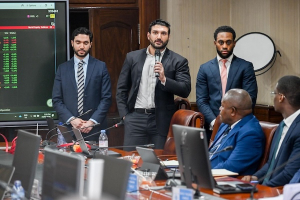
La Banque centrale du Congo (BCC) annonce le lancement prochain de Bloomberg FXGO DRC, une plateforme électronique de négociation de devises développée par Bloomberg et destinée à structurer les échanges sur le marché interbancaire des changes. Selon une communication publiée par la BCC, le dispositif doit être déployé officiellement d’ici deux mois.
Le 24 février 2026, le gouverneur André Wameso a présidé une réunion de travail avec des représentants de Bloomberg UK et des banques commerciales opérant en RDC. Cette séance a permis de faire le point sur l’avancement du projet, notamment à travers la présentation du module B-Match, décrit comme un carnet d’ordres anonyme.
La BCC indique qu’une phase bêta est déjà engagée. Sur une durée de six semaines, les banques participantes sont appelées à tester la robustesse, la fiabilité et les performances du système, avant son passage en production.
Dans sa version finale, la plateforme doit intégrer des outils de surveillance et de supervision en temps réel, offrant à la banque centrale une visibilité accrue sur les transactions et un meilleur suivi de la formation des prix, avec l’objectif affiché de renforcer la transparence du marché et le cadre de stabilité financière.
Au niveau international, Bloomberg FXGO propose des services de négociation de change en continu ou par demande de cotation (RFQ), couvrant notamment le comptant et plusieurs instruments dérivés, selon la description commerciale du fournisseur. La BCC n’a pas encore détaillé les fonctionnalités qui seront effectivement retenues pour le marché congolais, mais sa communication met l’accent sur l’organisation des échanges interbancaires via le module B-Match.
Dans un entretien accordé en octobre 2025 à Radio Top Congo, le gouverneur de la BCC expliquait que la démarche visait à corriger des dysfonctionnements observés sur le marché des changes, en particulier la dispersion des taux pratiqués et le déficit de transparence dans la confrontation entre acheteurs et vendeurs de devises.
Pour remédier à cette situation, il avait souligné la nécessité de connecter les banques commerciales au système Bloomberg. L’objectif, selon lui, est d’aboutir à un affichage plus homogène des prix et à une meilleure formation des taux, au bénéfice de l’ensemble des acteurs.
Ronsard Luabeya
Lire aussi :
Change et transferts d’argent : comment la BCC tente de mettre de l’ordre
Stabilisation du franc congolais : ce que peut apporter une réserve d’or
Dédollarisation : la Banque centrale du Congo accentue la pression sur les banques