





Equipe Publication
Télécoms : British International Investment explore les opportunités d’investissement en RDC
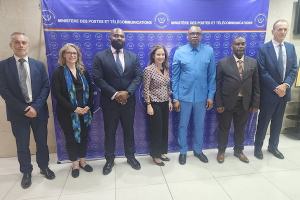
La British International Investment (BII), institution de financement du développement du gouvernement britannique, s’intéresse aux opportunités d’investissement dans le secteur des télécommunications et des postes en République démocratique du Congo (RDC). Une délégation conduite par le directeur Afrique, Christopher Chijiutomi, a été reçue le 11 novembre 2025 par le ministre des Postes et Télécommunications, José Mpanda Kabangu.
Dotée d’un portefeuille global de 8 milliards de dollars et investissant près d’un milliard par an dans divers projets à travers le monde, la BII cherche à comprendre les priorités du ministère afin d’évaluer les domaines de coopération possibles, a indiqué Christopher Chijiutomi.
De son côté, le ministre José Mpanda a exposé à la délégation britannique les défis majeurs du secteur, notamment la réduction de la fracture numérique et l’amélioration de la connectivité à l’échelle nationale. Il a rappelé que la RDC ne dispose que de 4 000 km de fibre optique, alors qu’il en faudrait près de 50 000 km pour relier l’ensemble des 145 territoires du pays.
Pour encourager les investisseurs, le gouvernement a mis en place des incitations fiscales, dont la réduction du prélèvement de 3 000 à 5 dollars par kilomètre de fibre optique installée. Le ministre a également souligné la nécessité de renforcer les infrastructures télécoms, précisant que la RDC compte seulement 5 150 tours pour un besoin estimé à 30 000, afin d’assurer une couverture suffisante, notamment dans les zones rurales et périurbaines.
José Mpanda a, par ailleurs, présenté à la BII le projet de création d’une banque postale et la relance du service postal national dans le cadre d’un partenariat public-privé avec la Société commerciale des Postes et Télécommunications.
Basée à Londres et détenue par le Foreign, Commonwealth and Development Office (FCDO), la BII soutient la croissance durable dans les pays en développement, principalement en Afrique et en Asie. Ses investissements couvrent les secteurs de l’énergie, des télécommunications, des infrastructures et de la finance, à travers des prêts et des prises de participation.
Ronsard Luabeya
Lire aussi :
Télécoms : 179 millions $ pour déployer 1 000 tours Orange–Vodacom en RDC
Numérique : la RDC élabore un plan quinquennal de plus de 1,5 milliard $
Télécoms : comment le Fonds de développement du service universel peut transformer la RDC
Lithium Manono : AVZ poursuivie pour non-divulgation d’informations sur le litige avec la RDC
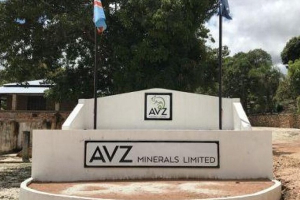
La Commission australienne des valeurs mobilières et des investissements (ASIC) a annoncé, le mardi 11 novembre, avoir engagé des poursuites devant une cour fédérale contre AVZ Minerals, compagnie minière revendiquant des droits d’exploitation sur le gisement de lithium de Manono, en République démocratique du Congo (RDC).
Le régulateur boursier australien accuse la société et deux de ses dirigeants d’avoir manqué à leurs obligations d’information envers les investisseurs dans le cadre du litige portant sur ce projet minier. AVZ était cotée à la Bourse australienne (ASX) jusqu’en mai 2022, date de sa suspension de cotation, avant d’être radiée en mai 2024.
Par l’intermédiaire de sa filiale Dathcom Mining, la compagnie détenait 75 % d’un permis couvrant une partie du site de Manono — considéré comme le plus grand gisement congolais de lithium —, mais n’a jamais obtenu les droits d’exploitation. Son partenaire dans la coentreprise, la compagnie publique Cominière, a annoncé en octobre 2023 la signature d’un accord en vue d’exploiter une partie du gisement aux côtés du groupe chinois Zijin Mining. AVZ conteste ces développements et a engagé plusieurs procédures internationales pour faire valoir ses droits.
Selon l’ASIC, la compagnie a omis de divulguer des information sur ce conflit juridique pendant près d’un an. Le directeur général d’AVZ, Nigel Ferguson, et le directeur technique, Graeme Johnston, sont également accusés d’avoir manqué à leurs obligations d’administrateurs, en autorisant ou en permettant la publication d’annonces à l’ASX « fausses ou trompeuses ».
« Il était pratiquement impossible pour les investisseurs particuliers de se rendre en Afrique centrale, où la société exerce ses activités. Dans ces circonstances, les investisseurs comptent sur la société pour leur fournir des informations précises et opportunes. Nous alléguons que M. Ferguson et M. Johnston ont omis d’informer les investisseurs des problèmes en cours pendant près de 12 mois », a déclaré Sarah Court, vice-présidente de l’ASIC.
Dans un communiqué publié dans la foulée, AVZ et ses administrateurs ont nié « fermement toutes les allégations d’actes répréhensibles », affirmant qu’ils se défendront vigoureusement devant la justice australienne.
Emiliano Tossou, Agence Ecofin
Lire aussi :
Lithium de Manono : l’Américain KoBold Metals obtient plusieurs permis de recherche
Lithium de Manono : AVZ relance l’offensive judiciaire, l’offre de KoBold fragilisée
Kongo-Central : Sattel obtient le feu vert de l’ARE pour une centrale solaire de 6 MWc
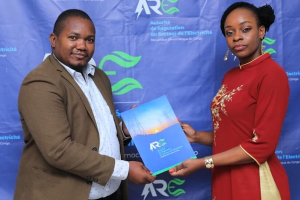
L’Autorité de régulation du secteur de l’électricité (ARE) a délivré, le 24 octobre 2025, un avis conforme à la société Sattel International pour l’obtention d’une licence de production indépendante d’électricité à partir d’une centrale solaire photovoltaïque de 6 MWc avec stockage, implantée dans le territoire de Luozi, dans la province du Kongo-Central.
Selon l’entreprise, cette infrastructure permettra d’alimenter plus de 7 500 ménages en électricité, de réduire les émissions de CO₂ de plus de 23 000 tonnes par an et de stimuler l’activité économique locale. Le projet vise également à améliorer l’accès à l’éducation et aux soins de santé dans la région. Toutefois, il n’est pas certain que le calendrier initial, qui prévoyait la mise en service de la centrale avant la fin de l’année 2025, puisse être respecté.
Spécialisée dans l’électrification durable et les solutions solaires hybrides depuis plus de 25 ans, Sattel International, à travers sa filiale Sattel Energy, conçoit, finance, installe et exploite des solutions énergétiques adaptées aux besoins des institutions financières, des entreprises, des administrations publiques et des communautés rurales.
Son modèle économique repose sur une combinaison de leasing énergétique, de vente directe et de services d’exploitation et de maintenance, appuyée par un système de gestion de l’énergie (EMS) permettant un suivi en temps réel et une optimisation des consommations.
En République démocratique du Congo (RDC), la société revendique la réalisation d’une trentaine de projets totalisant 7,5 MWc installés. Parmi ses principales réalisations figurent l’électrification solaire de banques — notamment Equity BCDC à Kinshasa et dans plusieurs provinces —, de résidences privées haut de gamme (à la Gombe, Mont-Fleury, Binza et Kintambo), ainsi que de sites agricoles, industriels et d’éclairage public à Boende. Présente en RDC et en République du Congo, Sattel International prévoit d’étendre ses activités à trois autres pays africains d’ici 2026.
Ronsard Luabeya
Kikwit’s Supply Routes Severed as Heavy Rains Worsen Road Conditions
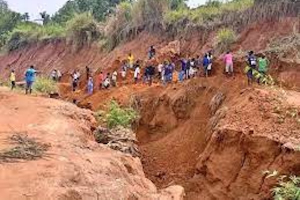
Deliveries of goods and food to the city of Kikwit in Kwilu Province have been severely disrupted by the poor condition of the road linking the city to Bulungu Territory. The situation has worsened with the return of heavy rains, making the road nearly impassable. The 35-kilometer Kikwit-Bumbaputa agricultural feeder road is now completely blocked.
According to farmer Claude Uzimesa from Bumbaputa, cited by the Congolese Press Agency (ACP), repeated rainfall has eroded the dirt road, washing out several sections and cutting off vehicle access. The situation has isolated rural communities that rely on Kikwit for manufactured goods and is preventing farmers from moving their produce to market.
Threat to Agricultural Hub
In the Kipuka sector, residents are struggling to sell their harvests, while traders in Kikwit face difficulties delivering essential goods to the isolated areas. In response, young volunteers have carried out temporary repairs, but their efforts have not stopped the ongoing degradation of the road, worsened by years without regular upkeep.
Bulungu Territory, one of Kwilu’s main farming regions, hosts several production zones supported by government programs. However, the widespread deterioration of feeder roads is seriously hindering the transport of crops. Civil society groups are calling for the urgent repair of the RN19, the main 100-kilometer road connecting Bulungu and Kikwit.
In June, a team of engineers from the Congolese Agency for Major Works (ACGT) visited the region to gather technical data for a new 65-kilometer modern road, but an official start date has yet to be announced.
Ronsard Luabeya
Train Service Resumes on Kananga-Lubumbashi Line
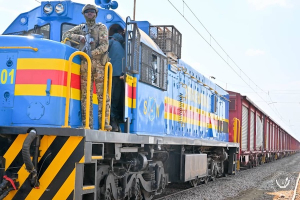
Train service between Kananga (Kasaï Central) and Lubumbashi (Haut-Katanga) officially resumed on Tuesday, Nov. 11, 2025, according to Emmanuel Kalonji, Director of the North Region Department at the National Railway Company of Congo (SNCC).
Service was initially scheduled to resume on Nov. 15 but was moved up after a meeting with local business leaders. “Our customers could not wait any longer. After consultation, we decided to restart operations on November 11,” Kalonji said. He added that the immediate priority was to clear stranded goods and restart passenger and freight transport to prevent heavy financial losses for both the company and its clients.
Train operations on this line had been suspended since early October due to anti-erosion work in Kamupongo, a locality near Kananga, carried out by the company Safrimex.
Logistics Chain Disruption
The suspension left goods stranded in SNCC warehouses in Kananga, disrupted regional market supplies, and caused delays across the supply chain. Throughout October, no mail trains ran on the Ilebo-Kananga and Kananga-Lubumbashi routes.
Even as service resumed, the SNCC stressed the need to secure the railway to ensure timely transport of ballast and other materials. Regular maintenance of the railway infrastructure remains essential to sustain interprovincial trade and keep goods moving smoothly.
In September, the SNCC began building culverts and drainage channels in Tshimbulu, the second-largest city in Kasaï Central, to contain erosion threatening both the railway line and a section of National Road No. 1. That work is expected to last three months.
Ronsard Luabeya
Lire Aussi: 30-10-2025 DRC: Rail Traffic Halted Between Ilebo and Lubumbashi Due to Erosion Damage
DRC-Angola Corridor: Plans Advance for Nsioni-Mbaka-Khosi Road Rehabilitation
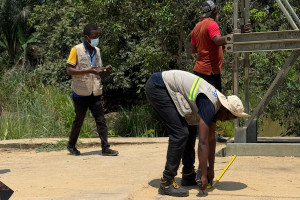
The Congolese Agency for Major Works (ACGT) is gearing up to rehabilitate the Nsioni-Mbaka-Khosi Road, a key route linking the Democratic Republic of Congo (DRC) to Angola through the southwestern province of Kongo Central.
According to a statement released on Nov. 9, 2025, a team of engineers has been in the province since Nov. 6 gathering technical data to design the rehabilitation plans. The team, led by Âgée Mavambu, Deputy Director of the Studies Department, is focusing on two sections: Nsioni-Mbata-Mbengi (44 km) and Mbata-Mbengi-Mbaka-Khosi (28 km). It is working under the supervision of Babi Kundu Mavungu, ACGT’s Provincial Director for Kongo Central.
“The goal of our mission is to prepare for the rehabilitation of the Nsioni-Mbaka-Khosi Road, a key route connecting the DRC and Angola,” said Mavungu. “This road is not just about transport; it sustains the economic life of the entire region. Its rehabilitation represents hope and the promise of new economic opportunities.”
The data collected will allow ACGT to draw up technical plans and propose infrastructure solutions suited to the terrain.
The project falls under the government’s national policy to modernize transport infrastructure, especially routes linking the DRC with neighboring countries. Last October, Prime Minister Judith Suminwa launched paving work on two other cross-border routes connecting to Angola: Moanda-Yema and Kwilu-Ngongo-Kimpangu.
Boaz Kabeya
Kibali Gold Mine Output Up 21% in Q3, Faces Uncertain Year-End Target
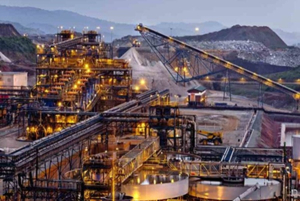
Kibali, the Democratic Republic of Congo’s largest gold mine, produced 191,000 ounces of gold in the third quarter of 2025, Barrick Mining said in its financial report released on November 10. That’s a 21% increase from the 159,000 ounces recorded in the same period of 2024.
Barrick attributed the improvement to the ramp-up of open-pit operations at the Kibali mining complex, where extracted ore volumes rose by 133% during the quarter. The increase offset a decline in underground mine output.
From January to September 2025, total production reached 498,000 ounces, slightly below the 509,000 ounces recorded over the same period last year. To meet its annual target of between 688,000 and 755,000 ounces, Kibali will need to produce between 190,000 and 257,000 ounces in the fourth quarter. That would require an additional rise of at least 19.5%, following the 21% increase already achieved in the third quarter.
Such performance would benefit the Congolese state, which owns 10% of the mine through the state company SOKIMO and collects various taxes and other statutory fees in addition to dividends. These include a 30% corporate profit tax, a 3.5% mining royalty on gross sales, and a 0.3% local development contribution based on turnover.
A persistent challenge, however, is improving the valuation of the gold sold. Official data show that in 2024, artisanal cooperatives exported their gold at an average price of $72,873.9 per ton, compared with $53,542.4 per ton for Kibali, a difference of $19,331 per ton. This discrepancy is hard to explain, given that Kibali uses advanced technology and expertise that should, in principle, secure higher international market prices.
Pierre Mukoko
Corridor RDC–Angola : la réhabilitation de la route Nsioni–Mbaka-Khosi se prépare
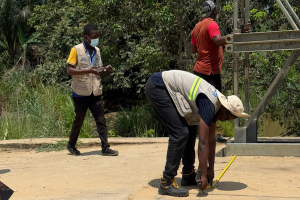
L’Agence congolaise des grands travaux (ACGT) prépare la réhabilitation de la route Nsioni–Mbaka-Khosi, un axe stratégique reliant la République démocratique du Congo (RDC) à l’Angola, à travers la province du Kongo Central, dans le sud-ouest du pays.
Selon un communiqué publié le 9 novembre 2025, une équipe d’ingénieurs séjourne dans la province depuis le 6 novembre afin de collecter les données techniques nécessaires à la conception des plans d’aménagement. La mission, conduite par l’ingénieur Âgée Mavambu, directeur adjoint à la Direction des études, couvre deux tronçons : Nsioni–Mbata-Mbengi (44 km) et Mbata-Mbengi–Mbaka-Khosi (28 km). Elle bénéficie de l’appui du directeur provincial de l’ACGT/Kongo Central, Babi Kundu Mavungu.
« L’objectif de notre mission est de préparer la réhabilitation de la route Nsioni–Mbaka-Khosi, un axe stratégique reliant la République démocratique du Congo à l’Angola. Cette route ne sert pas seulement au transport, elle soutient la vie économique de toute la région. Sa réhabilitation est synonyme d’espoir et d’ouverture vers de nouvelles opportunités économiques », a déclaré Babi Kundu Mavungu, directeur provincial de l’ACGT/Kongo Central.
Les données collectées permettront à l’ACGT d’élaborer les plans techniques de réhabilitation et de proposer des solutions d’aménagement adaptées aux contraintes du terrain.
La réhabilitation envisagée de la route Nsioni–Mbaka-Khosi s’inscrit dans la politique nationale d’amélioration des infrastructures de transport, notamment celles reliant la RDC à ses pays voisins. En octobre dernier, la Première ministre Judith Suminwa a lancé les travaux d’asphaltage de deux autres axes transfrontaliers avec l’Angola : Moanda–Yema et Kwilu–Ngongo–Kimpangu.
Boaz Kabeya
Lire aussi :
Corridor RDC–Angola : lancement du bitumage de la route Kwilu–Ngongo–Kimpangu
Corridor RDC-Angola : les travaux d’asphaltage de la route Moanda–Yema lancés
Route Kikwit–Bulungu : la dégradation compromet l’accès aux denrées alimentaires
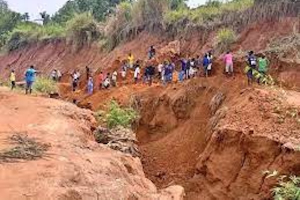
L’acheminement des marchandises et des denrées alimentaires vers la ville de Kikwit, dans la province du Kwilu, est fortement perturbé par l’état avancé de dégradation de la route reliant cette agglomération au territoire de Bulungu. La situation s’est aggravée avec le retour des pluies diluviennes, qui rendent la circulation quasi impossible sur ce tronçon. La route de desserte agricole Kikwit–Bumbaputa, longue d’environ 35 kilomètres, est désormais impraticable.
Selon Claude Uzimesa, agriculteur du village de Bumbaputa cité par l’Agence congolaise de presse (ACP), les pluies répétées ont accéléré l’érosion de la chaussée en terre battue, coupant plusieurs points de passage pour les véhicules. Cette situation isole les localités rurales dépendantes de Kikwit pour leur approvisionnement en produits manufacturés et bloque l’acheminement des produits agricoles vers les marchés urbains.
Dans le secteur de Kipuka, les habitants peinent à écouler leurs récoltes, tandis que les commerçants de Kikwit rencontrent des difficultés pour livrer les produits de première nécessité aux zones enclavées. Face à cette situation, des jeunes volontaires ont entrepris des travaux d’entretien provisoires, insuffisants toutefois pour enrayer la détérioration continue de la route, aggravée par l’absence d’entretien régulier.
Le territoire de Bulungu, considéré comme l’un des principaux greniers agricoles du Kwilu, abrite plusieurs bassins de production soutenus par des programmes agricoles. Mais la dégradation généralisée des routes de desserte compromet sérieusement l’évacuation des récoltes. Les organisations de la société civile appellent à la réhabilitation urgente de la RN19, principale voie reliant Bulungu à Kikwit sur environ 100 kilomètres.
En juin dernier, une équipe d’ingénieurs de l’Agence congolaise des grands travaux (ACGT) avait été dépêchée dans la région pour collecter les données techniques en vue de la construction d’une route moderne de 65 km, mais le démarrage effectif des travaux n’a pas encore été annoncé.
Ronsard Luabeya
Kananga–Lubumbashi : le trafic ferroviaire relancé
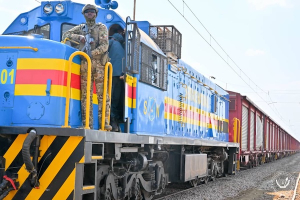
Le trafic ferroviaire entre Kananga, dans le Kasaï Central, et Lubumbashi, dans le Haut-Katanga, a repris officiellement ce 11 novembre 2025, a annoncé Emmanuel Kalonji, directeur du département Région Nord de la Société nationale des chemins de fer du Congo (SNCC).
Initialement prévue pour le 15 novembre, la reprise a été anticipée à la suite d’une réunion avec les opérateurs économiques. « La clientèle ne pouvait plus attendre. Nous avons donc décidé, après concertation, de relancer le trafic le 11 novembre », a déclaré Emmanuel Kalonji, précisant que l’urgence était de dégager les marchandises bloquées et de reprendre le transport de personnes et de biens afin d’éviter des pertes financières importantes pour l’entreprise et ses clients.
La circulation des trains sur ce tronçon était interrompue depuis début octobre, en raison de travaux antiérosifs menés à Kamupongo, une localité proche de Kananga, par l’entreprise Safrimex.
Cette interruption avait provoqué le blocage des marchandises dans les entrepôts de la SNCC à Kananga, perturbé l’approvisionnement des marchés régionaux et causé des retards dans la chaîne logistique. Durant tout le mois d’octobre, aucun train-courrier n’a circulé sur les axes Ilebo–Kananga et Kananga–Lubumbashi.
Malgré la reprise effective du trafic, la SNCC insiste sur la nécessité de sécuriser la voie ferroviaire pour garantir le transport des ballasts et autres matériaux dans les délais requis. L’entretien régulier des infrastructures ferroviaires est jugé essentiel pour soutenir le commerce interprovincial et maintenir la continuité logistique.
En septembre dernier, la SNCC avait déjà lancé des travaux de construction de caniveaux équipés de buses à Tshimbulu, deuxième ville du Kasaï Central, pour endiguer une érosion menaçant la voie ferrée et une portion de la Route nationale n°1. Ces travaux doivent durer trois mois.
Ronsard Luabeya
Lire aussi :
Transport ferroviaire : le trafic suspendu entre Ilebo et Lubumbashi depuis un mois
Kasaï : le port d’Ilebo relance ses activités, mais reste freiné par des défis logistiques