





Equipe Publication
DR Congo: Deputy Mboyo Proposes New Bill to Regulate Renting and Rely Less on Dollar

Deputy Venance Mboyo recently proposed a law that could significantly reshape the real estate market in the Democratic Republic of Congo (DRC). The bill aims to regulate landlord-tenant relations and reduce the country’s reliance on the US dollar.
Presented to the National Assembly on May 12, the bill also seeks to amend and supplement the 31 December 2015 law on non-professional rental leases.
Eyanga Mboyo, a member of Actions audibles pour la bonne gouvernance (AABG), a party within the presidential majority, explained that the proposal aims to ensure rents and related fees are set and paid exclusively in Congolese francs. This aligns with Decree no. 004/2001 on the regime for operations in national and foreign currencies, as well as Article 8, paragraph 2 of the 2014 exchange regulations, amended in 2018. The goal is to strengthen monetary stability and advance the de-dollarization of the Congolese economy.
The move comes amid challenges in several cities, notably Kinshasa, where the real estate market is poorly regulated, characterized by high rents denominated in US dollars, abusive evictions, and limited access to housing. Eyanga Mboyo criticized the absence of a formal contractual framework, which exposes both landlords and tenants to legal insecurity.
Mboyo’s bill includes 12 major reforms, such as the creation of a housing police force, the introduction of a lease permit, a framework for rent adjustments, mandatory signing of lease contracts by relevant authorities, and the exclusive payment of rents in Congolese francs.
Additional provisions call for mandatory approval of real estate agencies, the establishment of a national real estate appraisal commission, centralization of security deposits in a dedicated state bank account, regulation of premises exchanges, clarification of responsibilities for major repairs, the creation of a digitized national lease register, and continuity of contracts in the event of a party’s death.
While the National Assembly has deemed the text admissible, it must still undergo the full parliamentary process, be adopted, and promulgated by the President of the Republic before taking effect.
This article was initially published in French by Ronsard Luabeya (intern)
Edited in English by Ola Schad Akinocho
AfDB to Finance Modernization of Mbujimayi-Ngandajika Road, Critical Axis for Local Farmers
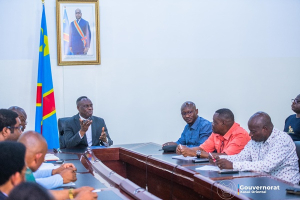
The African Development Bank (AfDB) will fund works to modernize the Mbujimayi-Ngandajika road in the Democratic Republic of Congo (DRC). A delegation from the pan-African bank has been in Mbujimayi since May 12, 2025, to carry out preliminary studies.
The project, according to Bruno Zalizali, water and sanitation expert at the AfDB, could be submitted to the Bank’s Board of Directors for approval by November, with start-up scheduled for 2026.
The 89-kilometer Mbujimayi-Ngandajika road is a strategic axis for farmers. They use it to transport their produce to the Mbujimayi market. It leads directly to Ngandajika, where an agro-industrial park is being built. This park is also financed by the AfDB under the Programme d'appui au développement agro-industriel de Ngandajika (PRODAN). The road’s modernization should boost agricultural activities and strengthen connectivity between the towns and their respective provinces.
The AfDB delegation's visit is part of a wider mission to supervise AfDB-financed projects in the region. These include the second phase of the Socio-Economic Infrastructure Strengthening Project (PRISE) and phase II of the Priority Air Safety Project (PPSA II), which involves the construction of Bipemba International Airport.
Makoko Copper: Ivanhoe’s New Resource Update Exceeds 8 Million Tonnes
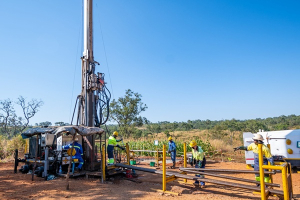
Ivanhoe Mines has announced updated resource estimates for its Western Forelands exploration project in the Democratic Republic of Congo (DRC). The company, which holds between 45% and 100% of the permits covering this area, reports that the Makoko, Makoko West, and Kitoko deposits now total 8.38 million tonnes of copper in so-called "inferred" resources, almost double the volumes estimated in 2023.
These new estimates are based on 86,000 meters of drilling conducted between November 2023 and February 2025. Ivanhoe groups these three deposits under the name "district of Makoko," a 13 km-long area where copper occurs at depth, in geological formations similar to those mined at the nearby Kamoa-Kakula mine.
Overall, 494 million tonnes of ore at an average grade of 1.70% copper have been classified as inferred resources. This classification designates volumes whose presence is deemed probable, but not yet certified due to insufficient data. These resources offer strong potential but require additional drilling campaigns to be confirmed.
The district also includes 27.7 million tonnes of "indicated resources" at 2.79% copper, or 773,000 tonnes of metal. This category offers a more reliable estimate than inferred resources.
This exploration work is part of Ivanhoe's strategy to develop a second copper production center in the DRC. Faced with growing global demand driven by the energy transition, the company has been conducting an extensive prospecting campaign for several years in the Western Forelands region, adjacent to the Kamoa-Kakula mining complex.
The 2025 drilling program, with a budget of $50 million, includes over 100,000 meters of additional drilling. The results will enable a new resource update expected in 2026.
However, the publication of these figures does not mean that Ivanhoe will be opening a new mine in the short term. At this stage, the Makoko district remains an exploration project, still far from the feasibility, environmental study, and financing phases. However, its proximity to the existing Kamoa-Kakula infrastructure could facilitate future production. The company also points out that the area remains open to exploration, meaning that the potential identified could be further expanded in future campaigns.
This article was initially published in French by Louis-Nino Kansoun
Edited in English by Ola Schad Akinocho
At 85, Billionaire George Forrest Issues a Bold Call for Africa’s Agricultural Renaissance
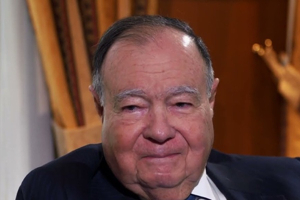
George Arthur Forrest, the Belgian-born industrialist who has long been a towering figure in the Democratic Republic of Congo’s mining sector, has turned his attention to a new frontier: agriculture. At 85, Forrest has published a compelling new book, Africa Can Feed the World, released in March 2025 by Le Cherche midi and prefaced by former Senegalese President Macky Sall. The book is a clarion call against Africa’s persistent food dependency, highlighting the continent’s paradoxical reliance on $35 billion worth of imported food annually despite its vast, fertile lands.
On May 14, the book’s launch in Kinshasa drew the presence of President Félix Tshisekedi, underscoring the weight of Forrest’s message. The man who calls himself the “White Congolese” declared, “Because of its vital importance, agriculture is at the heart of life and must therefore be elevated as a priority in the definition and implementation of our public policies.”
Forrest’s advocacy extends beyond the capital. In Lubumbashi, his birthplace and the economic hub of Katanga province, he reiterated his message during the 9th Expobéton trade fair, which focused on urban development and economic corridors in southern DRC. While the event centered on infrastructure and business opportunities, Forrest emphasized agriculture as the key to food sovereignty, reduced import dependence, and economic growth.
The Democratic Republic of Congo has exceptional agricultural assets: nearly 80 million hectares of arable land, a favorable climate, and an extensive hydrographic network. Yet the country heavily relies on imports to feed its population, with annual food imports estimated at $3 billion.
“Putting the Congo’s granary back inside.”
Forrest’s vision is clear: “Putting the Congo’s granary back inside.” He calls for reforming the business environment, particularly by amending the 2011 agricultural law that mandates 51% Congolese ownership in agricultural enterprises. He argues this requirement deters foreign investors and that removing it would restore confidence and make the country more attractive.
His ambition is to launch a new agricultural policy that ensures “Congo produces what it consumes and consumes what it produces.”
President Tshisekedi praised Forrest’s contribution at the vernissage, calling the book “a kind of bible for those who are going to embark with us on this dream of making agriculture’s revenge on mining.”
Forrest’s shift from mining to agriculture marks a significant transition. In 2018, he ended the mining activities of Groupe Forrest International to focus on infrastructure, energy, and agribusiness. This pivot took shape with the creation of GoCongo, an agribusiness holding company aimed at promoting food self-sufficiency in the DRC.
Today, GoCongo operates across multiple sectors, including cattle breeding with over 56,000 head of cattle, agri-food processing facilities producing cookies, flour, and meat products, and farms spanning thousands of hectares. This integrated approach reflects Forrest’s determination to build a complete value chain-from production to processing-to make a tangible contribution to the country’s food sovereignty.
This article was initially published in French by Timothée Manoke (intern)
Edited in English by Ola Schad Akinocho
Agriculture : le plaidoyer du milliardaire George Forrest
À 85 ans, George Arthur Forrest vient de publier un ouvrage. Il ne s’agit pas de ses mémoires, mais d’un livre-plaidoyer en faveur de l’investissement dans l’agriculture en Afrique, paru en mars 2025 aux éditions Le Cherche midi. Intitulé L’Afrique peut nourrir le monde et préfacé par l’ancien président sénégalais Macky Sall, l’œuvre dénonce la dépendance alimentaire du continent africain, qui importe chaque année pour 35 milliards de dollars de denrées alimentaires, malgré ses vastes terres arables.
Ce 14 mai 2025, une cérémonie de vernissage du livre s’est tenue à Kinshasa en présence du président de la République, Félix Tshisekedi. À cette occasion, celui qui se définit comme le « Congolais blanc » a affirmé que, « par son importance vitale, l’agriculture est au cœur de la vie et doit, de ce fait, être hissée comme une priorité dans la définition et la mise en œuvre de nos politiques publiques ».
À Lubumbashi (Katanga), la ville qui l’a vu naître en 1940, le milliardaire belge a mené le même plaidoyer à l’occasion de la 9 ᵉ édition d’Expobéton, salon dédié au développement des villes, corridors et zones économiques spéciales. Alors que cette édition, tenue du 16 au 19 avril, portait sur les projets à développer et les opportunités d’affaires dans les corridors sud de la RDC – SADC, George Forrest a longuement parlé d’agriculture.
Il a appelé à une mobilisation des investissements vers ce secteur, qu’il considère comme la clé de la souveraineté alimentaire, de la réduction de la dépendance aux importations et du développement économique en République démocratique du Congo (RDC).
En effet, la RDC dispose d’atouts agricoles exceptionnels, mais sous-utilisés : des terres arables estimées à près de 80 millions d’hectares, un climat favorable et un réseau hydrographique dense. Pourtant, le pays reste largement dépendant des importations pour nourrir sa population. Selon les autorités, la RDC importerait chaque année des denrées alimentaires pour trois milliards de dollars.
« Remettre le grenier du Congo à l’intérieur »
Pour attirer les capitaux vers ce secteur, George Forrest appelle à réformer l’environnement des affaires. Il demande notamment la modification de la loi agricole de 2011, qui exige que 51 % des parts des entreprises agricoles soient détenus par des Congolais. D’après lui, cet obstacle freine les investisseurs étrangers. Sa suppression, selon lui, permettrait de restaurer la confiance et de rendre le pays plus attractif.
L’ambition affichée par George Forrest est claire : « remettre le grenier du Congo à l’intérieur de nos frontières ». Il appelle ainsi au lancement d’une nouvelle politique agricole pour « que le Congo produise ce qu’il consomme et consomme ce qu’il produit ».
« Merci, George, pour cette contribution très importante (…). Cela va vraiment être une sorte de bible pour ceux qui vont se lancer avec nous dans ce rêve de faire la revanche de l’agriculture sur les mines », a déclaré Félix Tshisekedi lors du vernissage.
Longtemps figure emblématique du secteur minier congolais, George Forrest a opéré un virage significatif vers l’agriculture. En 2018, il a mis fin aux activités minières du Groupe Forrest International pour se concentrer sur des secteurs tels que les infrastructures, l’énergie et surtout l’agro-industrie. Cette transition s’est concrétisée par la création de GoCongo, une holding agroalimentaire visant à promouvoir l’autosuffisance alimentaire en RDC.
GoCongo regroupe aujourd’hui diverses activités, notamment l’élevage bovin, avec plus de 56 000 têtes de bétail, des unités de transformation agroalimentaire — biscuiterie, production de farine, transformation de viande — ainsi que des exploitations agricoles couvrant plusieurs milliers d’hectares. Ce développement intégré illustre la volonté de George Forrest de bâtir une filière complète, de la production à la transformation, pour contribuer concrètement à la souveraineté alimentaire du pays.
Timothée Manoke, Stagiaire
Lire aussi :
Agriculture : plus de 440 millions $ de marchés publics ouverts en RDC
Agriculture : une stratégie pour développer l’irrigation en élaboration en RDC
Agriculture en RDC : évolution, sources et orientation des investissements entre 2019 et 2023
Denrées alimentaires : plus de 3 milliards de dollars échappent aux producteurs locaux
Cuivre de Makoko : les estimations d’Ivanhoe franchissent les 8 millions de tonnes
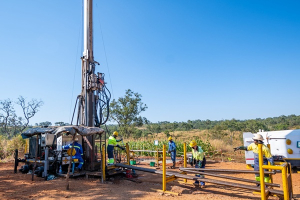
Ivanhoe Mines a annoncé une mise à jour des estimations de ressources de son projet d’exploration Western Forelands, situé en République démocratique du Congo. L’entreprise, qui détient entre 45 % et 100 % des permis couvrant cette zone, indique que les gisements de Makoko, Makoko Ouest et Kitoko totalisent désormais 8,38 millions de tonnes de cuivre en ressources dites « inférées », soit près du double des volumes estimés en 2023.
Ces nouvelles estimations reposent sur 86 000 mètres de forages réalisés entre novembre 2023 et février 2025. Ivanhoe regroupe ces trois gisements sous le nom de « district de Makoko », une zone de 13 km de long dans laquelle le cuivre est présent en profondeur, dans des formations géologiques similaires à celles exploitées à la mine voisine de Kamoa-Kakula.
Au total, 494 millions de tonnes de minerai à une teneur moyenne de 1,70 % de cuivre ont été recensées dans la catégorie des ressources inférées. Cette classification désigne des volumes dont la présence est jugée probable, mais encore peu certifiée faute de données suffisantes. Ces ressources offrent un fort potentiel, mais nécessitent des campagnes de forage supplémentaires pour être confirmées.
Le district comprend également 27,7 millions de tonnes de « ressources indiquées » à 2,79 % de cuivre, soit 773 000 tonnes de métal. Cette catégorie offre une estimation plus fiable que les ressources inférées.
Ce travail d’exploration s’inscrit dans la stratégie d’Ivanhoe de développer un deuxième centre de production de cuivre en RDC. Face à une demande mondiale croissante portée par la transition énergétique, la société mène depuis plusieurs années une vaste campagne de prospection dans la région des Western Forelands, adjacente au complexe minier de Kamoa-Kakula.
Le programme de forage 2025, doté d’un budget de 50 millions de dollars, prévoit plus de 100 000 mètres de forages supplémentaires. Les résultats permettront une nouvelle mise à jour des ressources attendue en 2026.
La publication de ces chiffres ne signifie toutefois pas qu’Ivanhoe ouvrira une nouvelle mine à court terme. Le district de Makoko reste à ce stade un projet d’exploration, encore éloigné des phases de faisabilité, d’études environnementales et de mobilisation de financements. Toutefois, la proximité avec les infrastructures existantes de Kamoa-Kakula pourrait faciliter une future mise en production. La compagnie souligne également que la zone reste ouverte à l’exploration, ce qui signifie que le potentiel identifié pourrait encore s’élargir lors des prochaines campagnes.
Louis-Nino Kansoun
Lire aussi :
Exploration du cuivre en RDC : Ivanhoe prévoit d’injecter 50 millions $ en 2025
DR Congo Announces Comprehensive Revision of Petroleum Code to Attract Investors
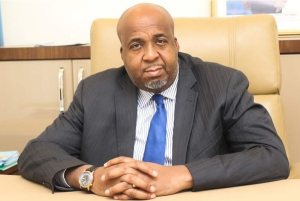
The Democratic Republic of Congo (DRC) plans a “comprehensive” revision of its Petroleum Code, with the draft reform expected to be submitted to the Council of Ministers within three months before being forwarded to Parliament for adoption, according to Hydrocarbons Minister Aimé Sakombi Molendo in an interview with Jeune Afrique.
Molendo explained that the reform is motivated by the failure of the July 28, 2022, tender for 27 oil blocks, which was hindered by an unattractive tax regime, lack of detailed seismic data, and the inclusion of protected environmental areas within the blocks offered.
Following the Council of Ministers meeting on May 2, 2025, the government announced the opening of 52 new oil blocks for exploration, bringing the total to 55 blocks in the Central Basin after awarding three blocks (Mbandaka, Lokoro, and Busira) to Compagnie Minière Congolaise.
Minister Molendo emphasized that these blocks have been “detoxified” by removing all protected areas, with technical support from the Ministry of the Environment, aiming to address environmental NGOs’ concerns.
Despite these measures, environmental groups remain opposed. The coalition "Our Land Without Oil," representing over 170 organizations, called for halting the exploration process and canceling the awarded blocks, arguing that the decision conflicts with the DRC’s climate commitments.
US Companies
The Minister of Hydrocarbons, Aimé Sakombi Molendo, affirmed that “the government will no longer back down” in the face of environmental criticisms regarding oil exploration. He emphasized that current policy aims to balance exploration and production with preserving future generations’ interests.
Molendo added that as part of the Petroleum Code revision, the government plans to update geological data to provide investors with a clearer understanding of the country’s oil potential. Seismic operations are scheduled to begin in the coming months to build a reliable and secure database.
This approach, the minister further noted, draws on recommendations from international oil companies and lessons learned from neighboring countries such as Angola and Congo-Brazzaville, with which the DRC now enjoys technical cooperation.
Minister Molendo also revealed that advanced discussions are underway with American companies specializing in seismic data reprocessing. He views this collaboration as a potential gateway to future partnerships with major American oil firms.
This article was initially published in French by Ronsard Luabeya (intern)
Edited in English by Ola Schad Akinocho
Christophe Bahi Replaces Jules Alingete as Inspector General of Finance
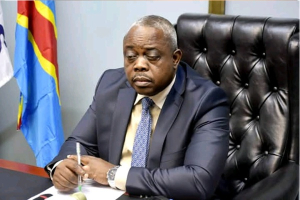
Christophe Bitasimwa Bahi is the current Inspector General of Finance in the Democratic Republic of Congo (DRC). He replaced Jules Alingete Key. Bahi’s appointment was announced on national television on May 7, 2025. Emmanuel Tshibingu Nsenga has been appointed as his deputy.
Bahi’s predecessor, Jules Alingete Key, has led the Inspectorate General of Finance (IGF) since July 2020. During this period, he earned a reputation as a tough and uncompromising figure in the fight against corruption, fraud, and embezzlement of public funds.
His tenure was marked by high-profile actions, including the deactivation of credit cards linked to the Treasury account used by political authorities following an audit of the Central Bank of Congo. He also pursued cases involving embezzled mining taxes, fictitious schools created to capture subsidies, and fictitious jobs, securing heavy prison sentences for some offenders.
However, Alingete’s methods and reports faced criticism, with accusations that he was politically instrumentalized. In July 2024, he was investigated over a contract with Gécamines, raising questions about transparency during his management. At nearly 62 years old, he has now retired, as confirmed by the President’s spokeswoman, Tina Salama.
Before his departure, the IGF presented its 2025 action plan, which includes resuming control missions in key areas such as real estate acquisitions by public entities, payment of benefits due to public officials, compliance with public procurement rules, tax compliance of service providers and suppliers dealing with public entities, and payments related to medical care and official missions abroad.
Christophe Bitasimwa Bahi, who has over 25 years of experience in public finance, previously served as Secretary General of Finance since 2013 and held various leadership positions within the Inspectorate of Finance and public enterprises. His initial performance as head of the IGF will be evaluated against the 2025 roadmap.
Ronsard Luabeya (intern)
Cobalt: Artisanal Mining’s Share in DRC’s Total Output Drops to 2% (Report)
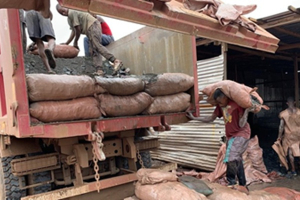
Last year, 2% of the cobalt produced in the Democratic Republic of Congo (DRC) came from artisanal mines. The figure, disclosed in the Cobalt Institute’s annual report published on May 14, 2025, is significantly lower than the years before. According to various organizations, in recent years, artisanal mining contributed between 10% and 30% to the country’s overall output.
"In 2018, when cobalt metal prices had reached over $40 per pound, smallholders' share represented around 10% of DRC production. By 2024, with the significant increase in supply in the DRC [and globally], Benchmark estimates that this share has fallen to less than 2% of national production, or around 1% of global production," says the Cobalt Institute.
The report does not provide detailed volumes for artisanal production in recent years, making precise verification difficult. The Congolese Ministry of Mines does not differentiate cobalt production or exports by mining type, unlike other minerals like diamonds, gold, or tin.
The Cobalt Institute report attributes the drop mainly to: the boom in industrial cobalt production and the decline in cobalt prices. However, the Cobalt Institute suggests artisanal mining volumes may rise again in early 2025 following Kinshasa’s February export suspension, which caused cobalt prices to increase by over 50%.
Artisanal and small-scale mining (ASM) faces criticism for poor traceability, child labor, and human rights violations. Dinah McLeod, Executive Director of the Cobalt Institute, emphasizes that the challenge is not to eliminate artisanal mining but to make it fair, safe, and free from abuses, as it remains a vital source of employment for many in the region.
The current decline in artisanal activity, often illegal, underscores the need for rapid formalization. Formalizing the sector would enable stakeholders to better benefit from favorable market conditions expected in the early 2030s, when supply deficits may emerge.
This article was initially published in French by Emiliano Tossou
Edited in English by Ola Schad Akinocho
DR Congo Secures $27M from Japan to Boost Power Supply in Mont-Amba District, Kinshasa
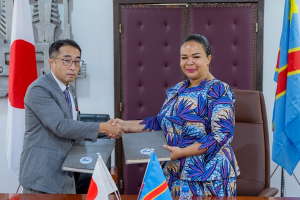
The Japan International Cooperation Agency (JICA) has granted $27 million in non-repayable financing to the SNEL, the power utility of the Democratic Republic of Congo (DRC). The related deal was sealed on May 9, 2025, by the Congolese Minister of Foreign Affairs, Thérèse Kayikwamba Wagner, and the Japanese Ambassador to the DRC, Ogawa Hidetoshi.
This funding is meant to help boost access to electricity in the Mont-Amba district of Kinshasa. This district regroups the following municipalities: Limete, Lemba, Matete, Ngaba, and Kisenso.
The project involves rehabilitating the 220-kV Liminga and Funa substations, modernizing the power transmission system, installing new high-voltage transformers, and building modern control rooms. These upgrades should help stabilize the power supply in this part of Kinshasa.
This initiative is part of ongoing bilateral cooperation between the DRC and Japan. JICA had initially allocated $18 million to the project in November 2023, but after feasibility studies, the amount was increased to $27 million to meet project requirements
BK (intern)