






News (946)
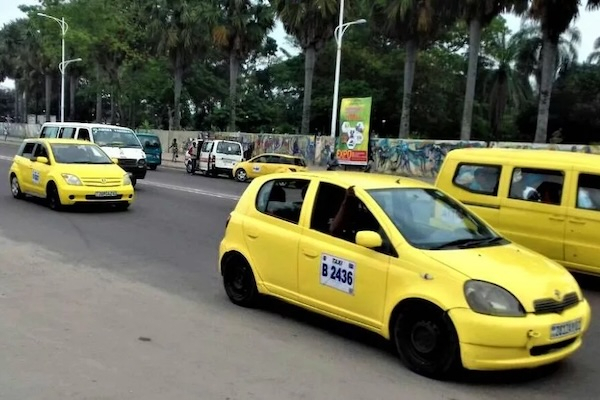
Kinshasa Governor Daniel Bumba met on October 13, 2025, with officials from the transport, economy, and finance ministries, as well as representatives of drivers’ unions, ahead of a tariff commission meeting expected in the coming days. The talks aim to establish a new and balanced public transport fare structure that reflects recent economic changes, including the appreciation of the Congolese franc (FC) and a sharp drop in fuel prices.
The franc has strengthened by about 20% in just a few weeks, rising from 2,800 FC to 2,246.57 FC per U.S. dollar as of October 14, 2025. Over the past year, fuel prices in the Western zone, which includes the capital, have fallen nearly 25%, with gasoline dropping from 3,440 FC to 2,690 FC per liter and diesel from 3,435 FC to 2,680 FC per liter.
The current fare schedule, adopted in December 2024 and setting prices between 500 FC and 8,500 FC depending on distance, has not been consistently enforced. Governor Bumba called for a fair and regulated adjustment, criticizing operators who set prices arbitrarily with no regard for market conditions.
He also denounced the widespread practice of “demi-terrain,” meaning drivers dividing routes in half to double fares, and announced measures to curb it, including the mandatory display of route information on all public transport vehicles and tighter inspections to ensure compliance.
The adoption and publication date of the revised fare schedule has not yet been announced.
Boaz Kabeya

• Belgium Innovation Company (Belinco) will conduct a three-month gold exploration mission in Luiza, Kasai Central, Democratic Republic of Congo (DRC).
• The company plans to train local teams and may invest further if results confirm significant mineral potential.
• Belinco, active in the DRC for over 15 years, previously partnered with Hazina Investments SAS on feasibility studies for Leta Mbanvu Mining Company in Luiza.
Belgium Innovation Company (Belinco) plans to start a gold exploration mission in Luiza, located in the Kasai Central province of the Democratic Republic of Congo (DRC).
The announcement came from Sahel Tshibangu, head of the Cooperative of Artisanal and Agricultural Miners of Luiza (CEMIAL), who led a company delegation to meet the acting provincial governor, Job Kuyindama, on October 3, 2024.
Tshibangu said the initiative is based on previous geological studies conducted in the area. The three-month mission aims to identify gold reserves and assess other exploitable mineral resources across the Luiza territory.
Representatives of Belinco also plan to strengthen the technical capacity of local teams to support the exploration process. If results prove promising, the company will expand its investment to the production stage, subject to official provincial approval.
Belinco, which has operated in the DRC for over 15 years, specializes in mining exploration and extraction. The company’s headquarters are in Kinshasa, and it is led by mining expert Joseph Olcauz.
In 2023, Belinco partnered with Hazina Investments SAS to conduct research and a feasibility study for Leta Mbanvu Mining Company, which holds mining rights in Luiza.
The upcoming mission marks a new phase of mineral development in Kasai Central, a province increasingly attracting junior and mid-tier mining investors seeking to tap underexplored gold deposits in central DRC.
This article was initially published in French by Ronsard Luabeya
Adapted in English by Ange Jason Quenum
• Oil companies in the Democratic Republic of Congo (DRC) expect $15.97 million in government reimbursements for losses and shortfalls in the first half of 2025.
• Fuel consumption doubled in the western region after the October 2024 price cut, while subsidies remained stable.
• A stronger Congolese franc and subsidy reforms are improving state finances and reducing payment delays to oil firms.
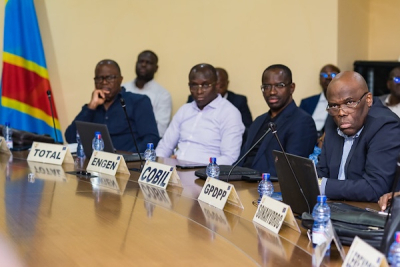
Oil companies operating in the Democratic Republic of Congo are awaiting a $15.97 million payment from the government to cover losses and shortfalls for the first half of 2025, the Ministry of Economy announced on October 10 on X, formerly Twitter.
The certified amount was approved by the committee overseeing petroleum product prices after joint discussions between government officials and oil-sector representatives from October 7 to 10.
Subsidies Remain Stable Despite Consumption Surge
Year-on-year, the subsidy level remained stable despite a sharp rise in fuel consumption. Economy Minister Daniel Mukoko Samba said fuel demand in the western region — which includes Equateur, Kongo-Central, Kwango, Kwilu, Mai-Ndombe, Mongala, Nord-Ubangi, Sud-Ubangi, Tshuapa, Kinshasa and Boende — has doubled since the October 2024 price cuts, increasing from under 50,000 cubic meters per month in September 2024 to nearly 100,000 cubic meters today.
“The southern zone, covering Haut-Katanga, Kasaï, Lualaba, and Tanganyika, has recorded record consumption levels,” the minister said. He did not provide data for the eastern and northern zones, including Haut-Uele, Ituri, and Kisangani.
The stability of the subsidies marks a relief for public finances. At the end of 2023, fuel subsidies exceeded $400 million, a burden that had forced the state to accumulate heavy arrears to oil companies, disrupting supplies of refined products.
By contrast, subsidies fell to $31.5 million in 2024, allowing faster reimbursements. “Payments are now made very quickly so oil companies can operate under the best conditions,” Minister Mukoko Samba assured.
Policy Reforms and Transparency Measures
These results stem from several reforms designed to improve transparency in the calculation of company shortfalls and the fuel pricing structure. The latest measure excludes fuels used in the mining industry — including gasoline, kerosene, diesel, fuel oil, lamp oil, and LPG — from public subsidies and all fiscal and customs exemptions.
On October 8, the government cut fuel prices again in the western zone. The price of gasoline fell from 2,990 to 2,690 Congolese francs (FC) per liter, and diesel from 2,980 to 2,680 FC, representing a 10% reduction. The minister said the decline should hold, though it may further stimulate consumption.
The price adjustment coincides with the appreciation of the Congolese franc against the dollar. Within weeks, the exchange rate strengthened from 2,800 FC to 2,300 FC per U.S. dollar. If this trend continues, the government will no longer need to offset exchange-rate losses for oil firms, as current fuel prices are based on an exchange rate of 2,600 FC per dollar.
This article was initially published in French by Pierre Mukoko and Ronsard Luabeya
Adapted in English by Ange Jason Quenum
• The European Union announced over €180 million ($208 million) in new financing for the DRC under its Global Gateway initiative.
• The funds target major projects, including €60.5 million for the Kivu–Kinshasa Green Corridor and €20 million for electrifying Kisangani.
• The Lobito Corridor will receive €16 million to strengthen agricultural value chains and cross-border trade.
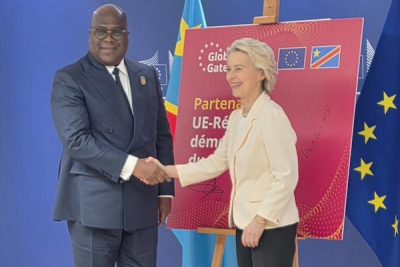
The European Union (EU) will provide more than €180 million ($208 million) to the Democratic Republic of Congo (DRC) to support energy, transport, and environmental projects, European Commission President Ursula von der Leyen announced at the Global Gateway Forum 2025 in Brussels.
The funding forms part of the EU’s Global Gateway strategy, designed to promote sustainable investment in Africa’s infrastructure, biodiversity, and value chains. The new commitments reinforce the EU’s role as a key partner in the DRC’s economic transition and regional connectivity.
The EU allocated €60.5 million to the Kivu–Kinshasa Green Corridor, a project that seeks to balance conservation of Congo Basin forests with the development of a sustainable green economy. The initiative, first presented at the World Economic Forum in Davos in January 2025, is part of a broader €1 billion program backed by Team Europe.
The corridor aims to create a protected area covering 544,000 square kilometers while generating around 500,000 jobs, including opportunities for young people leaving armed groups. According to EU officials, the project illustrates Europe’s commitment to linking climate action with inclusive growth in Africa.
The EU will also invest €16 million in the Lobito Corridor, a strategic logistics route connecting the DRC’s Copperbelt region to the Atlantic Ocean. The funding will strengthen agricultural value chains and cross-border trade along the route.
Further EU involvement is expected in rehabilitating the Dilolo–Kolwezi–Tenke rail section, valued at over $400 million, with an additional $180 million needed for long-term maintenance. A second phase extending the line to the Zambian border could raise the total investment to about $1.1 billion.
The EU will grant €20 million to support the electrification of Kisangani, a project expected to mobilize an additional €70 million in loans from the French Development Agency (AFD). The DRC’s Council of Ministers approved the plan in July 2025, estimating the total cost at $173.3 million.
The project includes rehabilitating the Tshopo hydroelectric plant, constructing a 5 MW solar power station, and modernizing the city’s power distribution network to boost energy access in northeastern Congo.
The EU will devote €13.8 million to improve mining governance, including €2 million for the Cobalt4Development program—a pilot initiative aimed at enhancing the living and working conditions of artisanal cobalt miners and surrounding communities.
The remaining €11.8 million will strengthen the institutional capacity of the Ministry of Mines to ensure transparency and sustainability in mineral resource management.
This article was initially published in French by Boaz Kabeya
Adapted in English by Ange Jason Quenum

The TALO price-control app is scheduled to begin its rollout in November across several cities in the Democratic Republic of Congo (DRC). The announcement was made on Tuesday, October 7, 2025, by Minister of National Economy Daniel Mukoko Samba during an interview on Kinshasa-based Top Congo FM.
The minister said the first phase will cover seven major cities, with six more to follow by year-end. The goal is to enable real-time tracking of prices for food and other staple consumer goods.
Developed by young Congolese professionals, TALO was unveiled by Minister Mukoko Samba on January 14, 2025. Designed to modernize the economic inspection service, the app helps field agents collect data more efficiently and increases transparency in business practices for consumers.
In Kinshasa, where the application is already in use, TALO has replaced manual price reporting. Agents now record data on their phones at market sites and send it directly to a central database. According to Jocelyne Mayungu Bwanga, head of the Kinshasa-East office at the Ministry of National Economy, the switch to digital data collection has significantly reduced processing times.
The ministry posts monthly reports on its official website summarizing the data. The latest report, for July, showed that weekly price tracking in Kinshasa covered 39 staple consumer products, 183 brands, and 62 types of traders across 16 markets, including Central, Gambela, Zigida, and Liberté.
Price differences of up to 40% were sometimes observed for the same product between different outlets. To identify the underlying causes, the ministry has commissioned a Congolese consulting firm to conduct a study. One preliminary finding points to two main supply routes: goods entering through the Lufu border with Angola tend to be cheaper than those coming via Matadi port.
By expanding TALO to the provinces, the Ministry of National Economy aims to strengthen its nationwide price-monitoring and regulatory capacity. The ultimate goal is to curb market speculation and protect consumers’ purchasing power.
Timothée Manoke
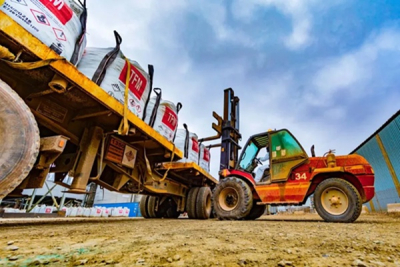
The Strategic Mineral Substances Markets Regulation and Control Authority (Arecoms) finalized the practical terms for implementing the Democratic Republic of Congo's (DRC) new cobalt export quota policy on October 10, 2025. The policy was first announced on September 20.
The quotas, approved by the Arecoms Board, allocate export volumes for the last quarter of 2025 to 21 companies.
China's CMOC Group, the world's largest cobalt producer, was granted 6,500 tons,4,250 tons for its Kisanfu Mining (KM) subsidiary, and 2,250 tons for Tenke Fungurume Mining (TFM). This total represents nearly 36% of the global volume allocated. Glencore follows with 3,925 tons, split between 2,775 tons for Kamoto Copper Company (KCC) and 1,150 tons for Mutanda Mining (MUMI). Combined, the two foreign giants capture 58% of the available quotas.
This dominance is rooted in the allocation formula. The Arecoms document specifies that "the base quota is distributed pro rata based on the historical quantities exported between January 1, 2022, and December 31, 2024." Exemptions were made for the state-owned Entreprise générale du cobalt (EGC) and the Société du Terril de Lubumbashi (STL), which were allotted 1,175 tons and 300 tons, respectively. During the 2022-2024 period, CMOC and Glencore controlled nearly 60% of total Congolese cobalt exports.
CMOC, whose primary shareholder is Chinese battery maker CATL, has not yet officially responded to the decision. However, the allocation poses a major challenge for the group, which relies heavily on Congolese cobalt to meet surging demand in China. Its metal trading subsidiary, IXM, already declared force majeure on June 30 due to the initial Congolese export embargo imposed in February 2025.
Despite the export suspension, CMOC maintained its operational pace in the DRC, extracting 61,073 tons in the first half of 2025 and projecting a full-year output of 100,000 to 120,000 tons. With only 6,500 tons authorized for the fourth quarter of 2025 and an estimated 31,200 tons for 2026 (based on the December quota being rolled over), the company will only be able to sell a small fraction of its production. Over two years, its total authorized exports would likely be capped at 37,700 tons, falling far short of its annual capacity.
Even if CMOC were to secure the entirety of the 9,600 tons set aside for "strategic quotas" in 2026, a volume reserved for projects deemed "of national importance" and allocated at Arecoms’ sole discretion,the situation would remain critical for the company.
Enforcement and Market Risk
CMOC also risks having its quotas revoked entirely. Sanctions are prescribed against any company that processes mining tailings or concentrates obtained from unauthorized third parties or artisanal miners, sells its quota to another firm, fails to export the allocated volumes, or violates existing laws.
While the export embargo is scheduled to end on October 15, the resumption of shipments could still face delays. To obtain an export certificate, operators are now required to present proof of prepayment of the mining royalty, validation of their available quota, a traceability certificate issued by Arecoms, and an environmental and fiscal compliance certificate.
Since the imposition of the embargo, the price of cobalt has more than doubled. On October 12, 2025, a tonne of cobalt was trading at $42,725 on the London Metal Exchange, compared to just $21,000 at the end of February.
Pierre Mukoko
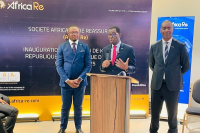
African Reinsurance Corporation (Africa Re) inaugurated an office in Kinshasa, Democratic Republic of Congo (DRC), on October 9.
According to Africa Re Chairman Moustapha Coulibaly, the new office aims to support local insurance companies in covering major risks and to offer solutions tailored for strategic sectors such as mining, energy, infrastructure, and agriculture.
Coulibaly also emphasized Africa Re's commitment to assisting the Insurance Regulation and Control Authority (Arca) in modernizing the regulatory framework, which is crucial for strengthening the credibility and attractiveness of the Congolese insurance market.
The opening of this office will allow the pan-African reinsurer to work more closely with its local partners to improve the retention of premiums nationally. Losses related to placing premiums abroad and the non-collection of value-added tax (VAT) were estimated at approximately $1.5 billion in 2023, according to Arca.
In accordance with a November 29, 2019, circular from Arca, Congolese insurance companies were already obligated to cede at least 5% of their reinsurance treaties to Africa Re. Building on this relationship, Arca and Africa Re launched the Reinsurance Facility in March 2024, a collective mechanism allowing companies in the same market to pool their risks and strengthen their financial capacity against claims.
This mechanism aims to "provide the DRC with greater national reinsurance capacity and better control over insurance and reinsurance operations, particularly in the oil, gas, mining sectors, and against political violence risks." It also serves to limit the outsourcing of insurance for companies where at least 75% of the risks are located in the DRC, aligning with Arca’s requirements.
Established in 1976 by the African Union and the African Development Bank, Africa Re is a pan-African reinsurance institution dedicated to enhancing the sector's capacity across the continent. In 2024, the company reported $1.21 billion in gross written premiums, representing a 9.73% increase over 2023. Its network now includes 11 offices across Africa, the Middle East, Asia, and Latin America, comprising various subsidiaries and regional offices. In the DRC, Africa Re becomes the second reinsurance player in the market, following the entry of reinsurer Zep-Re.
Ronsard Luabeya
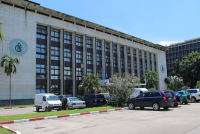
After its Monetary Policy Committee (MPC) meeting on October 7, the Central Bank of Congo (BCC) announced a sharp easing of its monetary policy. The benchmark interest rate, which determines the cost at which commercial banks borrow from the central bank, was cut from 25% to 17.5%. The marginal lending facility rate, applied for urgent liquidity needs, was lowered from 30% to 21.5%.
This technical adjustment, the largest since 2021, aims to make financing in Congolese francs (FC) cheaper for commercial banks and, in turn, for the state, businesses, and households. It could encourage lending to economic actors and increase the supply of francs in circulation.
Although not stated explicitly, the BCC’s measures are part of a strategy to restore the role of the franc in domestic transactions and reduce structural dependence on the U.S. dollar, which accounts for over 90% of payments. This is the main objective set by Governor André Wameso since taking office in July.
Behind this monetary goal lies a broader question of sovereignty. Dollar dominance limits the authorities’ ability to manage liquidity and control financial flows. Excessive reliance also exposes the economy to unilateral U.S. decisions, such as potential restrictions on dollar imports. By promoting the use of the Congolese franc, the BCC seeks to reduce external vulnerability and strengthen internal stability as economic fundamentals improve.
According to the MPC, inflation fell from 15.1% in September 2024 to 7.8% a year later, while the national currency appreciated by about 11.6% on the official market and 7.8% on the parallel market, trading at around 2,549 and 2,659 FC per dollar, respectively. For 2026, the BCC forecasts inflation at 6.8%, a more stable exchange rate, and “robust” economic growth.
A Risky Bet
However, the impact of these measures will depend on confidence in the local currency. An increase in the supply of francs without corresponding demand could weaken stability and trigger renewed depreciation.
The DRC’s heavy reliance on imports also poses a major risk. By the end of July 2025, imports had risen by nearly 6%, increasing the need for foreign currency, while exports fell by about 18%, mainly due to suspended cobalt sales. According to the International Monetary Fund (IMF), the faster outflow of foreign currency now represents one of the main risks to maintaining adequate reserves.
Aware of these threats, the BCC said it is ready “to respond in case of a reversal.” To strengthen stability, it plans to absorb excess liquidity by implementing, from October 15, the second stage of the exchange rate adjustment applied to reserve requirements, which has remained fixed at 1,999 FC per dollar since 2021. The governor noted that the first adjustment helped support the franc by withdrawing the equivalent of 371 billion FC from the market.
At the same time, the BCC is encouraging businesses to conduct transactions in francs, while the government plans to collect part of its taxes in the local currency. The rate cut is also expected to help the Treasury refinance domestic debt at lower costs, easing the interest burden on public finances.
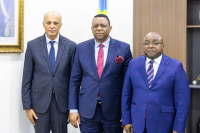
The Industrial Promotion Fund (FPI) plans to launch the production phase of its new digital system by the end of 2025, a key milestone in the public institution’s digital transformation.
The announcement was made by Zouheir Ben Ali, Director General of the Tunisian firm Système informatique de gestion automatisée (SIGA), after a meeting earlier this month with FPI Director General Hervé Claude Ntumba Batukonke in Kinshasa.
The initiative is central to the FPI’s reform agenda under its new leadership, which aims to digitalize all services. Upon taking office in August, Ntumba emphasized that technological modernization would be a core pillar of his management strategy. Full digital integration is also a priority in the FPI’s 2026-2028 plan, aimed at improving efficiency and transparency across its operations.
According to the SIGA Director General, two phases of the project, the study and system installation, have been completed. “We have started configuring the system with the departments, so we are now entering phase three,” Ben Ali said after his meeting with the FPI head.
Internal FPI sources said SIGA was selected following an international tender launched in July 2024 for the supply, installation, and implementation of an integrated management system (ERP). A year later, in July 2025, the institution announced it was close to finalizing the partnership, though details have not yet been disclosed.
SIGA develops customized integrated management and information systems for public and private institutions. According to its website, the company also designs large-scale, real-time interactive systems built on optimized databases and 4G technologies. The FPI noted that SIGA currently manages the IT systems for Tunisia’s national railway company, Tunisie Telecom, Tunisair, and several banks.
The FPI, a public financial institution, is mandated to promote local industry, strengthen the national production base, and support balanced industrial development. Its resources are used to finance industrial projects, support research and innovation, and develop economic infrastructure. According to data published on its official website, the FPI granted nearly $6.5 million in loans between April 2024 and May 2025 to six projects in sectors including pharmaceuticals, furniture, beverages, soap production, and printing.
Timothée Manoke

The Regulatory Authority for Subcontracting in the Private Sector (ARSP), the Guarantee Fund for Entrepreneurship in Congo (FOGEC), Rawbank, and Rawsur have launched a national financing program to support Congolese subcontractors in the mining, energy, and infrastructure sectors.
Presented to Prime Minister Judith Suminwa on Oct. 6, 2025, the initiative aims to make it easier for local small and medium-sized enterprises (SMEs) to access financing so they can compete for contracts and deliver on them. Loan amounts will range from $10,000 to $1 million, depending on each company’s size and capacity, the Prime Minister’s office said.
Rawbank will provide the funding through its “$20,000 SMEs” program, which has a total budget of $200 million dedicated to integrating local SMEs into the value chains of major corporations. In July, Rawbank Director Rawji Mustafa said during a meeting with the ARSP that 8,000 SMEs had already benefited from the facility. The ARSP will now focus on helping finance the remaining 12,000 businesses, drawing on its market oversight expertise to identify credible SMEs and provide them with tailored support.
ARSP Director General Miguel Kashal said the initiative will not only finance SMEs but also ensure prompt payments by main contractors, helping to stimulate growth. “We will share the list of subcontractors who have won contracts with Rawbank,” Kashal said. “The goal is to help these entrepreneurs grow into major players, because it’s impossible to build strong businesses without support from the banks.”
FOGEC will guarantee the loans, reducing risk for Rawbank and boosting the financial sector’s confidence in local businesses. A monitoring system will also be set up to ensure that funds are properly managed and that the funded projects remain viable.
Ronsard Luabeya
More...

Congolese mining company Compagnie minière Orient industrielle (Comoi-Sarl) has accused Ding Sheng SARL, a Chinese-owned firm, of illegally operating on three of its gold concessions in Mambasa territory, Ituri province.
In a complaint reported by the ACP news agency, Comoi-Sarl claims that Ding Sheng SARL is operating without authorization on its concessions, in breach of the national Mining Code. In its official complaint to the head of the General Inspectorate of Mines (IGM) in Kinshasa, Comoi-Sarl said it is the sole holder of research permits No. 16133, 16188, and 16325, all properly registered and validated by the mining authorities.
The company has requested that the IGM immediately suspend Ding Sheng SARL’s operations, seize its equipment, and order $10 million in damages for losses incurred.
According to ACP, an inspection team from the provincial mines division in Ituri confirmed the presence of Ding Sheng SARL’s operations on the disputed sites, supporting Comoi-Sarl’s allegations. The case has been referred to local authorities for follow-up, including the head of the Congolese National Police’s economic and financial crimes unit in Ituri, the Mambasa territory administrator, and the local mining office chief.
The incident follows a similar crackdown on Oct. 5, when Chinese nationals were arrested for illegal mining at a Kibali Gold concession in Haut-Uélé. That operation, led by Mines Minister Louis Watum Kabamba, resulted in the seizure of equipment and the immediate closure of the site.
Ronsard Luabeya
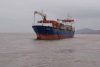
The Port of Boma, in southwestern Democratic Republic of Congo (DRC), welcomed the container ship MV APALOS, operated by Maersk Congo, on Tuesday, October 8, 2025. It was the first commercial vessel to dock at the port in more than ten years, according to the Congolese News Agency (ACP).
The ship carried a large number of containers. Interim mayor Claudelle Phemba said the visit followed a July 8, 2025, meeting between the mayor’s office and Maersk Congo, during which the company confirmed plans to resume operations at the facility.
Maersk Congo said the move is part of its broader strategy to diversify logistics access points across the country, in response to growing demand for modern, efficient port infrastructure.
Separately, eight industrial fishing vessels built in Egypt by Pyrlant Shipyard are expected to dock at Boma before entering service.
The Maersk ship’s arrival and the upcoming delivery of the fishing boats could signal the start of a long-awaited revival at the Port of Boma, which has been largely idle for years.
BK
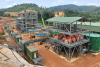
Alphamin Resources Ltd said it expects to produce between 18,000 and 18,500 tons of tin in 2025 at its Bisie mine in the Democratic Republic of Congo (DRC). The company raised its April forecast of 17,500 tons, according to an operational update published on October 8.
The operator initially planned to produce 20,000 tons in 2025. However, Alphamin cut its target earlier this year after halting operations in March because of rebel activity in eastern Congo.
The company reported a cumulative output of 13,566 tons in the first nine months of 2025. It expects to add around 5,000 tons in the fourth quarter, which would bring annual production to the new range of 18,000–18,500 tons.
“The Company expects to produce approximately 5,000 tons of contained tin during the final quarter of the financial year which, together with its year-to-date production of 13,566 tons, increases tin production guidance for FY2025 to between 18,000 and 18,500 tons (17,500 tons previously),” the company said in its update.
The Bisie mine produced 5,190 tons of tin in the third quarter, a 26% increase from the second quarter, which had been impacted by the temporary shutdown. The company attributed the rebound to “processing facilities continuing to deliver good results.”
Alphamin reported annual output of 17,324 tons in 2024. The company said final fourth-quarter results will determine whether the revised 2025 target is fully achieved.

The European Union (EU) announced on October 8 that it has allocated €1.8 million in humanitarian aid through its Emergency Response Coordination Centre (ERCC) to support efforts to contain a new Ebola outbreak in Kasai province, Democratic Republic of Congo (DRC).
The funding forms part of the EU’s broader on-the-ground response. According to the EU delegation in the DRC, the assistance includes a specially equipped helicopter for medical evacuations and the delivery of essential supplies.
The EU has also set up temporary offices and accommodation in Bulape, the affected health zone, to house up to 36 health experts. In addition, two Norwegian specialists in medical evacuation and patient isolation will join the World Health Organization (WHO) response team through the EU Civil Protection Mechanism.
The Ebola resurgence was declared on September 4 by Health Minister Roger Kamba, after several cases were confirmed in Bulape. Officials say they are encouraged that the virus remains confined to the area, with no signs of spread to neighboring zones.
The Red Cross has launched a $25 million response plan aimed at 965,000 people over 12 weeks, including 23,200 directly affected individuals, patients, contacts, caregivers, and volunteers, and about 680,000 residents in at-risk areas.
In its October 5 update, the WHO reported a stabilizing trend, noting that no new confirmed or probable cases had been detected for ten days, a sign that transmission is coming under control.
Since the start of the resurgence, 64 cases have been reported (53 confirmed and 11 probable), resulting in 43 deaths, a fatality rate of 67.2%. Fifteen patients have recovered, while six remain hospitalized at the Ebola treatment center.
The WHO said that if no new cases appear and the remaining patients recover, the DRC could begin the 42-day countdown before officially declaring the outbreak over.
Timothée Manoke