






News (946)
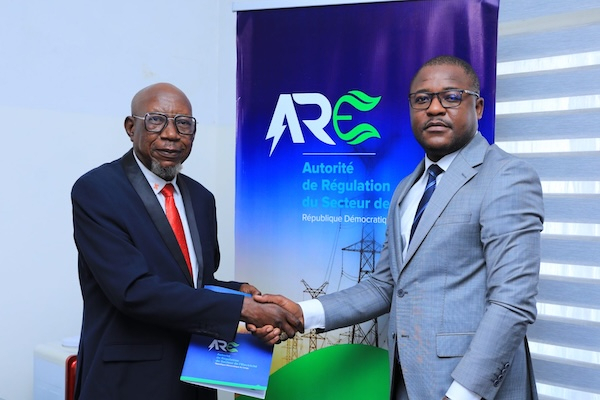
The Electricity Sector Regulatory Authority (ARE) of the Democratic Republic of Congo (DRC) announced on October 7, 2025, that it had granted regulatory clearance on September 15 to Gujarat DRC SA for its planned solar power plant. The approval allows the Minister of Energy to sign the production license—the final step before construction can begin.
The project will be built in Fipango village, on the Kashamata site in Kipushi territory, Haut-Katanga province. It is being developed by Soleos Energy of India and Melci Holdings of the DRC, which formed the joint venture Gujarat DRC SA to carry out the project. The final ownership structure has not yet been made public.
While earlier reports mentioned a 200 MW plant, the ARE confirmed that the facility’s peak capacity will be 248 MWp (megawatt-peak)—the maximum output under ideal sunlight and temperature conditions. In practice, such plants operate below that level: a 248 MWp installation typically delivers an average of 40–50 MW of effective power in Africa.
According to ARE data, the project will supply electricity to about 70,000 households and create roughly 50 permanent and 500 temporary jobs. Early investor presentations projected completion by the end of 2025.
Four months ago, Tshimbalanga Madiba, General Manager of Melci Holdings and Deputy General Manager of Gujarat DRC SA, announced the imminent start of construction and said the plant would include a Battery Energy Storage System (BESS) with a 107 MWh capacity.
The power produced will be sold to the National Electricity Company (SNEL) under a 25-year Power Purchase Agreement (PPA). Bhavesh Kumar Rathod, founder and director of Soleos Energy, described the tariff as “very advantageous,” without disclosing specifics. SNEL will handle power distribution to households and businesses.
The project also enjoys a dedicated transmission corridor and government guarantees—factors that have reinforced Soleos Energy’s confidence as it seeks to develop up to 1,000 MW of solar capacity in the DRC, covering roughly one-third of the country’s 3,000 MW electricity deficit, according to Minister Aimé Sakombi Molendo.
Timothée Manoke
• The Democratic Republic of Congo (DRC) plans to invest $1 billion in public funds and secure an additional $500 million from international partners to implement its new five-year digital strategy.
• The plan aims to transform the DRC into a regional digital hub by 2030, with a focus on AI, connectivity, and digital inclusion.
• The country’s first national artificial intelligence (AI) strategy will include the creation of a Congolese AI academy to train young talent and foster innovation.
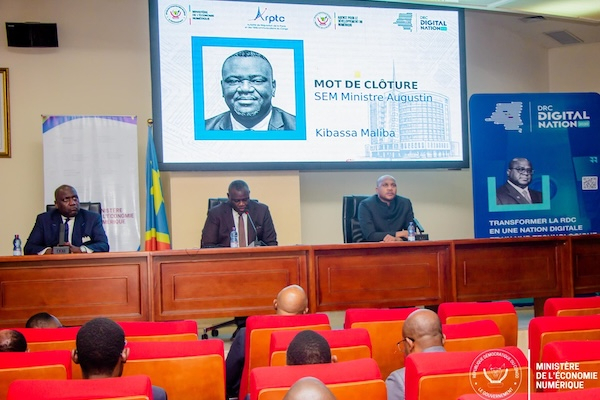
The Democratic Republic of Congo (DRC) has launched the drafting process for its National Digital Plan 2026–2030 (PNN2) and its first National Artificial Intelligence Strategy, the Ministry of Digital Economy said on Wednesday.
Minister Augustin Kibassa Maliba announced the initiative, which aims to position the DRC as a regional digital hub by 2030.
“This is about capturing the dividends of digital transformation and positioning our country — rich in critical minerals essential to the digital and energy transitions — as both an investment catalyst and a provider of solutions to global challenges,” Kibassa said.
The new plan will rest on four main pillars: infrastructure and connectivity development, creation of digital public platforms and services, human capital enhancement and digital inclusion, and strengthening of cybersecurity and digital trust.
It will also integrate five cross-cutting axes — digital entrepreneurship, innovation, technological sovereignty, artificial intelligence, and strategic partnerships — to ensure coherence across policy areas.
To support this roadmap, the government plans to invest $1 billion in public funds over five years, complemented by $500 million in external financing already secured from international partners.
As part of the AI strategy, authorities will establish a Congolese Artificial Intelligence Academy to train young professionals, promote applied research, and stimulate local innovation.
This initiative follows the National Digital Plan “Horizon 2025”, launched in 2019, which achieved about 60% of its objectives. The first plan laid the groundwork for the digital economy through improvements in fiber-optic connectivity, regional integration projects such as CAB5, and the introduction of e-government tools like online tax portals and customs modernization via a single window system.
Ongoing projects include the digitization of civil registration and the establishment of a national digital ID system.
With PNN2, Kinshasa seeks to consolidate these achievements and accelerate its digital transformation. A GSMA report presented last month estimated that digital technologies could contribute 9.8 trillion Congolese francs (about $3.6 billion) to the economy by 2029, provided that fiscal and regulatory reforms advance.
The same report suggested that digital adoption could unlock 8.6 trillion FC in additional economic value across mining, agriculture, and public services.
Through this new strategy, the DRC aims to strengthen its technology ecosystem, create thousands of skilled jobs, and attract more investment in high-growth digital sectors.
This article was initially published in French by Samira Njoya, Agence Ecofin
Adapted in English by Ange Jason Quenum
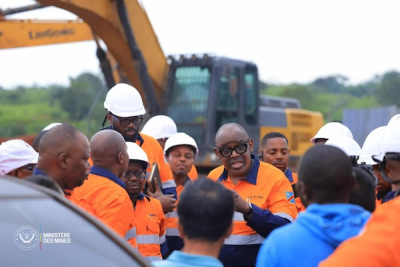
Ten illegal gold mining sites have reportedly been identified inside the concessions of Kibali Gold Mines, a subsidiary of Canada’s Barrick Gold, in Haut-Uélé province.
The finding was announced on October 5, 2025, after an inspection led by Mines Minister Louis Watum Kabamba, joined by the provincial governor and security officials.
The Kibali concessions, covering about 1,836 square kilometers in the Moto goldfields of Watsa territory, are among ten permits held by the company. Officials say these areas are regularly invaded by illegal artisanal and semi-industrial miners.
At Barrick Gold’s 50th annual conference in 2023, CEO Mark Bristow had already warned about the rise of illegal mining in parts of Haut-Uélé, citing the involvement of foreign operators, mainly of Asian origin.
During the minister’s visit, several Chinese nationals were caught mining inside one of the concessions. They were carrying out open-pit artisanal and semi-industrial operations using heavy machinery and employing Congolese workers in unsafe conditions, in violation of the Mining Code.
Provincial authorities and security forces dismantled the network. The minister ordered the arrest of those involved, the seizure of equipment, and the closure of the site. He denounced the illegal exploitation of national resources by foreign operators.
The scale of Kibali Gold’s losses is still unclear. However, during a meeting with the Mines Minister on September 18, 2025, industry representatives called encroachment on mining concessions the “most critical problem.” The Federation of Enterprises of Congo (FEC) estimates that the phenomenon has already cost at least one mining company more than $3 billion through illegal extraction.
Ronsard Luabeya
• The 200 MW Nzilo 2 hydropower plant in Lualaba province targets a 2029 commissioning.
• Lualaba Power Group leads the project, financed by MES and CMOC.
• The plant will include a solar component to ensure stable power supply.
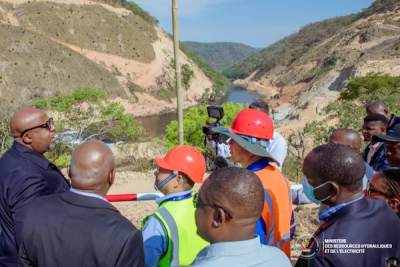
Aimé Sakombi Molendo, Minister of Hydraulic Resources and Electricity, inspected the Nzilo 2 hydropower plant construction site in Lualaba province on October 4, 2025. The site is located approximately 60 kilometers from Kolwezi.
Lualaba Power Group spearheads this project, aiming to alleviate the energy deficit in the mining province. Industrial expansion rapidly increases electricity demand in the region.
Mohamed Badri, a corporate advisor for Lualaba Power Group, stated that work remains in the preparatory phase. This phase includes constructing access roads and a river diversion tunnel. The plant expects commissioning by early 2029.
Nzilo 2 will feature an installed capacity of 200 MW, equipped with four 50 MW turbines. The project also incorporates a solar component, designed to complement hydropower generation. This integration aims to ensure a stable power supply for both mining industries and local populations.
The overall cost exceeds $470 million. Mining Engineering Services (MES) and China Molybdenum Company Limited (CMOC) jointly finance the project under a partnership signed in May 2024. Named the Heshima project, this partnership covers full financing through construction completion. Lualaba Power, a joint venture between MES and the National Electricity Company (SNEL), obtained its independent power producer license in 2023.
Minister Aimé Sakombi Molendo emphasized his visit's role in monitoring priority government energy projects. He stated, "Projects visited on this tour total nearly 1,000 MW, against a national deficit estimated at 3,000 MW. If we manage to cover a third of this deficit, pending the large Inga project, it would already be a significant step forward."
This article was initially published in French by Ronsard Luabeya
Adapted in English by Ange Jason Quenum
-
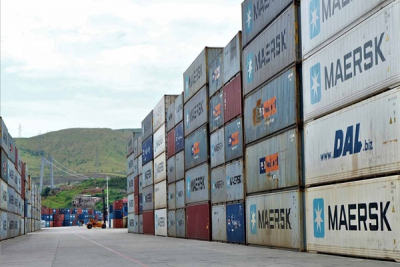
Exports from the Democratic Republic of Congo (DRC) to the U.S. reached $1.3 billion between January and July 2025, more than the total of 2017–2024 combined.
-
The surge coincides with the U.S.–China trade war, which redirected Congolese minerals directly to the American market.
-
The U.S. trade deficit with the DRC widened to over $1 billion by July 2025, compared to just $96 million in 2024.
Exports from the Democratic Republic of Congo to the United States reached $1.3 billion in the first seven months of 2025, according to U.S. government data. The figure already exceeds the cumulative total of the previous eight years (2017–2024).
The Bureau of the Census said shipments peaked between April and July, when the DRC sent more than $1 billion worth of goods. June alone nearly hit $400 million, the highest monthly level on record.
Previous export peaks were $605.6 million in 2011, $527.6 million in 2010, and $400.7 million in 1985, making the 2025 surge unprecedented in at least four decades.
The U.S. Census Bureau did not provide reasons for the surge. However, the United Nations Economic Commission for Africa (UNECA) attributed it to sustained U.S. demand for African raw materials and trade diversion effects.
The timing coincides with Washington’s tariff escalation against Beijing. In April 2025, the Trump administration raised tariffs on Chinese goods to 145% before lowering them to an average of 57.6%. UNECA suggested that Chinese firms operating in the DRC, which usually exported minerals to China for processing, redirected shipments directly to the U.S. market.
The hypothesis gains weight as the DRC faces average U.S. tariffs of just 11%, while copper — its main export — is exempt. Between January and July, U.S. copper imports totaled $11.3 billion, up 135.4% year-on-year. Although not broken down by country, the DRC, the world’s second-largest copper producer with more than 3 million tonnes mined in 2024, is likely a major contributor.
UNECA also noted that higher global commodity prices supported the performance. Gold prices rose more than 60% between January 2024 and July 2025, while coffee prices nearly doubled. Both commodities, though exported in smaller volumes, regularly feature in DRC shipments to the U.S.
This export boom sharply widened the U.S. trade deficit with the DRC. By end-July 2025, the deficit surpassed $1 billion, compared with just $96 million in 2024.
The expiration of the African Growth and Opportunity Act (AGOA) on September 30, which since 2000 had eliminated tariffs on more than 6,800 African products, is expected to have only a limited impact on the trend.
This article was initially published in French by Pierre Mukoko
Adapted in English by Ange Jason Quenum
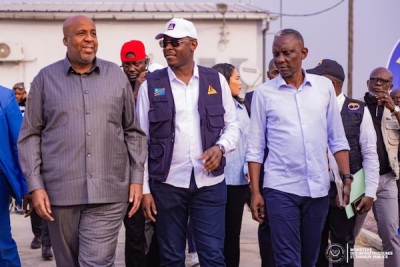
The Congolese government began emergency repairs on Oct. 2, 2025, to secure Pylon P8 of the Inga-Kimwenza high-voltage power line in the Mont Ngafula district of southwestern Kinshasa. Officials said the work is crucial to protect the structure from soil erosion that threatens its stability and could cause a major blackout across much of the capital.
Pylon P8 is a steel tower supporting the 400-kilovolt transmission line linking the Inga hydroelectric complex on the Congo River to several substations in Kinshasa. According to SNEL’s Director of Power Transmission, Ngindu Mutshima Kola, the collapse of just three similar pylons could plunge nearly two-thirds of the city into darkness.
The danger comes mainly from soil erosion around the tower, worsened by heavy rains and illegal construction nearby, which have disrupted natural drainage and made the site unstable. Calling the situation urgent, Infrastructure and Public Works Minister John Banza convened the national power utility SNEL and the Roads Office to coordinate an immediate response.
The stabilization contract was awarded to the Chinese firm SCI. The first phase involves reinforcing the ground around the pylon by placing sandbags in ravines to slow erosion and secure the foundations before launching full restoration work.
Meanwhile, Kinshasa City Hall has been instructed to begin expropriation procedures to clear illegal dwellings near the site. The goal is to create a safety buffer in accordance with regulations requiring a 25-meter clearance on each side of the tower.
Boaz Kabeya
The government of the Democratic Republic of Congo (DRC) has begun paving the Kwilu-Ngongoy-Kimpangu road in Kongo-Central province. The project covers 96 kilometers of two-lane road and includes administrative and logistics facilities, such as a dry port in Kimpangu and new buildings for customs and the border post with Angola.
The project is worth $160.38 million and will be carried out by the Chinese consortium CRBC-TECNOVIA, which will finance 80% of the cost. The Congolese government will provide the remaining 20%. Construction is scheduled to take 24 months.
The Kwilu-Ngongo-Kimpangu stretch, until now unpaved, is a strategic trade link with Angola and a vital route for several Kongo-Central localities. Often impassable during the rainy season, it is expected to boost cross-border trade and stimulate the local economy once modernized.
This project is part of a broader effort to modernize key roads connecting the DRC and Angola. On September 29, 2025, the paving of the Moanda-Yema road was inaugurated, while work continues on the Mbuji-Mayi–Kananga–Kalamba-Mbuji route, which also includes a dry port at Kalamba-Mbuji on the Angolan border.
PM
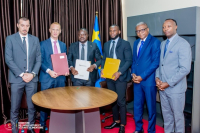
Swiss agricultural commodity trader Mole Group signed a Public-Private Partnership (PPP) with the Democratic Republic of Congo (DRC) on Sept. 30, 2025, for a vast agro-industrial project in Mbanza-Ngungu, Kongo Central province. The contract was signed by Mole Group Director General Grandi Mole and Agriculture Minister Muhindo Nzangi Butondo.
The agreement, expected for about one year now, is expected to complete the project’s structuring phase. Partners include Swiss firm Bühler, a specialist in agro-industrial machinery, and Belgian company De Smet Engineers & Contractors, known for turnkey plant construction. International financiers are also expected to join.
Mole said that secondary studies, to be carried out with the United Nations Industrial Development Organization (UNIDO), will begin in October 2025. Construction is scheduled to start in the third quarter of 2026 and will take four years.
The project covers more than 105,000 hectares, including 85,000 cultivable, and will require about $1 billion in investment. Plans call for an agro-industrial park with modern infrastructure: communication towers, hangars, warehouses, silos, processing plants, and administrative offices. It will also include schools and phytosanitary laboratories.
Annual production targets stand at 650,000 tons of food products: 70,000 tons of wheat flour, 150,000 tons of sugar, 150,000 tons of corn flour, 20,000 tons of rice, and 260,000 tons of cassava flour. Local raw materials such as cassava, maize, wheat, rice, and sugarcane will be transformed into flour, refined sugar and ethanol.
Mole Group expects the initiative to generate more than 20,000 direct and indirect jobs, stimulating the rural economy. If achieved, it would mark a step toward reducing the DRC’s chronic food deficit and dependence on imports. According to the Central Bank of Congo, food imports cost the country nearly $1.79 billion annually between 2019 and 2023.
Ronsard Luabeya
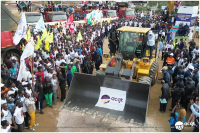
The Democratic Republic of Congo has begun construction of a 24-km road linking the coastal city of Moanda in Kongo Central province to Yema on the Angolan border.
Prime Minister Judith Suminwa launched the project on Sept. 29. It is being built by Congolese firm Vaste Réseau des Services au Congo (VRSC) under the supervision of the Agency for Major Works (ACGT) and is expected to take two years.
The works include paving the road, installing two toll and weigh stations, and building a dry port at Yema on the Angolan side.
The Moanda-Yema route is the second DRC-Angola corridor under modernization. Work is also ongoing on the Mbuji-Mayi–Kananga–Kalamba-Mbuji road, where a new dry port is planned. Both projects aim to ease commercial flows between the two countries.
BK
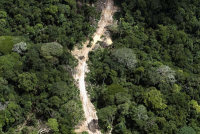
North Kivu’s military governor, Maj. Gen. Kakule Somo Évariste, has suspended charcoal production in Mayangose, Beni territory, after tensions flared between farmers and eco-guards from the Congolese Institute for Nature Conservation (ICCN).
The ICCN accuses farmers of clearing land inside Virunga National Park. In retaliation, eco-guards destroyed more than 20 hectares of crops, sparking conflict with local communities.
Governor Somo said a commission will be set up to investigate. Farming will be allowed to continue in the meantime to avoid further clashes, according to local chief Mwami Atsu Taibo Alphonse.
Illegal logging and charcoal production have long fueled disputes in Beni. In February 2025, authorities reported widespread exploitation in Mayangose and other areas, prompting a ban on harvesting timber, charcoal, bark and other forest products.
Military administrator Col. Euta Omeonga Charles reminded operators that forestry activities must comply with the 2002 Forestry Code, which requires permits, licenses and registration of equipment. Violators face legal sanctions.
Ronsard Luabeya
More...
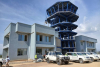
The project to modernize the Bunia National Airport, also known as Murongo, in Ituri province is expected to be delivered in February 2026, according to Barry Boubacar, track works director for the Congolese contractor Mont Gabaon SARLU.
The project manager at the Central Coordination Office (BCECO) reported in September that physical execution stood at about 76 percent, according to the Congolese News Agency (ACP).
The work, launched in June 2022 and originally slated for a 36-month duration, is running eight months behind schedule, Mont Gabaon stated. The company cited several challenges, including delays in releasing the site by the MONUSCO peacekeeping mission and surrounding populations, the presence of rocky areas not factored into the initial studies, and the lack of suitable gravel in Bunia. The scarcity required complicated imports from Uganda, made difficult by poor road conditions, especially during the rainy season.
The entire project is valued at more than $48 million USD, according to Finance Minister Doudou Fwamba, who spoke on Top Congo FM on September 29. It encompasses four main lots.
The first involves extending and widening the runway from 1,850 to 2,500 meters in length and 30 to 45 meters in width. Boubacar confirmed that 2,300 meters have already been completed. The second lot focuses on expanding the aircraft parking area from 14,000 to 32,000 square meters.
The third lot covers the construction of a 3,500 square meter passenger terminal with two separate arrival and departure circuits, which is currently 70 percent complete. Finally, the fourth lot includes the new control tower, which will offer visibility of both runway ends and is scheduled for completion in December 2025, alongside a fire station that has already been completed and provisionally accepted.
The works director emphasized that the chosen strategy allowed the airport to remain operational throughout the construction period, preventing the province from being isolated.
The project's objective is to increase the airport’s capacity to accommodate wide-body aircraft, grant it international status, and link it to major cities across the continent. Currently, Bunia Airport primarily handles domestic flights and some international connections, mainly for medical evacuations and humanitarian operations.
Timothée Manoke
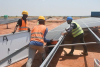
Chinese electronics component maker Shenzhen Hongfuhan Technology is set to be the main investor in a 30 megawatt (MW) solar power plant designed to supply the Kamoa-Kakula mining complex in the Democratic Republic of Congo (DRC).
Citing Chinese media, sources reported on Wednesday, October 1, 2025, that Hongfuhan announced it would soon sign a partnership agreement with its compatriot, Green World Energy and Green World's parent company, the Construction and Commercial Development Company (SDCC), to finance the $198 million project.
Hongfuhan, a Shenzhen-based firm that recently expanded into the solar sector, plans to invest $158.4 million in the project, with Green World/SDCC covering the remaining balance.
The pending agreement includes the creation of a joint venture, with shares distributed proportionate to the investment: 80 percent for Hongfuhan and 20 percent for Green World/SDCC. Green World/SDCC will handle construction, installation, operation, and maintenance, while the majority shareholder, Hongfuhan, will exercise control.
In April 2025, Kamoa Copper, the owner of the Kamoa-Kakula mine, signed a power purchase agreement with Green World Energy. The Beijing-based firm committed to financing, building, and operating a solar plant with a constant power capacity of 30 MW. Hongfuhan states the contract duration is 15 years.
High Profitability Expected
During the first 5.5 years—a period encompassing the construction phase and deemed necessary to recoup the initial investment—net profits will be shared pro rata to the joint venture stakes. After that, the distribution will shift to 76 percent for Hongfuhan and 24 percent for SDCC.
Kamoa Copper plans to boost its total solar capacity to 120 MW to power Kamoa-Kakula, which has an annual copper production capacity of 600,000 metric tons. The mining company has also signed an agreement with CrossBoundary Energy DRC to finance, build, and operate a separate 30 MW constant-power solar plant, with a contract duration of 17 years.
Both solar projects, including grid connection, are expected to be completed by the end of July 2026. By that deadline, the Kamoa-Kakula complex’s electricity needs are projected to reach 240 MW. The company aims to cover this demand exclusively with green energy, retiring its diesel generators.
Beyond solar, Kamoa is also relying on hydropower, specifically through the rehabilitation of Inga II’s Turbine 5 (178 MW). Full commissioning of the turbine is expected in 2026 after network reinforcement. With these combined projects, Kamoa Copper anticipates being able to reduce its electricity imports from Zambia and Mozambique.
Timothée Manoke
• GSMA estimates telecom reforms could generate 9,800 billion Congolese francs ($3.7 billion) in GDP by 2029.
• Mobile operators in DRC face a tax burden of 91% of profits, among the heaviest compared to mining (71%) and banking (34%).
• The sector could connect 9.7 million new mobile internet users and unlock $3.2 billion in value across mining, agriculture, and public services.
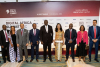
The first Digital Africa Summit in Kinshasa on Sept. 18 became a platform for mobile operators to advocate tax and regulatory reforms in the Democratic Republic of Congo (DRC). The push relied on a report by the GSMA, the global mobile industry association, titled “Driving Economic Growth through Digital Transformation in the DRC.”
Angela Wamelo, GSMA’s Africa director, said the reforms could add 9,800 billion Congolese francs ($3.7 billion) to GDP and connect 9.7 million additional mobile internet users by 2029. The report projected that mobile adoption could release more than 8,600 billion Congolese francs ($3.2 billion) in value across mining, agriculture, and public services.
“The Democratic Republic of Congo has the opportunity to leapfrog into a digital-driven economy,” Wamelo said. “But to realize this potential, reforms in taxation, spectrum management, and energy infrastructure must be a priority. We aim to regulate this sector in DRC to make it more transparent and attract investors,” she added.
A separate GSMA report from June, “Mobile Sector Taxation: Comparative Tax Burden in DRC,” highlighted the heavy fiscal environment operators face. It said mobile operators pay on average 91% of their profits in taxes, compared with 71% for mining companies and 34% for retail banks. The report blamed multiple sector-specific levies, often calculated on revenues, for deterring investment and limiting service expansion.
The GSMA urged simplification and harmonization of taxes. It recommended modernizing fiscal frameworks through rationalization of sectoral taxes to lower consumer prices and encourage investment. It also called for a collaborative national framework, coordination of energy and digital policies, expanded spectrum access, license reform, skills development through public-private partnerships, and integration of mobile platforms into education, health, and government services.
The government, facing major financing needs, has argued that telecom operators must pay their “fair share” of taxes. Some officials questioned the fiscal contribution of multinational operators, noting that some had not declared taxable profits in nearly two decades, raising suspicions of tax avoidance.
Despite these concerns, Digital Economy Minister Augustin Kibassa Maliba welcomed the GSMA report. He described it as a “clear diagnostic” of the sector’s progress and challenges. “We have the responsibility to transform the recommendations of this report into concrete actions, because it is through them that we will build a true digital economy,” he said.
According to GSMA, the mobile sector contributed an estimated $63–64 billion to DRC’s GDP in 2022 and $66 billion in 2023.
This article was initially published in French by Ronsard Luabeya
Adapted in English by Ange Jason Quenum
• President Félix Tshisekedi pledged $1 billion in public spending from 2026–2030 to implement the new national digital plan.
• The program will focus on infrastructure, e-government, cybersecurity, and digital skills training, with emphasis on women and youth.
• DRC signed an MoU with Cisco and Cybastion to train 250,000 young people in cybersecurity, data science, and programming.
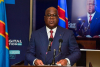
Democratic Republic of Congo (DRC) President Félix Tshisekedi announced a $1 billion public investment to support the country’s next five-year digital development plan. The pledge, made Sept. 26 during the “DRC Digital Nation 2030” event at the UN General Assembly in New York, represents an annual commitment of $250 million from 2026 to 2030.
Tshisekedi said the initiative aims to position Congo as a technology hub at the heart of Africa.
According to the Ministry of Digital Affairs, the program will center on four pillars: expanding digital infrastructure such as connectivity and data hosting, developing e-government services, strengthening cybersecurity governance, and building digital skills. Training programs will prioritize women and young people.
Dominique Migisha, head of the Digital Development Agency, said unfinished projects from the current plan—achieved at roughly 60% due to funding gaps—will be incorporated into the new program.
Tshisekedi stressed that digital development depends on political stability and implementation of peace accords with Rwanda and the M23 rebels. Security improvements are also vital to attract private investors.
On the sidelines of the forum, Digital Minister Kibassa Maliba held talks with U.S.-based Unity Development Fund, which expressed interest in investing in infrastructure, innovation, and youth entrepreneurship.
Congo also signed a memorandum of understanding with Cisco and Cybastion to train 250,000 young people over five years in fields such as cybersecurity, data science, programming, operating systems, technical English, digital transformation, and entrepreneurship.
This article was initially published in French by PM & Ecofin Agency
Adapted in English by Ange Jason Quenum