






MINING (253)
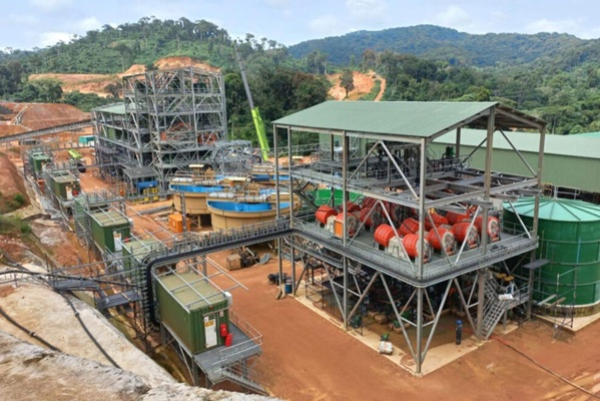
Alphamin Resources Ltd said it expects to produce between 18,000 and 18,500 tons of tin in 2025 at its Bisie mine in the Democratic Republic of Congo (DRC). The company raised its April forecast of 17,500 tons, according to an operational update published on October 8.
The operator initially planned to produce 20,000 tons in 2025. However, Alphamin cut its target earlier this year after halting operations in March because of rebel activity in eastern Congo.
The company reported a cumulative output of 13,566 tons in the first nine months of 2025. It expects to add around 5,000 tons in the fourth quarter, which would bring annual production to the new range of 18,000–18,500 tons.
“The Company expects to produce approximately 5,000 tons of contained tin during the final quarter of the financial year which, together with its year-to-date production of 13,566 tons, increases tin production guidance for FY2025 to between 18,000 and 18,500 tons (17,500 tons previously),” the company said in its update.
The Bisie mine produced 5,190 tons of tin in the third quarter, a 26% increase from the second quarter, which had been impacted by the temporary shutdown. The company attributed the rebound to “processing facilities continuing to deliver good results.”
Alphamin reported annual output of 17,324 tons in 2024. The company said final fourth-quarter results will determine whether the revised 2025 target is fully achieved.
Ten illegal gold mining sites have reportedly been identified inside the concessions of Kibali Gold Mines, a subsidiary of Canada’s Barrick Gold, in Haut-Uélé province.
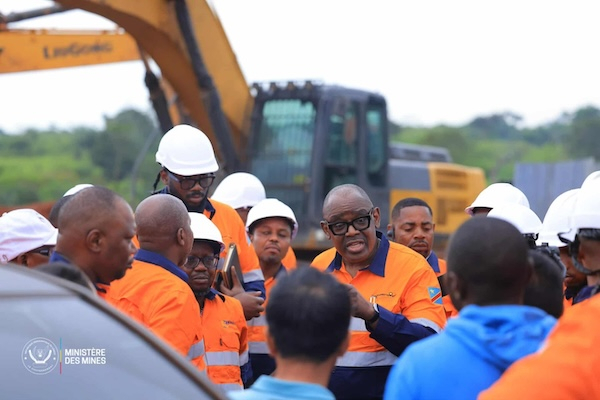
The finding was announced on October 5, 2025, after an inspection led by Mines Minister Louis Watum Kabamba, joined by the provincial governor and security officials.
The Kibali concessions, covering about 1,836 square kilometers in the Moto goldfields of Watsa territory, are among ten permits held by the company. Officials say these areas are regularly invaded by illegal artisanal and semi-industrial miners.
At Barrick Gold’s 50th annual conference in 2023, CEO Mark Bristow had already warned about the rise of illegal mining in parts of Haut-Uélé, citing the involvement of foreign operators, mainly of Asian origin.
During the minister’s visit, several Chinese nationals were caught mining inside one of the concessions. They were carrying out open-pit artisanal and semi-industrial operations using heavy machinery and employing Congolese workers in unsafe conditions, in violation of the Mining Code.
Provincial authorities and security forces dismantled the network. The minister ordered the arrest of those involved, the seizure of equipment, and the closure of the site. He denounced the illegal exploitation of national resources by foreign operators.
The scale of Kibali Gold’s losses is still unclear. However, during a meeting with the Mines Minister on September 18, 2025, industry representatives called encroachment on mining concessions the “most critical problem.” The Federation of Enterprises of Congo (FEC) estimates that the phenomenon has already cost at least one mining company more than $3 billion through illegal extraction.
Ronsard Luabeya
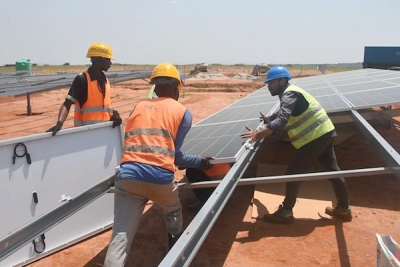
Chinese electronics component maker Shenzhen Hongfuhan Technology is set to be the main investor in a 30 megawatt (MW) solar power plant designed to supply the Kamoa-Kakula mining complex in the Democratic Republic of Congo (DRC).
Citing Chinese media, sources reported on Wednesday, October 1, 2025, that Hongfuhan announced it would soon sign a partnership agreement with its compatriot, Green World Energy and Green World's parent company, the Construction and Commercial Development Company (SDCC), to finance the $198 million project.
Hongfuhan, a Shenzhen-based firm that recently expanded into the solar sector, plans to invest $158.4 million in the project, with Green World/SDCC covering the remaining balance.
The pending agreement includes the creation of a joint venture, with shares distributed proportionate to the investment: 80 percent for Hongfuhan and 20 percent for Green World/SDCC. Green World/SDCC will handle construction, installation, operation, and maintenance, while the majority shareholder, Hongfuhan, will exercise control.
In April 2025, Kamoa Copper, the owner of the Kamoa-Kakula mine, signed a power purchase agreement with Green World Energy. The Beijing-based firm committed to financing, building, and operating a solar plant with a constant power capacity of 30 MW. Hongfuhan states the contract duration is 15 years.
High Profitability Expected
During the first 5.5 years—a period encompassing the construction phase and deemed necessary to recoup the initial investment—net profits will be shared pro rata to the joint venture stakes. After that, the distribution will shift to 76 percent for Hongfuhan and 24 percent for SDCC.
Kamoa Copper plans to boost its total solar capacity to 120 MW to power Kamoa-Kakula, which has an annual copper production capacity of 600,000 metric tons. The mining company has also signed an agreement with CrossBoundary Energy DRC to finance, build, and operate a separate 30 MW constant-power solar plant, with a contract duration of 17 years.
Both solar projects, including grid connection, are expected to be completed by the end of July 2026. By that deadline, the Kamoa-Kakula complex’s electricity needs are projected to reach 240 MW. The company aims to cover this demand exclusively with green energy, retiring its diesel generators.
Beyond solar, Kamoa is also relying on hydropower, specifically through the rehabilitation of Inga II’s Turbine 5 (178 MW). Full commissioning of the turbine is expected in 2026 after network reinforcement. With these combined projects, Kamoa Copper anticipates being able to reduce its electricity imports from Zambia and Mozambique.
Timothée Manoke
Highlights:
• Chemaf could halt copper cathode production by November after failed sale process that began in August 2023
• Company needs $250-300M to complete expansion projects despite already investing $570M in new mines
• 3,000 jobs at risk as unions report wage delays amid $900M total debt burden
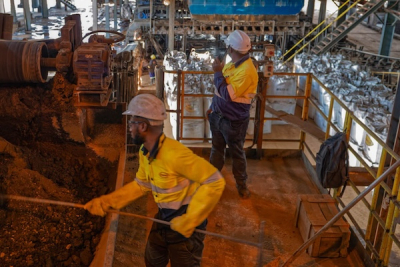
Mining company Chemaf may cease copper cathode production as early as November after months of financial difficulties, according to a management letter obtained by Radio Okapi on September 19, 2025. Board Chairman Shiraz Virj confirmed the potential shutdown, attributing it to the collapse of sale negotiations that began in August 2023.
Although a potential buyer had been identified, the transaction failed to secure expected regulatory approvals by March 2025. "We are doing everything we can to reach an agreement. However, in the absence of a new investor, Chemaf will be forced to cease operations," Virj said.
The company has been stretched by ambitious expansion projects, particularly developing the Mutoshi mine in Kolwezi and phase 2 of the Étoile mine in Lubumbashi. Both projects are over 80% complete, with more than $570 million already invested, but still require between $250 million and $300 million to finish. Once operational, these facilities would boost Chemaf's annual capacity to 75,000 tons of copper and 25,000 tons of cobalt hydroxide.
Owned 94.68% by Chemaf Resources Ltd and 5% by the Congolese government, the company carries total debt approaching $900 million. In June 2024, Chemaf announced an agreement to sell assets to Chinese group Norin Mining, including a major cobalt project on a Gécamines permit. However, the state-owned company opposed the transaction, seeking control of Chemaf itself.
Bloomberg reports that an American consortium led by Orion Resource Partners and Virtus Minerals, backed by main creditor Trafigura, is currently negotiating a takeover. Orion would provide financing while Virtus handles management. However, according to Jeune Afrique, this deal also lacks Gécamines' approval.
To address the impasse, company unions have initiated talks with Kinshasa authorities, calling for direct state involvement to guarantee jobs and establish tripartite dialogue. Unions already report wage delays, production drops, and benefit cuts affecting approximately 3,000 workers who fear worsening conditions if sale uncertainty persists.
The potential closure would eliminate a significant copper and cobalt producer in the DRC's mining heartland, highlighting the challenges facing mining companies caught between expansion ambitions and financing constraints in the current market environment.
Ronsard Luabeya
-
Qatar Investment Authority to acquire 4% stake in Ivanhoe Mines.
-
Deal worth $500 mln awaits Toronto Stock Exchange approval.
-
Funds to support copper, zinc projects in DRC and global exploration.
Ivanhoe Mines said on Sept. 17 it had struck a deal with Qatar’s sovereign wealth fund for a $500 million investment. The agreement gives the Qatar Investment Authority (QIA) a 4% stake in the Canadian miner through the purchase of 57.5 million shares.
The private placement is pending approval by the Toronto Stock Exchange. Ivanhoe’s top shareholders, CITIC Metal Africa Investments and Zijin Mining Group, retain the right to acquire shares at the same price as QIA to keep their level of participation.
QIA chief Mohammed Saif Al-Sowaidi said the investment reflected confidence in Ivanhoe’s assets and its role in supplying minerals for the energy transition. "This strategic investment reflects QIA's belief not only in Ivanhoe Mines' world-class portfolio of assets, but more importantly in supporting its team to find, develop and sustainably supply the minerals essential to the global energy transition and advanced technology applications," he said.
Ivanhoe claimed it plans to channel the funds into exploration and mining projects. In the Democratic Republic of Congo, the TSX-listed firm owns 39.6% of the Kamoa-Kakula copper mine, the country’s largest copper mine, and 62% of the Kipushi zinc mine. Ivanhoe operates both projects.
PM with Ecofin Agency
-
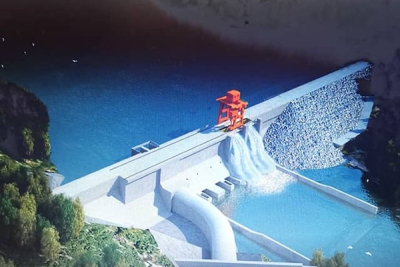
Chinese company Longjing Environmental Protection invests $399 million in a 140 MW hydroelectric plant in DRC's Haut-Lomami province
-
Zijin Mining applies for a concession to develop the 108 MW Mpiana-Mwanga hydroelectric station to power the world-class Manono lithium project
-
Combined projects will supply mining operations while providing electricity to local communities across multiple provinces
According to several trading platforms, Chinese environmental technology company Longjing Environmental Protection will invest $399 million in a 140 MW hydroelectric power plant in the Democratic Republic of Congo (DRC). The move highlights Beijing's deepening energy infrastructure push across mineral-rich Central Africa.
The project in Haut-Lomami province represents the latest phase of Chinese industrial expansion in the DRC, where parent company Zijin Mining operates extensive mining concessions and is positioning itself to tap one of the world's largest lithium deposits.
Lualaba River Project Powers Mining Expansion
Longjing's subsidiary Zijin Longjing secured 80% control of the hydroelectric project through its Hong Kong arm, which acquired rights-holding company GML. Located on the Lualaba River, approximately 200 kilometers from Kolwezi—home to several Zijin Mining concessions—the facility will generate an estimated 714 million kilowatt-hours annually.
Construction is scheduled to take three and a half years, with 90% of electricity earmarked for Zijin's mining sites and 10% allocated to local communities. The project aligns with Longjing's strategy of combining environmental protection with renewable energy development while supporting broader group expansion.
Lithium Ambitions Drive Second Major Project
Simultaneously, Zijin Mining has applied for concession rights to develop the 108 MW Mpiana-Mwanga hydroelectric station on the Luvua River in Tanganyika province. This facility, located over 90 kilometers northeast of Manono, will primarily power the massive Manono lithium project—considered among the world's largest high-grade lithium deposits.
The application, submitted through the Katamba Mining joint venture with Congolese state company Cominière, signals Zijin's commitment to securing reliable power for lithium extraction operations critical to global battery supply chains.
Vice President James Wang indicated the Mpiana-Mwanga station will also serve local communities, including Manono town and territory, Kanuka village, Malemba Nkulu territory, and Manono airfield—demonstrating efforts to balance industrial needs with community development.
Strategic Energy Infrastructure Play
The dual hydroelectric investments reflect a broader Chinese strategy in the DRC: securing energy infrastructure to support mineral extraction while positioning for long-term industrial presence. Zijin Mining's 29.25% stake in Longjing's parent company, Fujian Longking, underscores the integrated approach linking mining operations with power generation.
For the DRC, these projects promise much needed electricity infrastructure while raising questions about resource control and community benefits as Chinese industrial presence expands across the country's mineral-rich provinces.
Timothée Manoke
-
Worker crisis escalates with delayed salaries, reduced benefits, as months-long Chemaf sale uncertainty affects production
-
Bidding competition between an American consortium and a blocked Chinese deal over debt-laden mining assets worth $900M
-
Union pressure mounts for government intervention, written job guarantees, and a dialogue framework amid financial collapse
In the Democratic Congo Republic (DRC), Workers at financially troubled mining company Chemaf Resources are urging Congolese authorities to accelerate a stalled sale process, warning that mounting uncertainty threatens jobs and social stability across the company's operations.
In a memorandum to the Ministry of Employment obtained by the Congolese Press Agency, the Chemaf union delegation highlighted deteriorating conditions as the sale drags on: delayed salary payments, reduced social benefits, and plummeting production levels at facilities including the flagship Mutoshi mine in Kolwezi.
Employee representatives, who say they have been kept in the dark for months about sale negotiations, expressed fears that aging equipment and declining activity could worsen their plight. The union is demanding direct government intervention to remove administrative obstacles, written guarantees for job protection and social rights, and the establishment of permanent dialogue between authorities, management, and workers.
The company's financial crisis has attracted international attention, with Bloomberg reporting that an American consortium including former Special Forces members is currently negotiating to acquire Chemaf's assets. The group comprises Orion Resource Partners and Virtus Minerals, backed by Trafigura, Chemaf's primary creditor.
The potential deal follows a collapsed agreement from June 2024, when Chemaf had arranged to sell its assets—including a major cobalt development project on a Gécamines permit—to Chinese group Norin Mining. However, the state-owned mining company blocked that transaction with a counteroffer, leaving workers in limbo.
Under the proposed American deal, Orion would provide financing while Virtus assumes operational management of a company struggling with debts estimated at nearly $900 million.
The standoff illustrates broader challenges facing Congo's mining sector, where geopolitical competition over critical minerals intersects with urgent needs for economic stability and worker protection.
Ronsard Luabeya
Highlights
• DR Congo and Al Mansour Holding Seal 18 agreements totaling $21 billion.
• These investments are part of a $300 billion fund Doha has dedicated to Africa and Asia, handled via Al Mansour Holding.
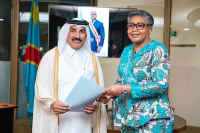
On 2nd September 2025, Sheikh Al-Mansour Bin Jabor Bin Jassim Al Thani, leader of Al Mansour Holding and cousin of Qatar’s Emir, arrived in Kinshasa. This visit culminated in the signing of 18 agreements with the Democratic Republic of Congo (DR Congo), totaling $21 billion according to the Prime Minister's office.
The signing ceremony was presided over by Deputy Prime Minster and Transportation Minister Jean-Pierre Bemba and attended by Public Health Minister Roger Kamba, Professional Training Minister Marc Ekila and other government members.
The agreements cover 15 sectors: fishing and livestock, agriculture, environment, public health, telecommunications, occupational training, national identity systems, logistics and transportation, water resources and electricity, finance and banking, cybersecurity, security and defense, urban development, mining and refining (copper, cobalt, gold), and hydrocarbons.
Although Sheikh Al-Mansour is acting as a private investor, these partnerships also involve the State of Qatar. As Jeune Afrique reported in August 2025, the $21 billion designated for DR Congo comes from a $300 billion fund that Doha has set aside for Africa and Asia, managed via Al Mansour Holding.
Key projects include the redevelopment of Kinshasa; the construction of Gateway City in Kasumbalesa; the creation of Congo Pharma, a medical equipment and drug manufacturing facility to reduce imports; the construction of 1.5 million affordable houses; the development of industrial units for the treatment and refining of minerals; and the modernisation of airports, including N'Dolo in Kinshasa.
In the oil and gas sector, there are plans to identify and assign strategic plots to Sonahydroc in the Albertine Graben and Central Basin, before a operational partnership with Amoc Oil and Gas, a subsidiary of Al Mansour Holding, is implemented. To secure these investments, preparatory documents also anticipate the deployment of private security companies in sensitive areas, approved by the Congolese Ministry of Defense.
According to Nidal Ammache, adviser to Sheikh Al-Mansour, these 18 memorandums are the result of a year of collaboration. Upon receiving the letter of intent, Prime Minister Judith Suminwa Tuluka praised a "win-win partnership" that demonstrates her government's openness to private investments, seen as a lever for economic diversification, job creation, and sustainable development.
Before Kinshasa, the Sheikh Al-Mansour and the Qatari delegation he led were in Zambia, Zimbabwe, Mozambique, and Botswana. In these countries, they also sealed deals totaling $51 billion.
The tour is set to continue in Tanzania, Gabon, Burundi, Central African Republic, and Angola, with a total portfolio exceeding $100 billion. With its $21 billion, DR Congo is one of the main recipients of these announced investments.
Timothée Manoke, stagiaire
Highlights
• Kipushi zinc mine boosts concentrator capacity by 20% after upgrades.
• Record output in first week points to global top-5 ranking potential.
• Ivanhoe stays cautious, keeping 2025 forecast unchanged at 180,000–240,000 tonnes.
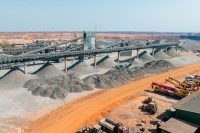
The Kipushi zinc mine in the Democratic Republic of Congo (DRC), operated by Ivanhoe Mines (62%) and state miner Gécamines (38%), has lifted production following the completion of upgrades to its concentrator and density separator (DMS).
The debottlenecking work, designed to resolve operational setbacks encountered in 2024, increased concentrator capacity by 20%, the company said in a statement released on August 27, 2025.
Within a week of restarting operations, Kipushi delivered 5,545 tonnes of zinc in concentrate — a record output equivalent to an annualized rate of 290,000 tonnes. At that pace, the mine could rank as the world’s fourth-largest zinc producer, according to a June 2024 GlobalData survey published by Mining Technology.
Despite the strong start, Ivanhoe has kept its 2025 production forecast at 180,000–240,000 tonnes.
The upgrade follows a challenging 2024, when high iron content in ore from the top of the deposit reduced recovery rates and forced Ivanhoe to lower its forecast from 100,000–140,000 tonnes to 50,000–70,000 tonnes. Actual output was 50,307 tonnes.
To address the issue, Ivanhoe launched a concentrator and DMS upgrade program in September 2024. According to early results, 42,736 tonnes of concentrate were produced in Q1 2025. The company now states that the work has been completed ahead of schedule and under budget, although it had previously informed investors that it expected to spend $25 million this year at Kipushi.
On the sales side, Ivanhoe signed an offtake deal in July with Swiss trader Mercuria for one-third of Kipushi’s output not already committed to CITIC Metal (HK) and Trafigura Asia Trading. Mercuria will also provide a $20 million loan at 6% interest.
Timothée Manoke, intern

-
U.S. firms push for DRC-Rwanda critical minerals agreement to foster economic growth and stability.
-
Roundtable discussions focused on investments and security, part of a regional integration framework.
-
The initiative aims to counter Chinese influence and increase U.S. private sector engagement in the region.
American business leaders are pressing for closer cooperation between the Democratic Republic of Congo (DRC) and Rwanda on critical minerals, seeking to turn the region’s vast resources into engines of growth rather than sources of conflict.
Securing America’s Future Energy (SAFE), a U.S. nonprofit that includes Fortune 500 executives on its board, hosted a roundtable in Washington on Aug. 28 with delegations from both countries. Talks focused on investment opportunities in critical minerals and regional security, SAFE said.
The meeting builds on a peace deal signed in June between Kinshasa and Kigali, which paved the way for a Regional Economic Integration Framework aimed at boosting trade and investment in supply chains for cobalt, lithium, and other minerals. A preliminary agreement was signed on Aug. 1, with a full deal expected by Sept. 27.
SAFE, which works closely with the U.S. State Department, said the framework could increase American private-sector investment while reducing reliance on conflict minerals and limiting China’s dominance in the sector.
At the same time, Kinshasa and Washington are negotiating a bilateral pact on strategic minerals. Several U.S. companies are already active in the DRC, including KoBold Metals in exploration and Starlink in satellite internet. Other Fortune 500 firms are also weighing entry into Congo’s resource sector.
This article was initially published in French by Boaz Kabeya
Adapted in English by Ange Jason Quenum
More...
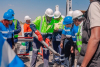
KoBold Metals, a U.S. company backed by Bill Gates and Jeff Bezos, has been granted seven new mining exploration permits in the Democratic Republic of Congo (DRC), international news reports said on August 27, 2025. According to data from the Mining Cadastre (CAMI), four of the permits are located in the Manono territory of Tanganyika province, with three others in Malemba Nkulu in Haut-Lomami province.
The move follows a preliminary agreement signed in July that allows KoBold to launch a large-scale exploration program across a 1,600 km² area. In accordance with the Congolese mining code, the exploration permits are valid for five years and grant KoBold the exclusive right to carry out work on the designated minerals, with work required to begin within one year.
The permits cover a dozen minerals, including lithium, coltan, and rare earths. However, an unnamed company official told Reuters that exploration efforts will focus on lithium. A portion of the Manono site is considered to hold one of the world's largest lithium deposits, though it remains at the center of a legal dispute.
The Australian company AVZ Minerals claims the Congolese government illegally terminated its rights to a permit covering a section of the site, which it initially held in partnership with the state-owned company Cominière. AVZ has initiated international arbitration at the International Centre for Settlement of Investment Disputes (ICSID). The process was frozen for a time in anticipation of an amicable settlement but resumed in June.
Under the preliminary agreement signed in July, KoBold is responsible for resolving the dispute. In that effort, KoBold and AVZ announced a framework agreement on May 6 for AVZ to sell its business interests in the Manono deposit at a "fair value." AVZ confirmed on July 21 that discussions remain ongoing.
Meanwhile, another part of the deposit is already under the control of China's Zijin Mining Group, which holds an exploitation permit for the northeast zone. According to its 2024 annual report, preliminary surveys identified 2.62 million tons of lithium oxide at an average grade of 1.5%, which is equivalent to approximately 6.47 million tons of lithium carbonate. Zijin plans to begin production in the first quarter of 2026.
The granting of permits to KoBold is part of a strategic alignment between Kinshasa and Washington. The Congolese and U.S. governments have engaged in discussions to link mining concessions with security support, as Washington seeks to reduce its industries' dependence on China's dominance of strategic mineral supply chains. Lithium, which is essential for manufacturing electric vehicle batteries, is central to these efforts.
Timothée Manoke (Intern)
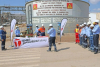
Cadastre minier (CAMI), the state body managing mining rights in the Democratic Republic of Congo (DRC), has reminded holders of mining rights of their regulatory obligations to begin work. In a statement dated August 20, 2025, and signed by its director general, Popol Mabolia Yenga, CAMI issued a warning that failure to comply could result in the revocation of titles.
The document includes a list of 93 titles at risk of cancellation for non-compliance with legal provisions. Of these, 55 are exploration permits and 33 are exploitation licenses. The list features prominent companies, including Tenke Fungurume Mining, cited for two titles covering six mining blocks in Lualaba province, and Cimenterie de Lukala (Cilu), which holds a title for five mining blocks in the Kongo Central province.
CAMI is enforcing articles 387 and 391 of the Mining Regulations, which require holders of mining and quarrying rights to provide proof that work has commenced within prescribed deadlines: one year from the date of issuance for exploration permits, and between one and three years for exploitation licenses, depending on the case.
Failure to comply exposes operators to the forfeiture of their rights, followed by definitive cancellation after an investigation. The Mining Code also stipulates that any holder whose rights have been forfeited is barred from obtaining new mining or quarrying rights for a period of five years.
This warning comes amid an increasingly strict approach to managing the DRC's mining sector. On August 4, 2025, CAMI submitted its cadastral registry cleanup report to the Minister of Mines, which stated that 594 mining and quarrying titles covering 37,253 mining blocks had been freed up for new investors. The report also noted the regularization of 210 rights that had been under a force majeure status, reclassifying them as active and subject once again to their fiscal, social, and technical obligations.
In 2024, the cleanup process led to the cancellation of over 1,000 non-compliant titles, helping CAMI exceed its budget forecasts for the first quarter of that year by 185.05%.
Timothée Manoke (Intern)
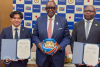
Japanese firm Solafune has signed a definitive agreement with the National Geological Service of Congo (SGNC), the Ministry of Mines announced on August 23, 2025. The deal, signed on the sidelines of the 9th Tokyo International Conference on African Development (TICAD9), was attended by Mines Minister Louis Watum Kabamba.
The document follows a memorandum of understanding reached in July. While details were not disclosed, the ministry said the first phase of the partnership “starts immediately” and introduces a platform combining satellite remote sensing and geospatial technology with artificial intelligence. The aim is to equip Congolese geologists with modern tools to improve knowledge of the national subsoil, about 90% of which remains unexplored.
Minister Watum Kabamba described the technology transfer as “a decisive step” for national technical services, urging the SGNC to fully exploit the tools to expand geological mapping and accelerate the discovery of new deposits.
The agreement comes as mining exploration in DR Congo increasingly turns to advanced technology. U.S.-based KoBold Metals, backed by Jeff Bezos and Bill Gates, is preparing to use satellite data and AI to explore Congolese deposits. The company has applied for a research permit covering 1,600 km² and signed an agreement with the mining cadastre (CAMI) to digitize geological archives preserved at the Royal Museum for Central Africa.
-
Kibali produced 306,667 ounces in H1 2025, below the half-year target of 344,000–377,500 ounces.
-
Production is down 13% year-on-year due to lower ore grades and operational challenges.
-
Strong gold prices boosted revenues despite lower output
The Kibali gold mine in Haut-Uélé province, DRC, produced 306,666.6 ounces (8,693.8 kg) of gold in the first half of 2025. Barrick Mining, the mine’s operator, reported the figure on August 11. This output falls short of the half-year target of 344,000–377,500 ounces and marks a 13% decline compared with 351,111 ounces in the same period of 2024.
AngloGold Ashanti, which holds a 45% stake in the mine alongside Barrick, attributes the decline to lower ore grades. “Operational difficulties have reduced the amount of underground ore available for processing, increasing the use of lower-grade open-pit ore,” the company said. Barrick had previously forecast higher underground grades later in the year, but this has not yet materialized.
Despite the production drop, high gold prices have bolstered revenue. Kibali’s first-half average selling price is forecast at $3,099 per ounce, up from $2,213 a year earlier. The mine generated $702.2 million in sales in 2024, and analysts from Canadian firm Fidelity anticipate gold could reach $4,000 per ounce by year-end, supporting Barrick’s revenue growth even amid lower output.
This article was initially reported in French by Pierre Mukoko
Adapted in English by Ola Schad Akinocho