





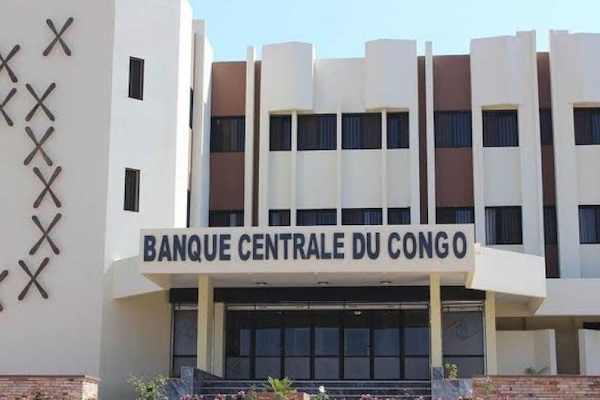
The International Monetary Fund has identified a “significant” weakness in the Democratic Republic of Congo’s special bank resolution framework: to meet international standards, the framework must revise the scope of judicial review of decisions taken by the resolution authority, according to an IMF technical assistance report on the regime’s implementation published in October 2025.
The report notes that “in the recent past,” the Central Bank of the Congo (BCC) has faced court rulings that set invalidates it had adopted and instead applied other statutory provisions considered more favorable to the shareholders of a failing bank.
In 2020, the BCC’s decision to place Banque internationale pour l’Afrique au Congo (BIAC) into liquidation was challenged in court, illustrating potential tensions between the supervisory authority and the judiciary.
The IMF recalls that judicial review must be available before competent courts at the request of parties affected by a resolution decision. However, in line with international standards, the Fund argues that initiating legal proceedings “should not, as a general rule, suspend” the implementation of a resolution authority’s decision, which must be “immediately enforceable.”
Lengthy liquidations
Along the same lines, the report states that the powers of courts “should not extend” to invalidating resolution measures taken by the BCC within its legal mandate and in good faith. For the IMF, this reflects an operational need: allowing the resolution authority to act with the speed and flexibility required to achieve its statutory objectives.
The report situates the issue of judicial review within the broader context of protracted proceedings: in practice, bank liquidations in the DRC “take years,” and the oldest liquidation under way at the time of the IMF’s review had been opened in 1998.
On creditor protection, the IMF recommends incorporating into the legal framework an alternative to the annulment of measures: monetary compensation for creditors who receive less as a result of resolution than they would have received in liquidation, under the so-called no-creditor-worse-off safeguard.
The report warns that invalidating a resolution decision would create serious difficulties because of its retroactive effect, potentially undermining the credibility of the resolution process and posing risks to financial stability. In that context, the IMF recommends introducing legal provisions to prevent court actions from obstructing the implementation of a resolution or leading to the invalidation of measures already applied.
Boaz Kabeya