




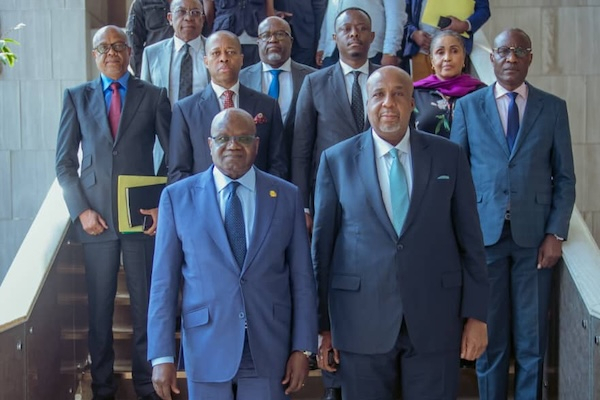
The Democratic Republic of Congo and the Republic of Congo signed an agreement on December 20, 2025, to share up to 30 MW of electricity. The contract was concluded between the Congolese national power utility SNEL SA and Énergie électrique du Congo (E2C SAU) during a ceremony attended by the two countries’ energy ministers, Aimé Sakombi Molendo for the DR Congo and Émile Ouosso for the Republic of Congo.
Until now, the power interconnection between the two countries had operated without a structured contractual framework, limiting effective management of electricity flows and financial reconciliation. The new agreement establishes a formal basis for cooperation, covering power exchanges, billing and settlement, and the development of regional energy integration projects intended to benefit consumers on both sides of the Congo River.
To oversee implementation, the two utilities have set up a joint commission, which will serve as a permanent consultation mechanism between SNEL and E2C.
According to a statement from the Congolese Ministry of Water Resources and Electricity, the agreement concludes three years of negotiations. These talks led to consensus on key technical, commercial, and financial parameters, including the maximum exchange capacity of 30 MW, pricing mechanisms, power quality standards, and operational monitoring arrangements.
Minister Aimé Sakombi Molendo said the establishment of a clear, consensual, and transparent contractual framework marks a decisive step toward more structured and sustainable energy cooperation. His counterpart, Émile Ouosso, highlighted the central role of electricity in supporting industrial and social development in both countries.
The electrical interconnection between the DR Congo and the Republic of Congo dates back to 1982 and is described as one of the earliest examples of energy integration in Central Africa, aligned with the regional power pool. Both countries are also involved in another project, known as the Energy Friendship Loop, which aims to secure electricity supply for Kinshasa, Brazzaville, and Cabinda by linking them to major generation centers, including Inga in the DR Congo and Pointe-Noire in the Republic of Congo.
Ronsard Luabeya