




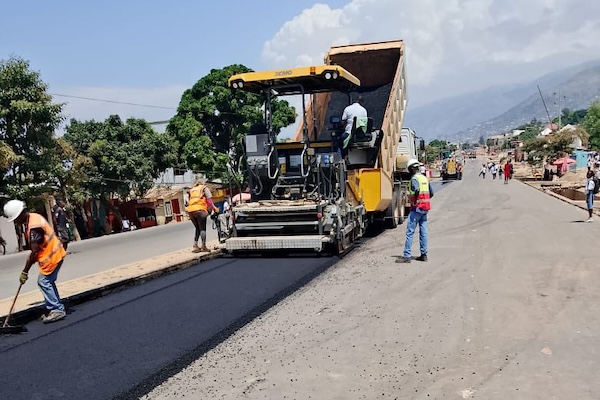
Work has resumed on the urban section of National Highway 5 (RN5) in Uvira, with crews laying the first asphalt layer, DR Congo’s Ministry of Infrastructure and Public Works announced on May 21. The project had been suspended since June 2025.
The works concern a roughly 10-kilometer stretch linking the Kavimvira roundabout to the public port of Kalundu. Contractor EIS-EKA said the project was 40% complete a month before work was halted. At the time, the company cited operational constraints. Local media later reported delays in the delivery of materials and equipment, alongside financial constraints and administrative and land-related hurdles.
Before the suspension, local sources had indicated that EIS-EKA was continuing part of the works with its own funds while awaiting the release of planned financing. Funding arrangements for the project remain unclear. Several sources mention support from the central government, sometimes combined with provincial funding and contributions from oil companies.
The section under construction is a key route to the port of Kalundu and to trade flows with neighboring Burundi. However, it represents only a small portion of the broader RN5 corridor, which stretches more than 1,300 kilometers from Bukavu to Lubumbashi.
On the ground, paving works are still focused on priority sections, particularly in South Kivu. The Bukavu-Nyangezi-Kamanyola section, spanning around 55 kilometers, is among the most advanced projects. That site falls under the Sino-Congolese cooperation program, with SISC SA as the main contractor and Sinohydro 14 as subcontractor.
Upgrading RN5 is considered an economic priority for eastern Congo. The corridor is expected to improve connectivity between Bukavu, Uvira, Baraka, Fizi, Kalemie and, further south, parts of Haut-Katanga province.
The road also provides a domestic alternative to routes that transit neighboring countries, especially for freight moving between South Kivu and the rest of the country. Commercially, the upgrade could reduce transport costs, ease the movement of agricultural goods and strengthen trade between eastern and southeastern provinces.
Boaz Kabeya