




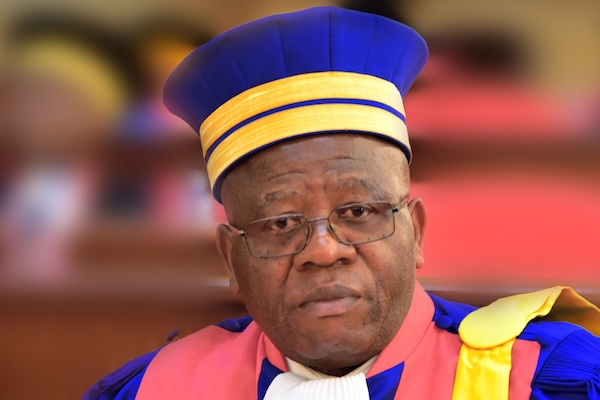
The Democratic Republic of Congo's Court of Auditors is stepping up action against irregularities in public finance management. Its president, Jimmy Munganga Ngwaka, announced the launch of legal proceedings against public accountants involved in undocumented expenditures, a practice he described as one of the main ways public funds are embezzled.
The warning came during a press briefing held on May 13, 2026, in Kinshasa on public accountants’ accountability and oversight of state spending. “This is where the abuse happens; this is where the country is being looted,” Munganga Ngwaka said, pledging to “significantly reduce the level of misconduct” in the financial management of public institutions.
The Court’s president detailed how the public spending process operates in the DRC. Each institution holds a dedicated account at the Central Bank of Congo (BCC), funded through budget execution. Authorizing officers are responsible for approving and validating expenditures, while payments are processed through the Central Bank with the mandatory involvement of public accountants, officials responsible for recording transactions and retaining all supporting documents required under public accounting rules.
The Court of Auditors said it had identified numerous cases of spending carried out without proper documentation, which it considers a serious warning sign. “Multiple cases of expenditure without supporting documents; in such cases, there is a presumption of embezzlement. All public accountants involved will be prosecuted before the Court of Auditors,” Munganga Ngwaka warned.
The move marks a significant shift toward greater scrutiny of the administrative officials involved in processing public expenditures, who have historically faced less attention than political decision-makers. The announcements come as the Court, which Munganga Ngwaka has led since 2022, expands its judicial activities.
A Strategic Roadmap
In its 2024-2025 annual public report, the institution said it intended to make the auditing of public accounts and prosecution of management failures “essential instruments of budgetary and financial discipline.” The financial court argues that these mechanisms are necessary to combat “financial impunity” and strengthen compliance with budgetary law.
The Court of Auditors says inadequate documentation in parts of the public spending system weakens the credibility of budget oversight and facilitates the misappropriation of public funds. It also criticized several practices it considers incompatible with budget discipline, including the abuse of emergency procurement procedures, payments related to uncertified domestic debt, and spending outside approved budget allocations.
The institution warned that these irregularities continue to undermine public governance and financial transparency despite the existence of oversight mechanisms provided for under Congolese law.
The report also highlighted shortfalls recorded by the Directorate General of Customs and Excise (DGDA), the Directorate General of Taxes (DGI), and the Directorate General of Administrative, Judicial, Land and Participation Revenue (DGRAD). Combined, these gaps represent an estimated revenue shortfall of 3,730.3 billion Congolese francs, approximately $1.67 billion at the current exchange rate.
Through this crackdown on undocumented spending, the Court of Auditors is seeking to tighten oversight across the entire public spending process, from the authorization of expenditures to their final payment. The message to public accountants is clear: any transaction lacking adequate documentary evidence may now be treated as presumed embezzlement, exposing those responsible to judicial prosecution.
The move comes as Congolese authorities step up efforts to reform public finances and improve budgetary governance.
Boaz Kabeya