




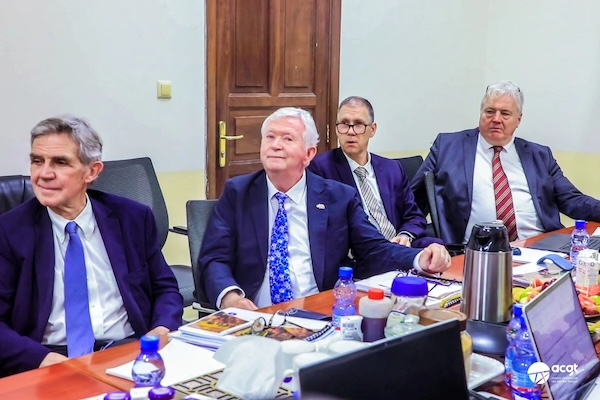
New details have emerged about the structure of the Kinshasa tramway project, which is being developed by a consortium comprising Frateur-De Pourcq, Prume Tramway RDC and PowerChina. Following a meeting held on May 19, 2026 with consortium representatives, the Congolese Agency for Major Works (ACGT) announced that the project would be developed under a public-private partnership (PPP) involving the transfer of two cobalt and copper mines to the Tramways Kinshasa consortium.
According to the same source, the project would be fully financed by PowerChina through a “minerals for infrastructure” mechanism. The ACGT said the project would be carried out “without any impact on the state budget.”
The arrangement echoes the model adopted under a 2008 contract between the Democratic Republic of Congo and a consortium of Chinese companies, under which public infrastructure projects were financed in exchange for mining rights granted to Sicomines. Such mechanisms are intended to address infrastructure gaps in a context where the government’s fiscal capacity remains limited.
At this stage, however, several key details have yet to be disclosed, including the identity of the mines involved, the value of the mining rights, the project’s total cost and the precise legal framework governing the partnership. Those details will be critical in assessing the soundness of the arrangement and determining whether lessons from the 2008 Sino-Congolese agreement have been incorporated into the new project.
Since its signing, the 2008 contract has faced recurring criticism, notably over the opacity surrounding loans, mining and infrastructure investments, and revenues generated by Sicomines, as well as the absence of a competitive tender process and the risk of cost overruns. A technical and financial audit was launched last March to examine the implementation of the deal more closely.
Ambitious timetable
The Kinshasa tramway project calls for the construction of seven main lines totaling 323 kilometers of prefabricated hybrid track. The first phase is expected to include three priority lines: a 32-kilometer Kintambo-Ndolo-Matete-N’djili International Airport route with 32 stations; a 24-kilometer Kintambo-UNIKIN-Matete line with 25 stations; and an underground express line modeled on Line 17 of the Grand Paris Express.
According to the consortium, preliminary studies based on historical maps of the capital identified the need to build 173 bridges between the city center and N’djili International Airport. The consortium nevertheless projects that the first underground express tramway line will enter service on Nov. 27, 2027.
Several steps remain before the project can move forward, including finalizing a binding implementation timetable, coordinating technical studies, securing the financing structure and signing the PPP agreement. In February, during a meeting with Jean-Pierre Van Erps, coordinator of the Tramways de Kinshasa consortium, Infrastructure and Public Works Minister John Banza reaffirmed the government’s intention to accelerate the project’s operational phase and formalize the public-private partnership structure.
The Kinshasa tramway is being presented as a response to the city’s worsening mobility challenges. With an estimated population of more than 17 million inhabitants, Kinshasa is one of Africa’s largest urban agglomerations and suffers from a chronic lack of reliable mass transit infrastructure. Traffic congestion imposes a significant economic cost, weighing on productivity, travel times and commercial activity.
Ronsard Luabeya