





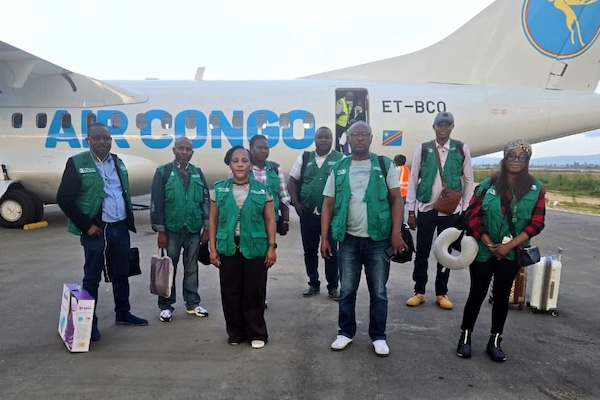
A resurgence of the Ebola virus in eastern Democratic Republic of Congo is raising concerns beyond the health sector, as African health officials warn that new travel restrictions could disrupt trade and fragile regional economies.
As Congolese authorities work to contain the outbreak identified in Ituri province, the Africa Centres for Disease Control and Prevention (Africa CDC), the African Union’s public health agency, has cautioned against broad border and travel measures that could hamper commerce and humanitarian operations across East and Central Africa.
The warning came after the United States raised its travel advisory for the DRC to Level 4, advising against travel to the country and imposing entry restrictions on people who have recently been in the DRC, Uganda or South Sudan.
Washington said the measures were intended to reduce the risk of international spread of the Ebola Bundibugyo strain and announced an initial $13 million in aid to support response operations.
Africa CDC, however, warned that blanket travel restrictions and border closures could have disproportionate economic consequences. In a statement issued on May 19, 2026, the agency said such measures risk disrupting trade flows, complicating humanitarian and health operations, and pushing people toward informal border crossings that are harder to monitor.
“Blanket travel and trade restrictions are not the solution to outbreaks,” the agency said, calling instead for stronger regional coordination and investment in local health systems.
Exposed trade corridors
The outbreak is centered in the health zones of Mongwalu, Bunia, Rwampara and Nyankunde, in a region closely tied to East Africa’s mining and trade networks. Cases have also been reported in Butembo and Goma, two cities that serve as key hubs for regional commerce.
The situation has heightened fears of disruption along several economic corridors linking the DRC to Uganda, Rwanda and South Sudan. In that part of Africa, cross-border movements of traders, transport operators, workers and humanitarian personnel are vital to supplying local markets and sustaining border economies.
Africa CDC warned that disorderly border closures could further weaken a region already strained by armed conflict, population displacement and heavy dependence on informal economic activity.
Instead, the agency called for an intensified response focused on epidemiological surveillance, contact tracing, laboratory capacity, cross-border coordination and logistical support for health teams.
A familiar crisis
The Congolese government says it has the experience needed to contain the outbreak. Health Minister Samuel Roger Kamba noted that the DRC is confronting its 17th Ebola epidemic and that Congolese teams have already taken part in response operations in several African countries.
Congolese health authorities also said the Bundibugyo strain, previously recorded in the DRC in 2012, is generally considered less lethal than the Ebola Zaire strain. They nonetheless reported more than 500 suspected cases and over 130 deaths, figures that are still being verified.
Beyond the immediate crisis, Africa CDC highlighted what it described as a longstanding weakness in global health research. Nearly two decades after the Bundibugyo strain was first identified, no widely available licensed vaccine or specific treatment exists.
The agency said the gap reflects persistent inequalities in global investment in diseases that primarily affect African countries.
For the DRC, the challenge now is to prevent a localized health emergency from turning into a broader regional economic shock in an area where cross-border trade remains critical to commercial activity and the supply of goods to local populations.
Boaz Kabeya