




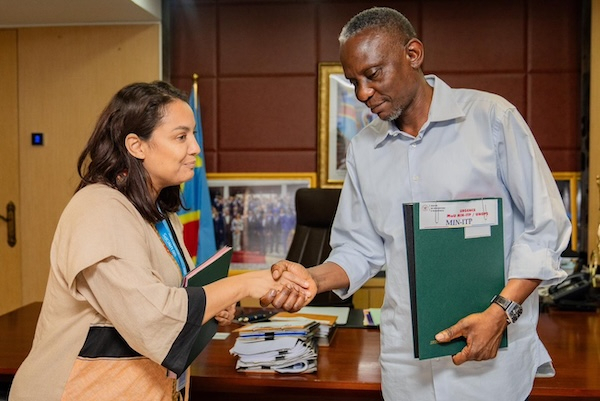
The Democratic Republic of Congo and the United Nations Office for Project Services (UNOPS) have advanced their partnership. On Feb. 18, 2026, in Kinshasa, the Ministry of Infrastructure and Public Works (ITP) and UNOPS signed a memorandum of understanding (MOU).
The document was signed by ITP Minister John Banza and UNOPS Country Director for the DRC Mouna El-Jaouhari. Presented as a key step in the country’s infrastructure reconstruction, the memorandum aims to transform the country’s infrastructure while strengthening local capacities.
The agreement is structured around four main components. The first covers infrastructure development and rehabilitation, including the construction of new facilities and the restoration of existing infrastructure nationwide. The second focuses on skills transfer, notably strengthening the capacity of Congolese institutions and improving construction standards and methods. The third promotes strategic cooperation, positioning infrastructure as a driver of economic growth. The fourth addresses social impact and progress toward the Sustainable Development Goals (SDGs), through improved connectivity, poverty reduction and better access to basic services, particularly via road projects.
The MOU is described as a flexible framework agreement, with monitoring mechanisms designed to allow adjustments and reinforce cooperation as implementation advances. It does not specify priority projects, funding amounts or a timeline. Instead, it establishes a strategic framework to be implemented through project-specific agreements.
UNOPS specializes in project implementation. It supports states, U.N. agencies, donors and other partners by providing project management, procurement and infrastructure services, operating under a self-financing model based on fees charged to projects. The organization has been active in the DRC for several years. According to its public data, UNOPS carried out more than 53 projects in the country in 2024, with a total value of about $61.2 million and 26 partners. Its portfolio includes transport infrastructure, health, water, vocational training and stabilization programs in the east.
The agency says it has contributed to the construction or rehabilitation of 132 health centers, 27 vaccine depots and 16 regional drug distribution centers. It also reports water infrastructure projects benefiting 45,000 people in rural areas, as well as road rehabilitation and bridge construction operations.
By formalizing their cooperation through this agreement, Kinshasa and UNOPS are placing these activities within a structured framework under the ITP ministry. The key challenge now is to turn this partnership into funded, planned and implemented projects.
Boaz Kabeya