




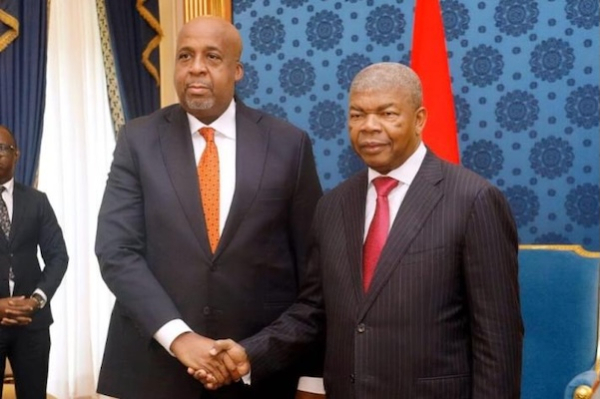
The Democratic Republic of Congo is looking to import electricity from neighbouring Angola as it waits for progress on the long-delayed Inga 3 hydropower project. On May 14, 2026, Congolese Water Resources and Electricity Minister Aimé Sakombi Molendo travelled to Luanda for talks with Angolan President João Lourenço on a proposed electricity interconnection between the two countries.
According to Angola’s state news agency ANGOP, Kinshasa and Luanda are considering the construction of two high-voltage transmission lines. The first would run from Malanje in Angola to Fungurume in Lualaba province, at the centre of the DRC’s copper belt. The second would connect Soyo, in Angola’s Zaire province, to the Inga site in western Congo, with capacity to supply up to 2,000 megawatts to Congolese consumers.
The project, estimated to cost several hundred million dollars, will require extensive technical and feasibility studies before construction can begin. Sakombi Molendo said that once the report is submitted to President Félix Tshisekedi, authorities intend to fast-track the studies, with the aim of completing the Soyo-Inga line and launching the Malanje-Dilolo-Fungurume corridor within 18 months.
A Chronic Power Shortage
The DRC’s interest in Angolan electricity reflects a long-standing domestic power deficit. Despite possessing one of Africa’s largest hydroelectric potential reserves, the country continues to struggle to meet demand, particularly in its mining regions.
The south-east, which produces most of the country’s copper and cobalt, is facing rapidly rising electricity demand as mining activity expands. According to figures from the Congolese Ministry of Mines, the electricity shortfall for mining operators alone exceeds 1,500 MW.
The proposed imports from Angola are therefore being presented as a temporary solution while authorities continue efforts to advance the governance framework for the planned Inga 3 dam project, which remains years away from completion. In the meantime, imported electricity could provide faster relief for households, businesses and mining operations, the minister said.
Expanding Regional Energy Projects
The latest initiative adds to a growing list of projects already announced along the Angola-DRC energy corridor.
In July 2024, commodity trader Trafigura and ProMarks signed a memorandum of understanding with the Angolan government to study the technical and economic viability of a regional electricity transmission project under a public-private partnership model.
Moroccan construction group Somagec has also been associated with plans for a high-voltage line linking Angola and the DRC, in a project estimated at around $1.3 billion.
In October 2025, U.S. company Hydro-Link finalised preliminary agreements for a 1,150-kilometre transmission line aimed at supplying 1.2 gigawatts of Angolan electricity to mining areas in south-eastern Congo. The project is estimated to cost about $1.5 billion.
Regional Ambitions
Beyond bilateral cooperation, the projects reflect wider strategic ambitions on both sides of the border.
For the DRC, the priority is securing reliable electricity supplies for its mining sector and reducing a major constraint on local mineral processing and industrial development. For Angola, the projects offer a chance to monetise surplus hydropower production and strengthen its position as a regional energy exporter.
According to the African Development Bank, Angola’s exportable clean hydropower capacity could reach 3.5 GW by 2027.
Questions remain over how the various projects would be coordinated, including their financing structures, implementation schedules, and the respective roles of Congo’s state utility SNEL, Angolan authorities and private-sector partners.
For now, however, the Luanda discussions confirm a broader trend: long before Inga 3 becomes operational, the DRC is already looking beyond its borders to address its immediate electricity needs.
Pierre Mukoko