





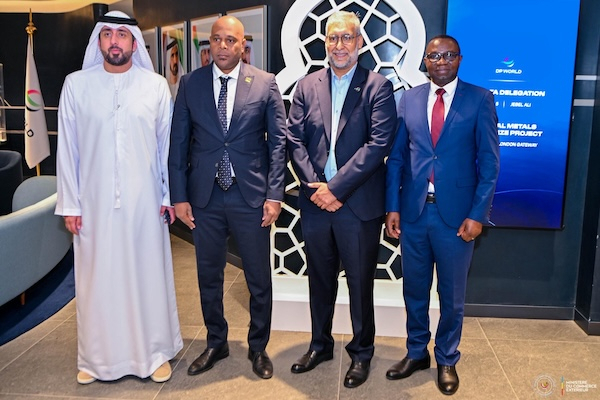
The Democratic Republic of Congo, Zambia, Mozambique, Zimbabwe and Botswana are developing a financing model for the construction of one-stop border posts. On Feb. 18, 2026, trade ministers from the five countries reviewed the project with officials from DP World and the secretary-general of the African Continental Free Trade Area (AfCFTA) during a meeting in Dubai.
According to a statement from the Congolese Ministry of Foreign Trade, the initiative aims to cut waiting times and ease cross-border transit, two factors that directly affect logistics costs and the competitiveness of goods in the region. The one-stop border post model is based on coordinated controls and harmonized procedures, eliminating duplication between neighboring countries and speeding up trade flows.
The project prioritizes full digitization of procedures, with reduced manual intervention, improved traceability and faster data processing. The objective is to improve the predictability of transit times while reducing administrative bottlenecks and the costs faced by businesses.
The participation of DP World and the AfCFTA secretariat signals a shift toward implementation. Discussions moved beyond general commitments to focus on a structure compatible with public-private partnerships (PPPs). Under this model, a logistics operator would manage project engineering, including design, equipment, digital systems and logistics integration, while customs, immigration and security functions would remain under state authority.
The delegations agreed to adopt a financial model developed by a joint team of experts tasked with the assignment. They set a 15-day deadline to finalize the financing framework, project timeline and country-specific administrative procedures within the PPP framework.
The initiative forms part of the operational rollout of AfCFTA instruments and broader regional integration efforts in southern Africa. In that context, the DRC and Zambia signed an agreement in December 2025 to modernize and build border infrastructure. The deal includes the development of facilities at Kasumbalesa, Kambimba, Kipushi and Mokambo, as well as other entry points to be identified later by mutual agreement.
The two countries have yet to define the technical, financial and operational arrangements needed to make the one-stop border posts fully operational, in line with regional coordination requirements.
Ronsard Luabeya