




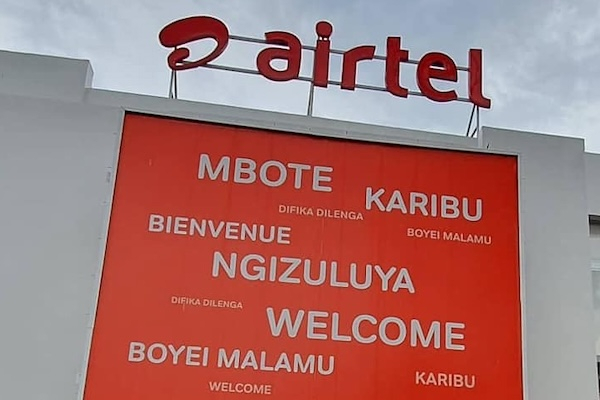
Airtel Africa said on Tuesday it signed a new partnership with SpaceX to roll out Starlink Direct-to-Cell technology, enabling satellite-to-smartphone connectivity across its 14 African markets, including the Democratic Republic of Congo (DRC).
The deal builds on an initial collaboration announced last May, which allowed Airtel to distribute Starlink’s high-speed satellite internet through conventional ground terminals. Taken together, the two agreements cover both fixed satellite broadband and direct satellite-to-mobile connectivity.
Under the new arrangement, Airtel subscribers using compatible smartphones will be able to access satellite connectivity in areas without terrestrial network coverage. The service will rely on the Starlink satellite constellation, the largest in the world by 4G geographic coverage. The agreement also includes the deployment of a new generation of satellites capable of delivering speeds up to 20 times faster than current systems.
The service is scheduled to launch in 2026, initially offering text messaging and selected data services. Its rollout will be subject to regulatory approvals in each country.
In the DRC, conditions are already favourable for the introduction of Starlink services. Since May 2025, SpaceX’s local subsidiary has been authorised to operate in the country after receiving an operating licence from the Congolese Post and Telecommunications Regulatory Authority (ARPTC). The licence allows Starlink DRC S.A. to provide satellite internet services in the local market.
With these partnerships, Airtel Africa becomes the first operator on the continent to offer both Starlink access via terminals and direct satellite-to-mobile connectivity. In the DRC, where large parts of the territory remain outside terrestrial network coverage, this dual capability gives Airtel a significant operational advantage in extending connectivity to remote areas and strengthening its service offering. The move is expected to reinforce its position in the strategic mobile internet segment.
According to the ARPTC Observatory, mobile internet generated $594 million in revenue by the end of June 2025, accounting for nearly 52.7% of total sector revenue. In the second quarter, the number of active users reached 34.5 million, corresponding to a penetration rate of 30.79%, up 0.81 percentage points. Data consumption rose by 26.91% compared with the first quarter of 2025.
Financially, Airtel leads the market with a 41.6% revenue share, ahead of Orange at 29.5%, Vodacom at 24.7% and Africell at 4.1%. By subscriber share, the market is more fragmented: Vodacom leads with 36.4%, followed by Airtel at 30.8%, Orange at 29.8% and Africell at 3%.
Boaz Kabeya