




The expiration of the Fina Log concession on Dec. 31, 2025, has reshaped the oil logistics chain between Matadi and Kinshasa by bringing in a new state entity. This corridor is the main transit route for fuel consumed in the western region of the Democratic Republic of Congo (DRC) and accounts for about 80% of fuel bound for the Central African Republic.
The National Petroleum Infrastructure Management Company (ENGIP) was established in January 2026 to manage the corridor’s operations. The public company took over Fina Log’s assets, including pipelines, pumping stations and depots, which returned to the Congolese state at no cost.
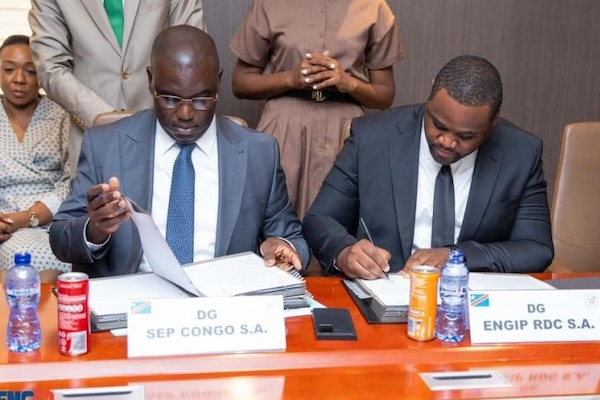
On April 7, 2026, the new state enterprise signed operating agreements covering these assets with SEP Congo, the long-standing operator of the Matadi-Kinshasa logistics chain.
“These agreements do not affect the price structure in any way. On the contrary, they could help reduce logistics costs and strengthen price stability,” ENGIP Director General Richard Beya Ilunga said, according to remarks reported by Actualite.cd.
The official fuel pricing structure for the western zone, set in December 2025, highlights the impact of logistics on final consumer prices. For gasoline, distribution costs amount to 724.03 Congolese francs (FC) per liter, compared with a pump price of 2,440 FC, nearly 30% of the final price.
For kerosene, these costs reach 516.06 FC per liter, or about 24% of a pump price of 2,130 FC. Diesel logistics costs stand at 688.78 FC per liter for a pump price of 2,430 FC, representing 28.3% of the final price. SEP Congo alone accounts for 192.79 FC per liter, about 8% to 9% of the final price and more than a quarter of total logistics costs.
Unanswered questions
According to the pricing structure, logistics is the second-largest cost component after international procurement. Lower logistics costs could therefore support price stability, a critical factor as conflict in the Middle East fuels uncertainty over global oil prices.
However, it remains difficult to assess the expected cost reductions, as the details of the contracts between ENGIP and SEP Congo have not been made public.
“These agreements will allow us to operate in a stable environment, with the objective of delivering positive outcomes for our company, government ministries and, above all, citizens,” SEP Congo Director General Malick Ndiaye said. Ndiaye, cited by Actualite.cd, added that negotiations lasted several months but provided no further details.
One point is clear: the state, through ENGIP, now owns 100% of the assets along the Matadi-Kinshasa corridor, compared with 40% before the end of the Fina Log concession. This gives the government greater room to influence logistics costs.
The state must nevertheless balance this with the need to ensure service continuity, which requires maintaining and expanding infrastructure. This also involves mobilising resources, particularly for new investments. For now, ENGIP has not outlined how it plans to address these competing challenges.
Pierre Mukoko & Ronsard Luabeya