




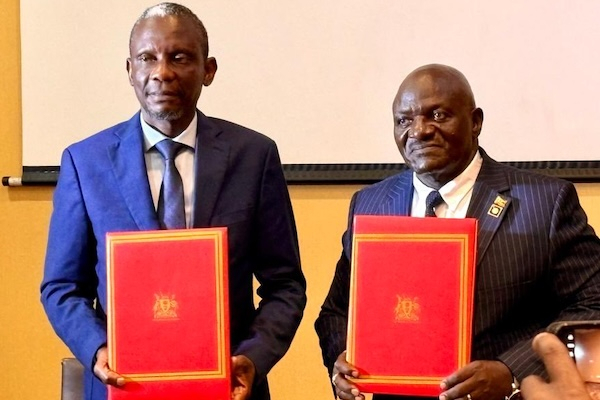
The Democratic Republic of Congo (DRC) and Uganda plan to accelerate the modernization of their cross-border road corridor. According to a statement issued by the Congolese Ministry of Infrastructure and Public Works on March 5, 2026, Congolese Minister John Banza Lunda and his Ugandan counterpart Katumba Wamala agreed to begin paving the first 15 kilometers of the 80-km Kasindi–Beni road.
The statement said both sides decided to remove administrative and technical bottlenecks that had slowed the project. The Congolese and Ugandan governments, together with contractor Dott Services Ltd, committed to accelerating construction.
The announcement follows the timeline presented in July 2025, which projected paving works on the Kasindi-Beni (80 km) and Beni-Butembo (54 km) roads in the first quarter of 2026.
The Congolese minister of infrastructure had previously acknowledged several challenges delaying the project while reaffirming the commitment of stakeholders to overcome them and meet the agreed timetable. In December 2025, John Banza Lunda visited the Beni-Kasindi section to assess progress. During the visit, he noted the installation and commissioning of several crushing units intended to supply construction materials for the works.
Preparatory work has also widened and secured the existing road, reducing travel time between Beni and Kasindi to about one and a half hours, according to project information.
The project is part of a broader cross-border road program officially launched in June 2021 by the presidents of the DRC and Uganda. It covers three sections: Kasindi-Beni (80 km), Beni-Butembo (54 km), and Bunagana-Rutshuru-Goma (89 km), for a total of 223 kilometers.
The total cost is estimated at $551.6 million. Under the financing structure, Dott Services Ltd covers 60% of the funding, while the Congolese and Ugandan governments each contribute 20%.
Investments will be repaid through a toll system, with reduced rates due to the participation of the two governments. According to previously published project information, the concession is expected to last at least 15 years, while the initial construction phase was planned over three years. The project has both economic and security implications. It aims to improve connectivity between the DRC and Uganda, facilitate trade flows, and support stabilization efforts in eastern Congo.
Ronsard Luabeya