




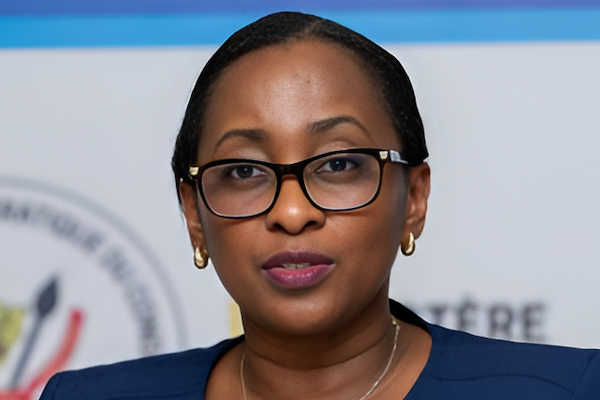
As the Democratic Republic of Congo steps up efforts to strengthen the credibility of its financial system and accelerate its digital transformation, compliance, anti-money laundering, cybersecurity and financial inclusion have become key priorities. On the sidelines of a financial compliance workshop in Kinshasa, Marie-Gabrielle Opese, President of the Congolese Banking Association (ACB) and Managing Director of Standard Bank DRC, discusses with Ecofin Agency the progress made by the country's banking sector, the challenges involved in securing its removal from the FATF grey list, and how the rapid digitization of financial services is reshaping the industry.
Ecofin Agency: Kinshasa recently hosted a workshop on financial compliance, gathering regulators, banks and international players around a shared goal of repositioning compliance as a strategic lever for Congo's financial sector. What are your main takeaways from this workshop, and what impact could it have on the banking sector in the DRC?
Marie-Gabrielle Opese: The workshop was first and foremost an opportunity to reaffirm that compliance can no longer be seen as a simple regulatory burden. It is now a genuine strategic lever for the stability, credibility and modernization of the financial sector. The discussions highlighted several realities: the rapid evolution of risks, the growing sophistication of fraud, the rise of digital payments and the constant need to adapt our control and risk management frameworks.
The progress recorded today allows us to look forward with confidence to a favorable outcome in the near future. But beyond exiting the gray list, the real challenge is to embed these gains durably in the practices and governance of the financial sector.
More than anything, the initiative strengthened dialogue between banks, the regulator, international partners and other players in the financial ecosystem. That is essential, because the challenges we face today cannot be addressed in isolation. Beyond the technical aspects, the meeting also helped deepen a culture of compliance within Congo's banking sector and encouraged a gradual convergence toward international best practices.
Ecofin Agency: The DRC has been on the FATF gray list since 2022. What impact has this had on the country's banking sector, and what developments give you confidence that the DRC could be removed from the list in the near future?
Marie-Gabrielle Opese: The gray-list designation has had significant consequences, particularly in terms of country risk perception, compliance costs, heightened scrutiny from correspondent banks and, at times, slower international financial relationships.
That said, it is important to highlight the significant efforts made in recent years by the Congolese authorities, the Central Bank of Congo, CENAREF and the financial institutions as a whole. Major reforms have been undertaken, both on the regulatory and operational fronts, with a gradual strengthening of frameworks to combat money laundering and the financing of terrorism.
The progress recorded today allows us to look forward with confidence to a favorable outcome in the near future. But beyond exiting the gray list, the real challenge is to embed these gains durably in the practices and governance of the financial sector.
Ecofin Agency: According to Visa, an economy less dependent on cash would facilitate compliance and financial traceability. In a country where cash remains dominant, how far can banks support this transition without excluding part of the population?
Marie-Gabrielle Opese: Reducing reliance on cash is an important step toward improving the traceability of financial flows, strengthening oversight and expanding financial inclusion.
That said, the transition must be gradual and tailored to the realities of the Congolese market. The key challenge is to strike the right balance between increasing the share of transactions conducted through formal channels and ensuring that people who still depend heavily on cash are not left behind.
Achieving that will require further investment in payment infrastructure, stronger financial literacy efforts, broader access to banking and digital financial services, and close cooperation among banks, regulators and technology providers.
Ecofin Agency: In that context, the Monetary Policy Committee of the Central Bank of Congo decided on April 9 to grant the central bank exclusive authority to import foreign-currency banknotes and to prohibit cash transactions in foreign currencies from April 9, 2027. What impact do you expect these measures to have on the banking sector, and what challenges do banks face as they prepare for the transition?
Marie-Gabrielle Opese: This reform is a major development for DR Congo's financial ecosystem and reflects a determination to strengthen the formalization of financial flows as well as the effectiveness of monetary policy and control mechanisms.
Achieving that transition will require further investment in payment infrastructure, stronger financial literacy efforts, broader access to banking and digital financial services, and close cooperation among banks, regulators and technology providers.
Its implementation naturally raises several challenges, particularly around adapting payment habits, the availability of digital infrastructure, raising awareness among economic actors and the operational management of financial flows. Banks are gradually preparing for this transition, notably by strengthening electronic payment solutions, improving compliance frameworks and supporting customers in adopting new practices. The success of the reform will depend on a gradual and well-coordinated implementation process that allows businesses and consumers enough time to adapt.
Ecofin Agency: The growth of digital financial services is creating new challenges, including cyber fraud, money mule schemes and crypto-related risks. To what extent are these issues already affecting the Congolese market, and how are banks responding?
Marie-Gabrielle Opese: These risks are already becoming more visible in the Congolese market, and banks are having to adapt to an increasingly complex threat environment. As financial services become more digital, fraud schemes are also becoming more sophisticated, ranging from money mule networks and social engineering attacks to account takeovers and crypto-related risks.
Strengthening the sector's resilience will require continued investment in security systems, regular staff training, information sharing, cyber-resilience testing and closer collaboration between financial institutions, regulators and other stakeholders
In response, banks are stepping up investment in transaction monitoring, fraud detection and cybersecurity, while also increasing awareness efforts for both customers and employees. Addressing these threats will require even closer cooperation between banks, regulators and technology providers to strengthen the resilience of the financial system.
Ecofin Agency: Digitalization also exposes DR Congo's financial system to cyberattacks. At an international conference on crypto-assets and digital innovation organized by the Central Bank of West African States, the governor of the Central Bank of Congo said the country's financial sector was not sufficiently prepared for the new generation of AI-facilitated cyberattacks. Is this a concern shared by the ACB? What needs to be done to strengthen the sector's defenses against these risks?
Marie-Gabrielle Opese: Cybersecurity has become a top priority for the financial sector, and the concerns raised by the governor reflect a challenge that financial institutions around the world are facing. As artificial intelligence becomes more widely available, cyber threats are becoming increasingly sophisticated and difficult to detect. As a result, cybersecurity can no longer be viewed solely as an IT issue. It has become a core business and governance priority that requires attention at every level of an organization.
Strengthening the sector's resilience will require continued investment in security systems, regular staff training, information sharing, cyber-resilience testing and closer collaboration between financial institutions, regulators and other stakeholders. Ultimately, the objective is not only to respond effectively to cyberattacks, but also to identify and prevent emerging threats before they materialize.
Interview by Ecofin Agency