




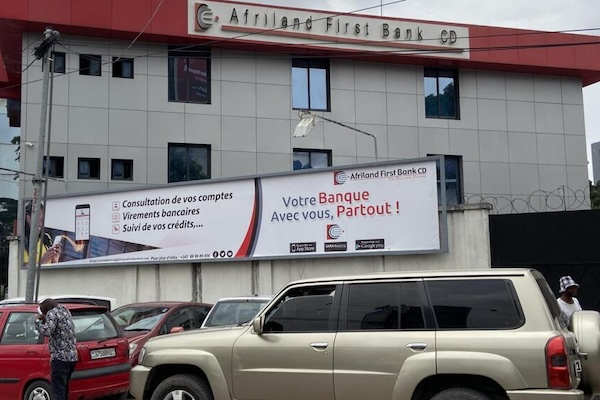
Protests by health workers in Gbadolite over unpaid wages and bonuses have drawn attention to the worsening financial situation at Afriland First Bank DRC, which has been under provisional administration since June 20, 2022.
Data from the Central Bank of the Congo (BCC) for December 2025 shows a sharp deterioration in the bank’s financial position. Afriland reported a negative net banking income (NBI) of $4.68 million, while the country’s banking sector generated $2.241 billion in positive NBI.
NBI reflects the core revenue generated by banking activity and is equivalent to turnover. It includes interest margins on loans, commissions and trading income.
“When it turns negative, it means the bank’s core activity no longer generates income,” a banker said.
In practice, the bank’s financial costs, mainly interest expenses on deposits, now exceed the revenue generated from lending and financial services.
At the end of 2025, Afriland held $124.9 million in customer deposits and $175 million in gross loans. However, a large share of these loans no longer produces income. Loans to private companies account for 70% of the portfolio, but performing loans total only $37.8 million, or 21.6% of outstanding credit.
As a result, the bank has set aside $131.9 million in provisions for non-performing loans.
Rising recapitalization needs
Afriland is also losing market share in payments to public sector employees, reducing commission income and further weakening NBI.
In 2025, the bank was accused of delays and irregularities in public salary payments. It subsequently lost the contract for paying teachers and school operating expenses in five regions to other financial institutions. The lost portfolio covered 29,513 employees, 2,039 schools and a monthly payment volume of about 12 billion Congolese francs.
Afriland ended 2025 with losses of $50.4 million and negative equity of $116.9 million. This situation significantly increases recapitalization needs. Banks operating in the Democratic Republic of Congo have been required to maintain a minimum capital of $50 million since January 2025.
As early as March 2022, the BCC estimated Afriland’s recapitalization needs at $90 million. The estimate was challenged by the majority shareholder, Afriland First Group (AFG), controlled by Cameroonian businessman Paul Kammogne Fokam. The group, which said it held 95.6% of the bank’s capital, argued the assessment was conducted while the bank was already under reinforced BCC supervision.
The central bank deployed a close monitoring team in August 2021 after a governance crisis triggered by the board chairman’s suspension of the chief executive. Before the crisis, the bank’s equity was $48.05 million.
AFG conditioned any recapitalization on a contradictory audit, a request the BCC reportedly rejected before placing Afriland First Bank RDC under provisional administration in June 2022. A seven-member team led by Mudiay Mpinga was appointed to manage the bank. Its mandate was to coordinate with stakeholders, resolve the crisis and prepare a recovery plan within 180 days.
Risk of AFG losing its stake
On Dec. 27, 2022, one week after the end of the first mandate, a new law governing credit institutions was enacted. On Jan. 20, 2023, the same team was reappointed with a new mandate, placing Afriland under a resolution regime.
Under Congolese law, resolution is the final stage of banking supervision. It applies when a bank’s financial condition threatens its solvency and the interests of depositors and creditors.
The mechanism allows authorities to restructure failing institutions quickly. However, by the end of 2025, the two key objectives, restoring profitability and solvency, had still not been achieved. Financial indicators suggest the bank’s situation has deteriorated since the crisis began in July 2021.
The law grants broad powers to the resolution commissioner, who can replace corporate bodies such as the general assembly, the board of directors and executive management. The commissioner may also decide on capital restructuring or asset sales.
Given the bank’s financial position, the risk that the historical majority shareholder could lose its stake appears high.
AFG has acknowledged the severity of the situation. In a statement issued on Feb. 12, 2026, following the protests by health workers in Gbadolite, the holding company said it had been “ousted” from the capital of Afriland First Bank RDC by the Congolese state and its central bank.
According to the group, arbitration proceedings have been filed with the International Centre for Settlement of Investment Disputes (ICSID) to challenge what it described as an “expropriation” and seek compensation.
Pierre Mukoko