




The Democratic Republic of Congo, Tanzania and Burundi are advancing a proposed electrified standard-gauge railway linking Uvinza, Musongati, Gitega, Bujumbura, Uvira and Kindu.
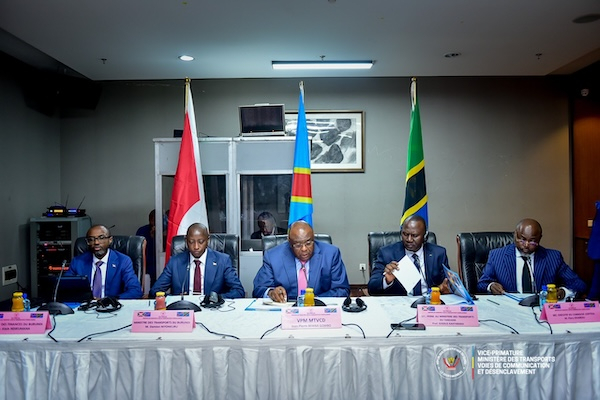
On March 31, 2026, the three countries’ transport ministers met in Kinshasa to review progress on feasibility work for the corridor, which spans more than 800 km, according to the Congolese Ministry of Transport. The meeting was chaired by Deputy Prime Minister and Transport Minister Jean-Pierre Bemba.
The project is being developed under the Central Corridor framework by the Central Corridor Transit Transport Facilitation Agency (CCTTFA), which has coordinated studies and the institutional framework of the regional rail corridor for several years. In March 2023, the agency announced the signing of a feasibility study and preliminary design contract for the Gitega-Bujumbura-Uvira-Kindu segment, awarded to a consortium of CPCS and Zutari on behalf of Burundi and the DRC.
The corridor is expected to reduce transport costs, facilitate the movement of people and goods, and better integrate landlocked countries in the Great Lakes region with the port of Dar es Salaam. It is also seen as supporting the energy transition, as electrified rail produces fewer greenhouse gas emissions than road transport.
Technical progress on the Burundi-DRC segment
On the Burundi-DRC segment, technical studies reached a milestone in November 2025 in Kindu, where six reports were presented to the steering committee. The documents covered traffic demand, railway operations, signalling, telecommunications and energy systems. The studies also defined a preliminary alignment for the Congolese section, running from Nyamoma through Sange, Luberizi, Nyangezi, Walungu, Mwenga, Kamituga, Kalole and Pangi before reaching Kindu. Extensions toward Uvira, Bukavu and Shabunda are also under consideration.
The final cost of the Congolese and Burundian segments has yet to be determined and will depend on ongoing studies. The Uvinza-Musongati section, on the Tanzanian and Burundian side, is further advanced, with several sources estimating costs at around $2.15 billion and pointing to expected support from the African Development Bank. Estimates nonetheless vary on key technical parameters, including the exact length of the segment and the construction timeline.
The project is progressing in phases. The Tanzania-Burundi segment is further advanced, while the Burundi-DRC section remains at the feasibility stage. The Kinshasa meeting reaffirmed the three countries’ commitment to move the project forward, which they see as a key regional connectivity project.
Ronsard Luabeya