





DR Congo's Finance Minister Doudou Fwamba has given Valornet, a subsidiary of South African group Syntell, 72 hours to transfer control of the national vehicle identification platform (INV) to the state. The ultimatum was contained in a letter dated May 25, 2026, revealed by Africa Intelligence.
Should the company fail to comply, the minister said he reserves the right to take measures to protect the state's interests. Options mentioned include suspending payments owed to the company, opening proceedings for embezzlement of public funds and breach of trust, and seeking reimbursement of certain fees already collected.
As the deadline passed, Bankable was unable to confirm whether Valornet had complied with the government's demand.
The company maintains that its contract with the Congolese state expressly stipulates that software and source code developed under the project remain the property of the service provider. The government contests that interpretation, citing digital sovereignty and national security concerns to justify its bid to regain control of the infrastructure.
The INV platform now centralizes the entire vehicle registration process in the Democratic Republic of Congo. It stores data on vehicles and their owners, as well as payment systems and revenue-sharing mechanisms among the various parties involved in the registration process. These elements are considered essential to the government's planned rollout of automated camera-based traffic enforcement.
A project launched in 2016
The dispute has its roots in August 2016, when the Congolese government signed a partnership agreement with South African company Syntell to modernize traffic management in Kinshasa.
The project called for the installation of traffic lights, cameras and radar systems at 36 intersections in the capital to ease traffic flow and improve road safety. Authorities also sought to increase traffic-related revenue by digitizing the processing of traffic violations and fines.
Before any equipment was deployed, Syntell was required to build a national database covering all vehicles and their owners. That step was considered indispensable for identifying motorists and enabling the future automation of traffic violation processing.
The overall cost of the project was estimated at $10 million, to be entirely pre-financed by the South African company, which planned to recoup its investment through revenue generated by traffic fines.
Years after its launch, however, the project was never fully implemented. Because the automated fines system never generated revenue, the executing company Valornet was instead paid for each pair of license plates sold.
The partnership with Syntell was nonetheless extended in 2021 for a period of five years. According to Africa Intelligence, the Finance Ministry is now refusing a further extension of the contract, which expires in August 2026. The state clearly intends to take back ownership of the project.
Change of supplier
The government's investment plan also includes the acquisition of a road surveillance and license plate recognition system, at an estimated total cost of nearly $2 million, spread across 2026 and 2027.
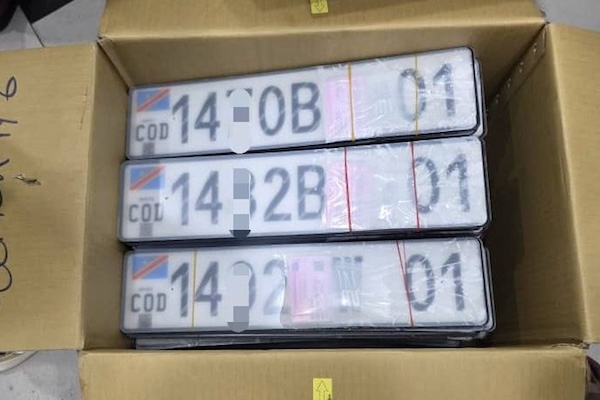
The government has also changed its license plate supplier. A contract previously held by Utsch Congo was awarded in July 2025 to Castillo Valere. The Belgian company is responsible for manufacturing and supplying the new license plates.
The new plates incorporate a QR code presented as a security and traceability feature. The innovation is intended to enable more reliable vehicle identification, a condition considered essential for the deployment of automated camera surveillance systems.
That change also appears to have affected the contractual relationship between the state and Syntell. According to Africa Intelligence, since November 2025, Valornet's fee, previously set at $20 per pair of plates sold, has been cut in half. The amounts deducted are now redistributed to a committee responsible for overseeing the execution of the contract with Castillo Valere.
Beyond the commercial dispute, the case highlights a broader issue: the state's dependence on digital infrastructure developed by private contractors. In the context of automated traffic enforcement, control over software, source code and vehicle registration data has become a central issue for public service continuity, digital sovereignty and government revenue collection.
Timothée Manoke