




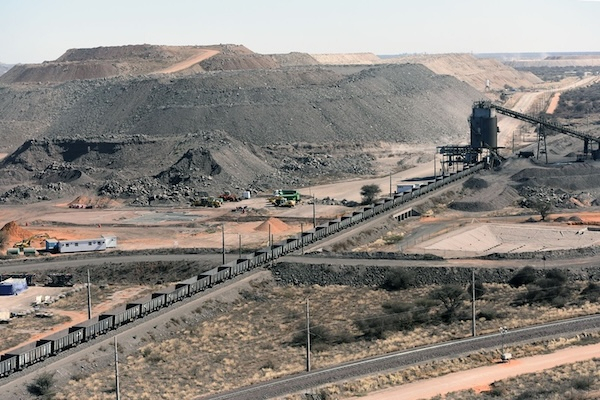
Power requirements for Asia Minerals Limited’s manganese project in Luozi, Kongo Central province, are projected to exceed 300 megawatts (MW), company officials said on November 26 at the Makutano Forum.
Fely Samuna, managing director of Kerith Resources, the Congolese partner of the Japanese multinational, said the total demand would comprise around 120 MW for mining operations and nearly 200 MW for in-country processing, in line with the government’s push to boost value addition and local employment.
Demand is not expected before just over three years. “Exploration will take three years, and mine development will start after that,” Samuna said, asking whether the country would be able to meet the project’s power needs.
Aimé Molendo Sakombi, Minister of Hydraulic Resources and Electricity, said the project area includes hydroelectric sites capable of supplying the operations, notably the Mpioka site on the Inkisi River. Jean-Pierre Mukadi Kalombo, coordinator of the Energy Ministry’s Project Coordination and Management Unit, said Mpioka has an estimated capacity of about 6,000 MW.
He said the site could help supply Kinshasa, including as the city expands, as well as meet rising demand from the mining sector. Feasibility studies are scheduled to begin next year to provide the government with the technical data required for the next phase of the project.
Samuna also questioned the competitiveness of electricity tariffs in the Democratic Republic of Congo. He noted that the group’s Malaysian smelter, Pertama Ferroalloys, commissioned in 2016, operates under a power purchase agreement at roughly $0.04 per kilowatt-hour. He asked whether lower tariffs could be offered in the DRC to ensure the competitiveness of local operations and encourage on-site processing.
Bob Mabiala Mvumbi, managing director of the Agency for the Development and Promotion of the Grand Inga Project (ADPI), said discussions on a future PPA were possible. “You will set a price and we will discuss it,” he said, adding that ADPI is working to secure firm demand for Inga 3, whose installed capacity is projected at between 3,000 MW and 11,000 MW.
However, the economics remain challenging. The National Electricity Company (SNEL) says the average tariff of $0.17 per kilowatt-hour is below cost and is seeking an increase. By comparison, mini-grid operators charge between $0.25 and $0.70 per kilowatt-hour.
Timothée Manoke