




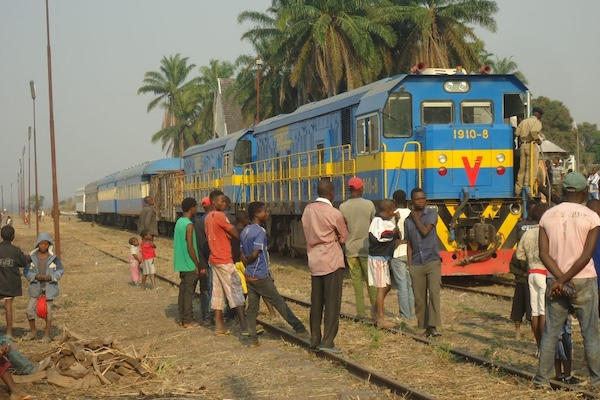
The U.S. International Development Finance Corporation (DFC) said in a statement dated December 5, 2025, that it had issued a Letter of Intent to Mota-Engil, signaling its readiness to help finance the rehabilitation and operation of the Dilolo-Sakania railway line in the Democratic Republic of Congo (DRC).
The move suggests that the Portuguese construction group is emerging as the frontrunner to secure the concession for the Congolese section of the Lobito Corridor, which links the DRC’s mining regions to the Atlantic port of Lobito in Angola.
Mota-Engil, together with Trafigura and Vecturis, forms the Lobito Atlantic Railway (LAR) consortium. The consortium has held a 30-year concession since July 2022 to operate and modernize the Angolan stretch of the corridor. The DRC, however, has not yet publicly announced who will be awarded the concession on its territory.
“What we are trying to do now is get the work started,” said Deputy Prime Minister for Transport Jean-Pierre Bemba on November 26 during a panel at the Makutano Forum. He said discussions are advancing within the strategic steering committee that brings together the DRC, the United States and the European Union.
With backing from the United States, Mota-Engil appears well-positioned in the process. The DFC has said it is prepared to mobilize up to 1 billion dollars for the project. The Dilolo-Sakania rail line is expected to become the main route for Congolese exports to the United States. Under a strategic agreement signed on December 4 between Kinshasa and Washington, public enterprises are expected over the next five years to send 50 percent of their copper, 30 percent of their cobalt and 90 percent of their zinc through the Lobito Corridor.
Economic Stakes
Feasibility studies presented in September by a joint European Union-U.S. expert mission estimate the cost of rehabilitating the Dilolo-Sakania line and extending it toward the Zambian border at about 1.1 billion dollars.
Current financing commitments already surpass that amount. In addition to the 1 billion dollars being considered by the DFC, the European Investment Bank is ready to contribute 500 million euros, and the World Bank is prepared to provide 500 million dollars, according to Bemba.
If implemented, the corridor is expected to give the Port of Lobito a competitive advantage over major regional ports such as Durban (South Africa), Dar es Salaam (Tanzania), Beira (Mozambique) and Walvis Bay (Namibia). Transporting freight from Tenke or Kolwezi to Lobito would take between five and eight days, compared with nearly 25 days for Durban. According to the transport minister, this reduction in transit time could lower logistics costs by up to 30 percent. In the first year of operations, authorities expect export volumes of 1 million tons and import volumes of 500,000 tons.
Bemba added that the corridor could lift the DRC’s GDP by 2 to 3 percent through growth in mining, industrial, agricultural and logistics activities along the route. He also said roughly 10,000 direct jobs could be created during rehabilitation and modernization of the Congolese section.
Pierre Mukoko