




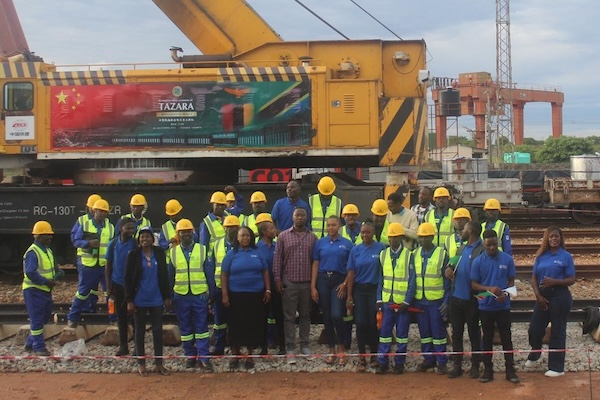
Two Chinese mining groups that account for a large share of copper and cobalt output in the Democratic Republic of Congo (DRC) are set to help finance the modernization of the TAZARA railway corridor. Backed by Beijing, the project is emerging as a competing export route to the Lobito Corridor, which the United States and the European Union are developing in parallel.
The TAZARA upgrade is valued at more than $1.4 billion, including about $1 billion for rail rehabilitation and $400 million for locomotives and rolling stock. Under the newly disclosed structure, China Civil Engineering Construction Corporation will hold an 80% stake, while CMOC, a Zijin Mining-linked entity, Jiayou International Logistics and COSCO Shipping Holdings will each take 5%, subject to regulatory approval in China.
The participation of mining firms underscores efforts to secure export routes for African minerals as competition between regional corridors intensifies. By backing TAZARA, CMOC and Zijin are reinforcing China’s position along key mineral export routes in southern and central Africa, where major powers are competing for control over copper, cobalt and zinc supply chains.
Through its subsidiaries Tenke Fungurume Mining and Kisanfu, CMOC exported 747,468 metric tons of copper in 2025, according to official Congolese data, accounting for nearly 22% of national exports. Zijin Mining holds an indirect 39.6% stake in Kamoa-Kakula, alongside Ivanhoe Mines at 39.6%, the Congolese state at 20% and Crystal River at 0.8%. The Kamoa complex exported 400,185.59 metric tons of copper in 2025, or about 12% of total exports.
TAZARA as an alternative
Meanwhile, the United States and the European Union are stepping up support for the Lobito Corridor. The project aims to link mining areas in the DRC and Zambia to Angola’s Atlantic port of Lobito through upgraded rail and logistics infrastructure. It is intended to provide a faster, more competitive route for Copperbelt minerals.
According to a November 2025 presentation by Germany’s Federal Institute for Geosciences and Natural Resources, prepared with the Congolese Ministry of Mines, the 1,740-kilometre Lobito Corridor, including 450 km in the DRC and 1,290 km in Angola, is currently the fastest route among major export options. Transit times range from five to eight days, compared with 30 to 32 days to Dar es Salaam, 28 to 34 days to Beira, 29 days to Walvis Bay and 30 to 36 days to Durban.
That advantage could erode as TAZARA is upgraded. The 1,800-kilometre line is widely seen as a viable alternative. The same presentation noted that Lobito is being developed in a competitive regional environment, with several rail extensions and interconnections under consideration, including links with TAZARA.
Limited support for Lobito
For Washington, the project has strategic significance beyond logistics. A December 2025 agreement between the United States and the DRC identifies the Sakania-Lobito route as a key channel for exporting copper, cobalt, zinc and other critical minerals. It requires that, over the next five years, at least 50% of copper, 30% of cobalt and 90% of zinc sold by state-owned mining companies transit through the corridor’s Congolese section.
Despite these advantages, questions remain over the corridor’s long-term viability. The European Centre for Development Policy Management said its success will depend on attracting sufficient volumes beyond geopolitical backing, while the French Institute for International and Strategic Affairs pointed to risks linked to governance, regional coordination and limited commitment from some operators.
So far, Kamoa Copper, which operates the Kamoa-Kakula complex, is among the few major producers to formally commit to the route. A memorandum of understanding signed in February 2024 with Lobito Atlantic Railway covers part of its copper exports. The company shipped its first copper anodes via Lobito in the first quarter of 2026.
“Lobito is still ramping up. This year, we plan to ship between 50,000 and 70,000 metric tons through the corridor, depending on its progress and competitiveness against other routes,” said Olivier Binyingo, chairman of Kamoa Copper, in February.
Pierre Mukoko