




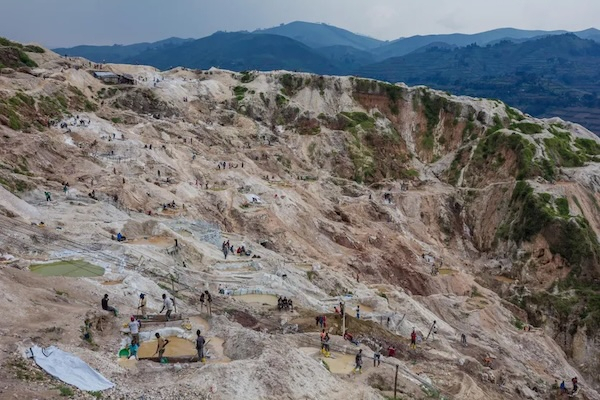
The industrial transformation of the Rubaya coltan mine in Masisi territory, North Kivu, would require an investment of between $50 million and $150 million. Reuters reported that this estimate appears in an initial list of 25 assets offered to American investors as part of a strategic critical minerals partnership signed between the Democratic Republic of Congo (DRC) and the United States on Dec. 4.
The document says the investments would accelerate commercial-scale production. A rapid return on investment is expected due to strong global demand for tantalum, a strategic metal extracted from coltan.
Congolese authorities say the Rubaya mine is of particular interest to Washington, reflecting U.S. efforts to secure Western supply chains for critical materials used in electronics, energy and defense industries. The site is widely described as one of the world’s most important coltan deposits.
It accounts for roughly 15% of global coltan production, with tantalum grades ranging between 20% and 40%.
Under the agreement between Kinshasa and Washington, American companies have a right of first offer on the selected assets. Even before the agreement was signed, Western groups had already expressed interest in the site.
Bloomberg reported that Swiss trader Mercuria Energy Group and investment firm TechMet are considering plans to develop and modernize the tantalum deposit near Rubaya. TechMet is backed by the U.S. International Development Finance Corporation (DFC).
The Financial Times has also reported interest from Texan businessman Gentry Beach through his company America First Global. Beach is described as being close to Donald Trump.
Zone under occupation
Despite its strategic importance, mining at the site remains largely artisanal and informal. These conditions frequently lead to deadly accidents.
In a statement published on March 4, 2026, the Congolese Ministry of Mines reported that a landslide occurred on March 3 at the Rubaya mining sites following heavy rains. Authorities said the provisional death toll exceeded 200 people, including around 70 children. Many injured were evacuated to health facilities in Goma.
Similar casualty figures had already been reported after landslides at the mine in late January.
In this context, industrializing the site is seen as a way to improve safety and reduce human risks by gradually replacing artisanal mining with more regulated operations. However, the project depends on improvements in the security situation.
Since April 2024, the Rubaya area has been under the control of the AFC/M23 rebel movement, which is supported by Rwanda. United Nations experts say some minerals extracted in the region are smuggled into Rwanda. The armed group reportedly earns around $800,000 per month by taxing mining activities.
“The development of sites located in occupied zones depends on the withdrawal of Rwandan troops, as provided for in the DRC-Rwanda peace agreement concluded in June 2025,” Daniel Mukoko Samba told Jeune Afrique in February.
Mukoko Samba is the Congolese vice-prime minister in charge of the economy and a signatory to the strategic agreement with the United States.
Aware of the situation, Washington has increased pressure on Kigali. The U.S. Treasury announced a new series of sanctions on March 2, 2026 targeting the Rwanda Defence Force (RDF) and four senior military officials.
In 2025, the United States had already sanctioned the armed group PARECO-FF, the Cooperative of Mining Artisans of Congo (CDMC), and the Chinese companies East Rise Corporation and Star Dragon Corporation for alleged involvement in the illegal trade of minerals from the Rubaya sites.
Dispute over the permit
“We are not the perpetrators, but the primary victims,” the CDMC said in response. The company also accused certain Congolese officials of leading a coordinated effort to undermine its ownership of the Rubaya mining permit with support from opaque diplomatic and financial channels.
Congolese mining registries indicate that the state-owned company Société Aurifère du Kivu et du Maniema (SAKIMA) holds the permit covering the Rubaya area. However, these rights are contested by the CDMC.
The company argues that the concession belongs to its subsidiary Congo Fair Mining (CFM), a joint venture formed with SAKIMA in which the state firm holds a 30% stake.
This claim is supported by rulings issued on April 30 and September 4, 2025 by the Council of State, the country’s highest administrative court.
The joint venture creating CFM was signed in 2020 between SAKIMA and the CDMC. It provided for the transfer of the Rubaya exploitation permit from the public enterprise to CFM. The transfer agreement was reportedly signed on March 11, 2021, leading to the registration of the permit transfer in the Mining Registry on May 20, 2022.
Mining Minister Louis Watum Kabamba told Bloomberg in October 2025 that he planned to bring the parties together to discuss the dispute. It remains unclear whether the meeting has taken place.
However, Kinshasa has already included the Rubaya coltan deposit among the strategic mining assets offered to American investors. The government now faces two key challenges: securing the site and resolving legal disputes to enable industrial development.
Pierre Mukoko & Timothée Manoke