





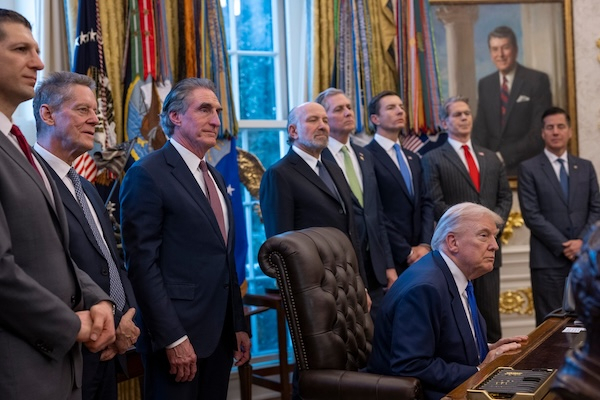
The United States officially launched Project Vault on Feb. 2, 2026. The $12 billion initiative aims to build a strategic stockpile of critical minerals to secure supply chains for industrial and civilian needs.
The program is backed by $1.67 billion in private capital and $10 billion in loans from the Export-Import Bank of the United States.
While full details have not been disclosed, the initiative is intended to shield U.S. industry from supply disruptions amid trade tensions with China. Until November 2025, Beijing had suspended exports of critical minerals such as germanium and gallium to the United States. The materials are essential for semiconductors, solar panels, lasers and night-vision equipment.
These minerals are produced in the Democratic Republic of Congo, notably at the Kipushi mine. The operation is jointly owned by Ivanhoe Mines, which holds a 62% stake, and state-owned miner Gécamines, which owns 38%.
Canadian firm Ivanhoe Mines, partly backed by Chinese capital, said its executive co-chairman Robert Friedland attended the Project Vault launch at the White House alongside Donald Trump.
The company added it is in advanced talks with Gécamines and commodities trader Mercuria to have Gécamines Trading, a dedicated mineral trading subsidiary, direct part of Kipushi’s zinc concentrate output to the United States. The concentrate also contains germanium and gallium.
That portion is currently allocated to Mercuria under an offtake agreement signed in July 2025. The three-year contract covers one-third of the mine’s total production and includes a $20 million loan to Kipushi at a 6% interest rate. The funds are intended to ease bottlenecks and expand concentrator capacity.
Strategic partnership
The remaining two-thirds of production is already committed to CITIC Metal and Trafigura under separate agreements reached in July 2024 and running through 2029.
However, Ivanhoe said in its statement that “Gécamines could be responsible for marketing up to 50% of the concentrate production from the Kipushi mine,” without providing further details. Under this scenario, Gécamines Trading, a joint venture between Gécamines and Mercuria, could become a key channel for exporting Kipushi minerals to the United States.
For 2026, Kipushi’s output is expected to reach between 240,000 and 290,000 tonnes of zinc concentrate, confirming its position as a major player in the global market. The opportunity offered to Gécamines by Project Vault appears significant, as several analyses indicate China controls a large share of active mining assets in the DRC. This has prompted Washington to closely track volumes linked to state holdings.
“The DRC and its state-owned enterprises will use their marketing rights under participation and contract arrangements to provide offtake access to U.S. and allied buyers,” according to the strategic agreement signed on Dec. 4 between Kinshasa and Washington.
As part of its implementation, Gécamines Trading plans to direct around 100,000 tonnes of copper from the Tenke Fungurume Mining (TFM) operation to the United States in 2026. This reflects the share tied to its 20% stake in TFM, a mine controlled 80% by Chinese group CMOC.
Timothée Manoke