




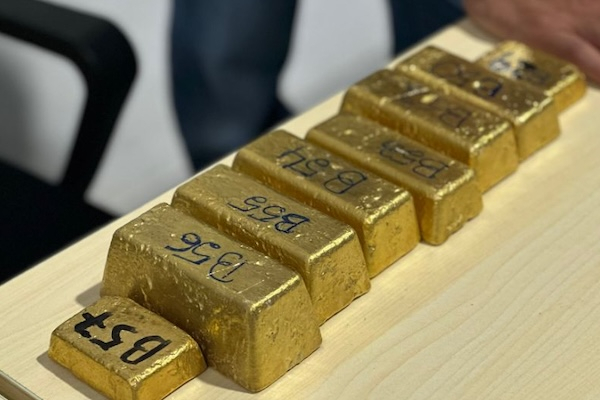
The Democratic Republic of Congo exported more than 28.2 metric tons of gold in 2025, little changed from 27.93 tons in 2024, according to data from the Cellule technique de coordination et de planification minière (CTCPM).
Flat export volumes contrasted with a sharp rise in revenue. The value of gold exports reached $2.84 billion in 2025, up from $1.53 billion in 2024, an increase of about 85.6%, driven by higher international gold prices.
The average annual gold price rose 44% to $110,280 per kilogram in 2025, according to the World Gold Council, which cited strong demand and a geopolitical and financial environment supportive of the metal.
Artisanal gold exports rose to 2,834.72 kilograms in 2025 from 1,755.82 kilograms in 2024, an increase of around 61.4%. This came despite the fall of Bukavu to M23 rebels, previously the country’s main artisanal gold export hub.
To compensate, the state-owned gold marketing company set up offices across the country in 2025, helping sustain export flows.
The Kibali Gold Mine, operated by Barrick Mining, also reflects the effect of higher prices. The industrial mine generated an estimated $2.3 billion in revenue in 2025, up 40% year on year, even as production fell 2% to about 673,000 ounces, below its annual target of at least 688,000 ounces.
Barrick attributed the shortfall to lower ore grades and reduced output from its richest underground zones. A fatal incident in the fourth quarter also led to a temporary suspension of some operations, weighing on year-end output.
There is a discrepancy of more than four metric tons between two sets of figures. The CTCPM reported Kibali’s 2025 output at more than 25 metric tons, while Barrick reported 673,333 ounces, or about 21 metric tons.
The CTCPM has acknowledged limits in its data collection. Its figures are based on company declarations and administrative reconciliations, while Barrick’s data are reported under international financial reporting standards, which may partly explain the gap.
Timothée Manoke