




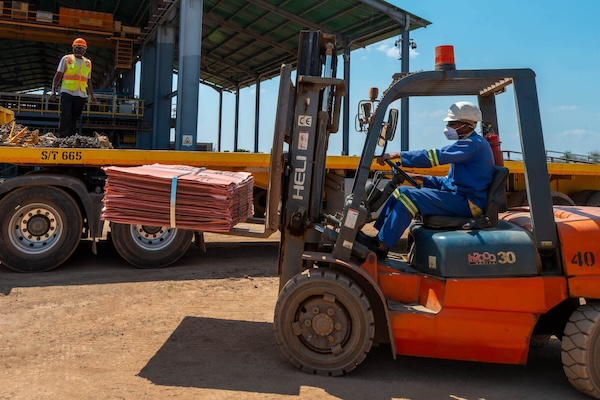
Buenassa has put forward a $1.5 billion offer to acquire Chemaf, a copper and cobalt producer in the Democratic Republic of Congo. The company presents the bid as the upstream component of a broader $3.5 billion industrial roadmap unveiled on January 29, just days ahead of the U.S.-organized Washington summit on critical minerals scheduled for February 4.
Buenassa said the $1.5 billion would be used to stabilize the asset and restructure its debt. The stated goal is to complete the Etoile II and Mutoshi industrial units to meet existing obligations and secure a reliable supply of ore for its planned refinery.
The second pillar of the roadmap centers on refinery construction. Buenassa has allocated $700 million to the first phase and now $1.3 billion to the second phase, revised down from an initial estimate of $2 billion. While the company did not explain the reasons for the revision, it maintained its production targets. Phase one is expected to deliver 30,000 tons of copper, in LME-grade cathodes, and 5,000 tons of cobalt, in sulfate and high-purity metal, per year. Phase two would lift output to 120,000 tons of copper and 20,000 tons of cobalt annually.
Buenassa Chief Executive Officer Eddy Kioni presented vertical integration as a response to market instability. He said it offers the most effective way to offset supply and price volatility that has historically discouraged Western investment. He added that the proposed structure is designed to ensure full transparency and prevent financial or risk-related conflicts between assets.
Employment, subcontracting
Buenassa Resources, the subsidiary leading the industrial project, said the plan would provide clarity for more than 3,000 direct Chemaf employees and thousands of subcontractors, according to its board chairman, former prime minister Samy Badibanga. He also said the refining complex could create around 5,000 jobs. By anchoring the project within the DRC’s industrial base, he said, the company aims to secure a sustainable future for workers and the surrounding region.
Buenassa highlighted a structure it says would improve the project’s bankability, supported by the Congolese state, which holds a 10% stake in Buenassa Resources, and by several partners. The company said it is working with consulting firm Roland Berger on an acquisition audit and debt rescheduling.
On the engineering side, Buenassa said a consortium made up of UK-based Bara Consulting and South Africa’s MET63 would act as owner’s engineer for the refinery, while also contributing to the management of upstream operations.
On financing and institutional engagement, the company cited intensified discussions with U.S. institutions, including the U.S. International Development Finance Corporation. It also named Rawbank and Nigeria’s United Bank for Africa as banking partners. Buenassa said it is seeking a partnership with a major industrial group from the Gulf and a large U.S. trading house to strengthen its commercial capacity.
Washington summit
Buenassa explicitly framed its announcement around the Washington critical minerals summit, which President Félix Tshisekedi and members of his government are expected to attend. The Financial Times, citing sources close to the matter, reported that the sale of Chemaf, described as an early test of the DRC–U.S. strategic partnership signed on December 4, could reach a turning point during the event.
Against this backdrop, rival bidders are intensifying their efforts. Africa Intelligence reported that Virtus Minerals recently signed a share purchase agreement with Zedra Skye Trustees, presented as representing nearly 95% of Chemaf shareholders. The U.S. company is said to have offered to take over Chemaf’s debts, estimated at more than $900 million. It is also considering outsourcing operations to India’s Lloyds Metals and Energy, described by the publication as having limited experience in copper-cobalt projects, particularly in Africa.
Securing financing remains a central issue. On this front, Virtus Minerals is said to have approached New York-based investment fund Orion Resource Partners and Anglo-Swiss trading group Glencore. As with Buenassa, however, Africa Intelligence reported that no binding agreement had been signed so far.
Even with a share purchase agreement in place, Virtus Minerals would still need approval from the Congolese government to complete the acquisition. International media reports say the company, founded by former U.S. security officials, benefits from support from the Trump administration. In Kinshasa, however, its offer has raised concerns. Beyond financing questions, it is seen as offering limited safeguards for local interests.
A delicate arbitration
Buenassa, for its part, says it is seeking to balance U.S. and Congolese interests. In addition to pledging to preserve jobs and subcontracting arrangements, the Congolese company presents its project as aligned with the government’s objective of processing minerals locally to capture more value.
Buenassa also positions itself as the operational arm of the DRC–U.S. critical minerals partnership. It has committed to reserving its production for the U.S. market in order to help build a secure supply chain outside Chinese influence. The company also said it is open to the formation of a DRC–U.S. consortium, involving players such as Gécamines and Buenassa, which it presents as the most realistic option given the financial, operational, and security challenges facing the sites.
The strategic agreement signed on December 4 grants U.S. companies a right of first offer on critical minerals deposits. It also states that if no U.S. bid is selected after nine months, projects may be opened to allied partners, including Congolese firms. Kinshasa must now arbitrate the Chemaf case without weakening its relationship with Washington, which it also sees as a key partner amid persistent security challenges in the east of the country.
Pierre Mukoko