




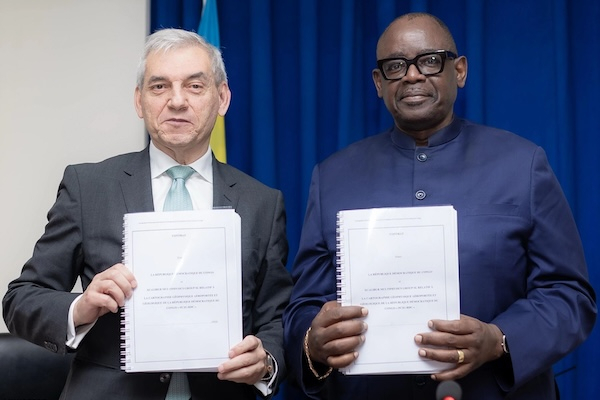
The Democratic Republic of Congo (DRC) Ministry of Mines and the Xcalibur group signed a second contract on Jan. 29 in Kinshasa for airborne geophysical and geological mapping of the national territory. Minister of Mines Louis Watum Kabamba and Xcalibur CEO Andres Blanco Grasa, who is based in Spain, signed the document after several months of anticipation.
The Ministry of Mines said last December that the selection was not a direct award but a continuation of the initial program, explaining the choice of the same provider. The ministry also said phase B takes into account the results of phase A. Officials added that they preferred signing a new contract rather than amending the existing one in order to comply with public procurement law and its implementing regulations.
The DRC signed a contract with Xcalibur in 2017 for national airborne geophysical and geological mapping. It was subsequently adjusted through amendments in 2019 and 2022. Documents published by the Ministry of Mines show the program is structured around two distinct components: a phase A described as a priority and a phase B described as optional.
According to Article 19 of the second amendment, the total cost of phase A, covered under the first contract, is set at $60,961,973. The cost of phase B is fixed at $297,873,516, bringing the overall budget to $358.8 million. This second phase, valued at nearly five times the first contract, was to be carried out later under a separate financing agreement and subject to a no-objection from the General Directorate for Control of Public Procurement (DGCMP). It is to be implemented taking into account results obtained during phase A.
The Minister of Mines said the first phase is finished. He said last November during the Makutano 2025 forum that they have submitted a report and collected data. He specified that the contract does not require Xcalibur to identify deposits. Instead, the company defines certain geological districts and formations, after which exploration work will begin.
According to the contract, phase A of the project was to cover mainly the Kasai, Equateur and Katanga blocks. It notably provided for remote sensing and interpretation of satellite images, and airborne geophysical surveys involving magnetic and radiometric data at resolutions allowing a regional-scale view of subsurface structures. It also included targeted gravity and electromagnetic surveys, initial geological and geochemical mapping of priority areas, the development of an open geological information system (GIS), and initial training for national technical staff.
Phase B provides for a densification of geophysical surveys in areas identified by phase A, as well as more detailed investigations of detected anomalies. It also includes magnetic and radiometric surveys across the rest of the country, standard gravity surveys in the central basin for gas and oil, and detailed geological and geochemical mapping at more actionable scales. The phase further includes advanced strengthening of national capacities and the full implementation of the GIS to support economic use and institutional management of the data. The program also includes the construction of a laboratory for chemical, petrographic and metallogenic analysis.
A boost for exploration
Many sector actors believe exploration in the DRC is stalled. Landry Djimpe, managing partner of Innogence Consulting, observed at Makutano 2025 that all current large mines without exception rely on geological clues identified during the colonial era.
The national airborne geophysical and geological mapping program is presented as an initial response to this problem. According to the Ministry of Mines, its objective is to provide the DRC with reliable and certified scientific data across the entire territory to better understand the country’s subsoil potential. It also aims to strengthen planning and transparency in the mining sector, attract responsible investment, and safeguard national economic sovereignty.
A central challenge remains ensuring rigorous monitoring of implementation so that this investment translates into better knowledge of the national subsoil and sustainable development of the country’s mineral resources. This challenge is further emphasized by the fact that Xcalibur holds no subsidiary in the DRC. The entities that signed the base contract and the various amendments are based in Mauritius, South Africa and Spain.
Pierre Mukoko