





Ivanhoe Mines has cut production forecasts again for the Kamoa-Kakula copper complex in southern Democratic Republic of Congo, citing updated results from an independent study.
The company said on March 31, 2026, it now expects output of 290,000 to 330,000 tonnes of copper in 2026, down from a previous target of 380,000 to 420,000 tonnes.
For 2027, forecasts have been lowered to 380,000 to 420,000 tonnes from 500,000 to 540,000 tonnes. The 500,000-tonne annual threshold, initially targeted for 2027, has been pushed back to 2028.
The revision follows a downgrade announced after a seismic event in May 2025. In its full-year results published on Feb. 18, 2026, Ivanhoe had maintained guidance of 380,000 to 420,000 tonnes for 2026 and 500,000 to 540,000 tonnes for 2027, while noting a new mine life plan would incorporate technical parameters adopted since the seismic event and the subsequent recovery plan.
The company attributed the latest cut to a more cautious operating approach. A March 31 report said new mining layouts at Kamoa and Kakula require a longer period of preparatory work to support a more sustainable extraction rate. Development over the next two years will focus primarily on Kakula before new extraction zones are brought online.
Ivanhoe also said underground development has fallen short of expectations due to unfavorable geotechnical and hydrological conditions, prompting the company to cut development targets by about 15%.
“Although conservative base-case assumptions are impacting production levels in 2026 and 2027, we are positioning Kamoa-Kakula to achieve new records from 2028 onwards,” said Marna Cloete, Ivanhoe Mines’ president and chief executive officer.
Higher Costs Expected
The revised outlook also affects cost projections. In February, Ivanhoe forecast direct cash costs of about $4,850 to $5,510 per tonne in 2026 and $4,190 to $5,070 per tonne in 2027. It now expects costs of about $5,730 to $6,610 per tonne in 2026, easing to $4,630 to $5,510 per tonne in 2027. The long-term target is set at about $4,410 per tonne from 2028.
In the near term, lower volumes and higher costs could weigh on revenue. In 2025, Kamoa-Kakula generated $3.28 billion in revenue and $1.45 billion in EBITDA, with a 44% margin, despite production disruptions since May. The site sold 351,674 tonnes of copper at an average price of about $9,700 per tonne.
Direct cash costs rose to about $4,760 per tonne from about $3,640 per tonne in 2024. Ivanhoe attributed the increase to the processing of lower-grade surface stockpiles, lower-quality ore and higher logistics costs per pound transported.
The delay has implications for the global copper market. Kamoa-Kakula had been expected to be one of the main drivers of growth in global supply, with output of more than half a million tonnes previously expected as early as 2027. The delay to 2028 postpones the arrival of significant volumes of high-grade copper on a market already under pressure from electrification and the energy transition.
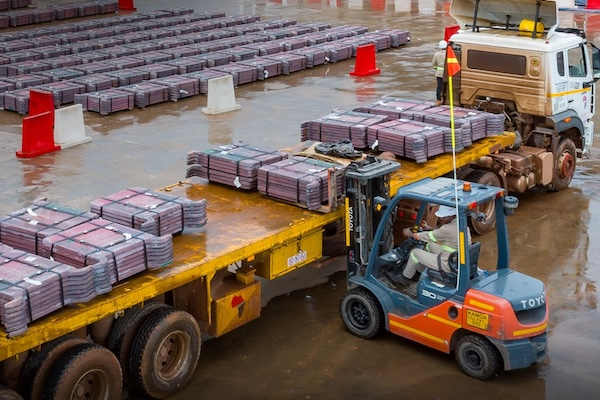
Ivanhoe highlighted several mitigating factors. The Kamoa-Kakula smelter, commissioned at the end of 2025, is now producing copper anodes at 99.7% purity. The company said the ramp-up of the facility should halve logistics costs, as shipments shift from concentrate grading 35% to 45% to near-pure anodes.
Sulfuric acid sales, a byproduct of the refinery, provide an additional buffer, with the average realized price exceeding $450 per tonne since start-up. The Kamoa-Kakula complex is owned 39.6% by Ivanhoe Mines, 39.6% by Zijin Mining, 20% by the Congolese state and 0.8% by Crystal River, within the Kamoa Copper joint venture.
Pierre Mukoko