




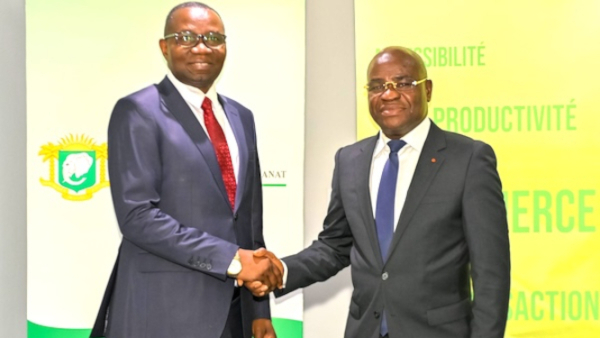
The Democratic Republic of Congo is looking to leverage Côte d'Ivoire's expertise to accelerate the development of its cocoa sector and strengthen the organisation of its producers. The issue was a key focus of a meeting held on June 2 in Abidjan between Congolese Foreign Trade Minister Julien Paluku Kahongya and his Ivorian counterpart for Trade, Industry and Crafts, Ibrahim Kalil Konaté, on the sidelines of the signing of the International Cocoa Agreement.
According to the Congolese Ministry of Foreign Trade, Kinshasa hopes to benefit from Ivorian expertise in organising local cooperatives, particularly to strengthen the protection and support of cocoa farmers.
The world's largest cocoa producer, with nearly 2 million tonnes a year, Côte d'Ivoire serves as a benchmark for the DRC, whose cocoa sector remains largely underdeveloped despite significant potential across several provinces.
The two countries also stressed the need to process more cocoa locally to capture a greater share of the value generated by the industry. They said Africa should produce more chocolate, cocoa butter, cocoa powder and other value-added cocoa products instead of relying largely on exports of raw beans.
Local processing
Discussions also covered global cocoa price volatility and ways to better protect the incomes of African producers. Kinshasa and Abidjan said they intend to coordinate their positions in response to the growing use of cocoa substitutes by manufacturers, which they view as a threat to the sector.
The Congolese ministry also said both sides discussed the Inga project, describing it as a key source of reliable energy needed to support cocoa processing and other agricultural value chains.
The meeting comes as the DRC seeks to revive its own cocoa sector. In May, Julien Paluku presented an inter-ministerial plan aimed at organising smallholder farmers into cooperatives, strengthening local processing and providing financing for cocoa purchases during the marketing season through the Fund for the Promotion of Industry.
Through this strategy, Kinshasa aims to make the DRC one of the world's leading cocoa producers within five years. The government has set a target of 3 million tonnes by 2030, up from around 100,000 tonnes in 2024, according to data from the Ministry of Foreign Trade. Reaching that goal would require major investment in production, farmer support, logistics and processing capacity.
Ronsard Luabeya