




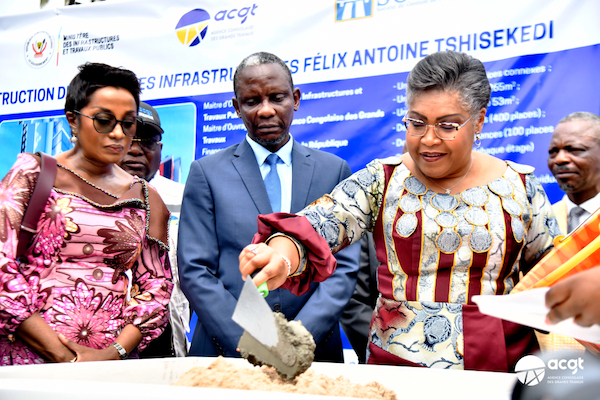
Infrastructure and Public Works Minister John Banza Lunda has announced the launch of an “infrastructure crusade,” a wide-ranging program aimed at developing new office complexes to bring together government agencies.
The announcement comes after the launch of the first project, the Félix-Antoine Tshisekedi Tshilombo Infrastructure Center (CIFATT), which broke ground on Jan. 22, 2026. According to the Congolese Agency for Large Works (ACGT), the building is intended to host key public bodies overseeing the Democratic Republic of Congo’s infrastructure sector.
The project is estimated to cost $25 million. The 14-storey building will span approximately 20,000 square meters and is expected to accommodate between 1,200 and 1,400 people. Located in the Gombe commune, construction is scheduled to take 24 months.
Representatives of the Société des péages du Congo (SOPECO) and the Société de gestion routière (SGR) said the project is financed exclusively through savings generated from the management of road concession contracts, with no funding from the state budget. SOPECO and SGR hold three concession agreements with the Congolese government covering the Kinshasa-Matadi, Lubumbashi-Kasumbalesa, and Lubumbashi-Likasi-Kolwezi corridors. These contracts include road paving, bridge construction, rehabilitation of strategic routes, and toll operations.
Alongside CIFATT, the minister announced three additional large-scale projects, including a new Ministry of Foreign Affairs building and a parliamentary complex comprising a debating chamber, a convention center, housing for lawmakers, and a five-star hotel. He also unveiled plans for an administrative city featuring a government building rising more than 50 floors.
The two latter complexes will be built near the Kinshasa ring road. According to the minister, the location was chosen to ease congestion in central Kinshasa by relocating part of the administrative apparatus away from the Gombe commune, currently the city’s main administrative hub. The heavy concentration of government offices and economic activity in the area contributes to chronic traffic congestion, as residents and workers converge daily on the district.
Banza Lunda said the projects would be partially financed through the public budget. “Nearly 40% of our budget is allocated to the infrastructure sector. This shows that the initiative is not just rhetoric,” he told RFI. He said further details would be presented at the first national infrastructure conference, scheduled for Jan. 29-31, 2026, in Kinshasa.
Timothée Manoke