




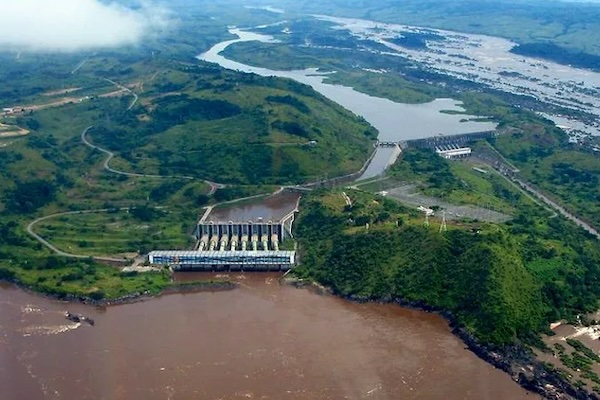
The Democratic Republic of Congo and South Africa plan to resume discussions on the Inga 3 hydroelectric project in April 2026, according to a March 12 statement by the Congolese Ministry of Hydraulic Resources and Electricity.
South Africa's Minister of Electricity and Energy, Kgosientsho Ramokgopa, has confirmed an official visit to the DRC to advance work on renewing and updating bilateral energy cooperation agreements tied to the project, the ministry said.
A political memorandum of understanding already exists between the DRC and South Africa to export 2,500 megawatts, according to the World Bank's Inga 3 project document. The institution also noted that the two countries must continue discussions to renew that agreement and increase the export target to 5,000 megawatts.
The World Bank further noted that the development of Inga 3 could reshape the DRC’s role in regional electricity trade, enabling the country to supply not only its domestic market but also several African power pools, including the Southern African Power Pool (SAPP), the Eastern Africa Power Pool (EAPP) and the Central African Power Pool (CAPP). The bank described the project as a potential source of export revenue, as well as a tool to secure power supply to Kinshasa and the industrial corridor around the Inga site.
Financing and new agreements
According to the Congolese ministry, authorities are also preparing to sign a memorandum of understanding with the Agency for the Development and Promotion of the Grand Inga Project (ADPI) to develop the financing structure of Inga 3 with World Bank support. On Feb. 2, 2026, the French Development Agency (AFD) and ADPI had already signed a memorandum of understanding in Kinshasa to support project preparation.
Inga 3 remains at the preparation stage. The World Bank noted that its final specifications have not yet been determined, with options under study ranging from approximately 4,800 megawatts to 11,000 megawatts, at an estimated cost expected to exceed $10 billion. The institution stressed the need not only to prepare the project itself, but also to ensure the country is ready for it, given its institutional, social, territorial and financial scale.
To that end, the Inga 3 Development Program was established, backed by $1 billion in World Bank funding over a ten-year period, divided into four phases of $250 million each. The first tranche was approved on June 3, 2025.
Pending an investment decision, the steps now underway primarily reflect Kinshasa’s push to reactivate diplomatic, technical and financial partnerships around a project that Congolese authorities regard as central to the country’s national energy strategy.
Ronsard Luabeya