




Democratic Republic of Congo President Félix Tshisekedi has ordered tighter oversight of the creation of public funds, commissions, cells and state institutions, in a bid to rationalize government spending.
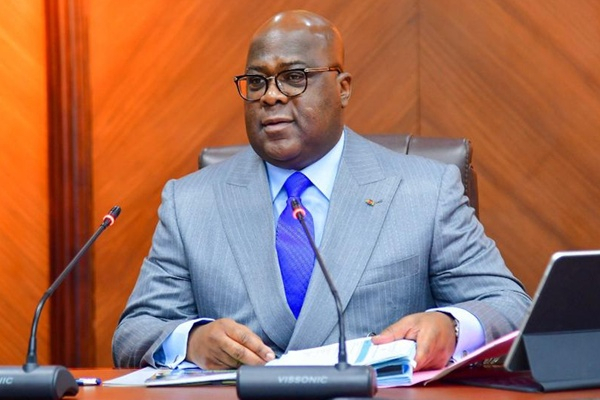
At the 82nd Council of Ministers meeting on March 13, 2026, Tshisekedi said any new public body must receive prior approval from the prime minister, who will assess its relevance, strategic value and financial impact before a final decision.
According to the council’s communiqué, the measure aims to improve management of public resources and curb the proliferation of structures deemed ineffective or redundant. The review will identify entities with clear utility, those of limited relevance, and cases of overlapping mandates or institutional duplication.
A review process already underway
The decision builds on measures launched several months ago. At the 74th Council of Ministers meeting on Jan. 9, 2026, Tshisekedi stressed the need for stronger budget discipline, describing spending rationalization as an “immediate, credible and indispensable lever” to preserve macroeconomic stability.
He called for the elimination of non-priority or insufficiently justified expenditures and requested a progress report from the prime minister on measures already under way.
The directive dates back to the 42nd Council of Ministers meeting on May 2, 2025, when the government was instructed to identify recently created public bodies, assess their added value and consider dissolving or restructuring those deemed unproductive or a drain on the budget. The results have not yet been made public.
Pressure on public finances
The move comes amid continued pressure on public finances. The 2026 budget law, promulgated in late December 2025, was set at about $22 billion, up from an initial draft of $20.3 billion presented in September.
In this context, the executive is seeking to contain operating costs, limit the dispersion of budgetary resources and focus spending on priorities, notably security, reconstruction and infrastructure.
Through these measures, the government aims to use administrative rationalization as a tool to strengthen budget discipline and improve public governance.
Boaz Kabeya