




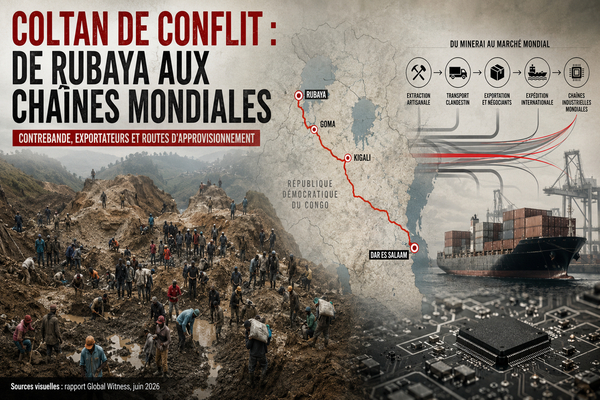
For years, Kinshasa has warned that minerals sourced from conflict zones were being incorporated into global supply chains, but it has often struggled to document exactly how those resources moved from the mines into finished products sold on international markets. A new report by the British NGO Global Witness, published in June 2026, sheds further light on this trade. Based on a year-long investigation drawing on customs records, trade-flow analysis, and witness testimony, the report traces the path of coltan extracted from mines controlled by the AFC/M23 to smelters and component suppliers connected to the supply chains of major technology companies.
The story begins in Rubaya, a mining area in the Masisi territory of North Kivu, in eastern Democratic Republic of Congo. The coltan-rich hills there have become, since 2024, one of the key financial lifelines for the AFC/M23 armed group.
According to Global Witness, the Rubaya mines account for roughly 15% of global demand for tantalum, a metal derived from coltan that is used in capacitors found in smartphones, laptops, servers, telecommunications equipment and modern vehicles.
After seizing control of the main roads around Rubaya in late 2023 and then the mines themselves in April 2024, the AFC/M23 allegedly established an illegal coltan smuggling route into Rwanda. Those findings echo conclusions previously reached by United Nations experts.
The Rubaya Route
The smuggling network between Rubaya and Rwanda is said to revolve around Bahati Erasto, whom the AFC/M23 appointed governor of North Kivu under its de facto administration. Global Witness also names Augustin Baribugwira Bizimana, Mutombo "Safari" Cimana, Charles Munyaneza and Manizabayo Semafuko as key figures in the network.
According to Global Witness, the Rubaya mines account for roughly 15% of global demand for tantalum, a metal derived from coltan that is used in capacitors
The NGO describes a system of taxes imposed at multiple stages of the trading chain. Traders reportedly pay the AFC/M23 $4 per kilogram, while $3 per kilogram goes to Rwandan public officials. According to U.N. experts, the scheme has generated approximately $800,000 per month for the AFC/M23.
Global Witness says at least 1,400 tonnes of coltan were smuggled illegally from the DRC into Rwanda during the first year of the Rubaya mines' occupation. The organization also cites more than 2,000 tonnes of smuggled coltan whose final destination remains difficult to determine precisely.
The route now frequently passes through Goma, which is controlled by the AFC/M23, before crossing the Goma-Gisenyi border. Some of the coltan reportedly moves past Rwandan border officials before being transported to Kigali.
Once in Rwanda, the mineral is said to be blended with local production before being exported as Rwandan coltan. This practice raises questions about the effectiveness of traceability mechanisms, particularly the ITSCI system used in the Great Lakes region to certify so-called 3T minerals: tin, tungsten and tantalum.
Once in Rwanda, the mineral is said to be blended with local production before being exported as Rwandan coltan. This practice raises questions about the effectiveness of traceability mechanisms
Traffickers interviewed by the NGO said coltan from AFC/M23-controlled areas had received traceability tags, giving it the appearance of compliance. Global Witness also notes that ITSCI-certified coltan exports have risen sharply, mirroring the increase in Rwanda's overall coltan exports since the capture of Rubaya.
Kigali as the Exit Point
According to the investigation, seven companies handled the bulk of Rwanda's coltan exports between January 2023 and September 2025. Global Witness says it has evidence showing that at least five of them sourced coltan linked to the Rubaya mines: Kanzamin, African Panther Resources, Sunrise Metal Company, Boss Mining Solution and Philbert Trading Minerals.
Kanzamin, formerly known as Trading Services Logistics, is described as one of the major players in Rwanda's coltan trade. Global Witness says several traders sold coltan originating from Rubaya and that a company employee confirmed purchasing minerals from the area. The NGO also says Kanzamin established a small laboratory in Rubaya to measure tantalum content.
Global Witness says Sunrise Metal Company sold coltan to several Chinese smelters, including Jiujiang Jinxin Nonferrous Metals, Jiujiang Tanbre and Ningxia Orient Tantalum Industry. The NGO says it also contacted Sunrise while posing as a Rubaya trader. According to the report, Sunrise expressed interest in purchasing the coltan and offered assistance with border crossings.
The two other major exporters identified are East Group Minerals and Tawotin. The latter is described as being linked to Swiss businessman Chris Huber. Global Witness says Tawotin sells to East Rise Corporation, a Hong Kong-based company run by John Crawley. The NGO also cites Star Dragon Corporation, TMC Minerals and Metals Holding Company and Trend Minerals Corporation SDN as entities connected to that trading network.
The two other major exporters identified are East Group Minerals and Tawotin. The latter is described as being linked to Swiss businessman Chris Huber. Global Witness says Tawotin sells to East Rise Corporation, a Hong Kong-based company run by John Crawley
After leaving Rwanda, the coltan is said to travel primarily through East African logistics corridors. Shipments reportedly pass through the ports of Dar es Salaam in Tanzania and Mombasa in Kenya before being shipped to Asia or sold to international traders.
From African Ports to Asian Smelters
According to Global Witness, eight buyers directly purchased nearly 85% of the coltan exported from Rwanda since early 2023. The names cited include Minterra, Halcyon, Traxys, East Rise Corporation, Novocore, Ningxia Orient Tantalum Industry and Jiujiang Jinxin Nonferrous Metals.
These buyers are based primarily in the United Arab Emirates, China, Hong Kong and Luxembourg. With the exception of China, these locations serve mainly as trading and transit hubs before the mineral is resold to smelters and refiners elsewhere.
Global Witness says it identified eight smelters that processed most of the coltan exported from Rwanda between 2023 and September 2025. Six are based in China: Ningxia Orient Tantalum Industry Co., Jiujiang Jinxin Nonferrous Metals Co., Jiujiang Tanbre Co., Jiujiang Zhongao Tantalum & Niobium Co., Ximei Resources (Guangdong) and Hengyang King Xing Lifeng New Materials Co. Two others are also named: Ulba Metallurgical Plant in Kazakhstan and Taniobis in Thailand.
According to the NGO, at least four of those smelters probably processed coltan linked to the Rubaya mines.
The report details several specific trade flows. Halcyon reportedly shipped part of its coltan from Dar es Salaam to Taniobis in 2023 and also sent coltan from Rwanda to China. Specialty Metals Resources reportedly sent at least one shipment from Dar es Salaam to Ximei Resources in 2024. Sunrise Metal Company is said to have sold large volumes of coltan to Jiujiang Jinxin, Jiujiang Tanbre and Ningxia Orient Tantalum Industry, and to have sent at least one shipment to Hengyang King Xing Lifeng New Materials.
It notes that the United States, El Salvador, Israel and the Philippines are among the leading importers of tantalum from China, where most of the coltan exported from Rwanda is said to have been processed.
East Group Minerals reportedly sent most of its coltan to China through Minterra while also shipping coltan to Jiujiang Zhongao. Minterra is also said to have delivered Rwandan coltan to Ulba and to Ningxia Orient Tantalum Industry.
Global Witness also mentions East Rise Corporation, which reportedly shipped coltan in 2023 and 2024, including material of Congolese or ambiguous origin, to Ulba. In 2024 and 2025, East Rise Corporation also allegedly sent coltan from Rwanda and the DRC to its Malaysian subsidiary, Trend Minerals Corporation, which had previously shipped coltan to China.
Where Origin Becomes Difficult to Trace
It is at the smelting stage that tracing the geographic origin of the material becomes significantly more difficult. Once coltan is processed into tantalum, distinguishing metal sourced from a certified mine from that originating in a conflict zone becomes a complex undertaking.
The tantalum produced then enters component manufacturing, particularly capacitors. Global Witness notes that the global tantalum capacitor market is dominated by a handful of major players, including Kemet, Kyocera AVX, Vishay, Panasonic and Hongda Electronics Corp.
The NGO then draws links between the cited smelters and the supply chains of major international groups. It notes that the United States, El Salvador, Israel and the Philippines are among the leading importers of tantalum from China, where most of the coltan exported from Rwanda is said to have been processed.
In the United States, Global Witness names capacitor producers such as Vishay, Kyocera AVX, Global Advanced Metals and Kemet. The NGO also says Kyocera AVX may be one of the primary beneficiaries of tantalum exports from China to El Salvador, where the company operates a major production facility.
The report also challenges industry safeguards […] The NGO argues that those audits do not always verify the true origin of minerals because of a lack of reliable mine-by-mine production data and independent geochemical identification tools.
Trade flows also linked Ningxia Orient Tantalum Industry to Samsung subsidiaries in the Philippines, where Samsung operates a capacitor plant, and to a Panasonic subsidiary. Tantalum shipments destined for Israel, where Vishay has a major production site, have in recent years originated from China's Ningxia province, which Global Witness says suggests a possible connection to Ningxia Orient Tantalum Industry.
It is through these supply-chain pathways that Global Witness concludes Rubaya coltan may have entered the supply chains of international groups including Amazon, Microsoft, Vodafone, Toyota, Sony, Nvidia, Honda, LG Display, Ericsson and Apple.
The NGO does not claim that any specific product from those brands contains coltan directly mined at Rubaya. Instead, it identifies supply-chain links between certain smelters, component suppliers and major international companies.
Contested Safeguards
The report also challenges industry safeguards. According to Global Witness, some of the cited smelters were found compliant under the Responsible Minerals Assurance Process even as they allegedly processed conflict-linked coltan. The NGO argues that those audits do not always verify the true origin of minerals because of a lack of reliable mine-by-mine production data and independent geochemical identification tools.
The Responsible Minerals Initiative disputes that assessment. According to Global Witness, the RMI argues that RMAP audits do allow for monitoring of conflict-financing risks and points to limitations in the commercial data used by the NGO, including possible discrepancies between extraction, storage, shipment and receipt by smelters.
Samsung told Global Witness it had reviewed the concerns raised and found no cause for alarm regarding its transactions with certain smelters. Ulba pointed to its inclusion on the list of RMAP-compliant smelters. Several other companies named did not respond to the NGO's requests for comment.
For Apple, the findings come amid an already sensitive backdrop. In 2024, the DRC filed complaints in France and Belgium against Apple subsidiaries, accusing them of receiving conflict minerals and engaging in deceptive commercial practices related to the company's responsible sourcing commitments.
Samsung told Global Witness it had reviewed the concerns raised and found no cause for alarm regarding its transactions with certain smelters. Ulba pointed to its inclusion on the list of RMAP-compliant smelters. Several other companies named did not respond to the NGO's requests for comment.
Apple rejected those allegations and said it had asked its suppliers to suspend purchases of tin, tantalum and tungsten from the DRC and Rwanda. The complaint filed in France was dismissed in 2025 for lack of sufficiently established offenses. In Belgium, however, proceedings were opened and an investigating judge was appointed.
For Kinshasa, the Global Witness report provides new material to maintain pressure on global critical-mineral supply chains. Beyond the Apple case, it raises a broader question: how can tantalum used in the world's electronics be guaranteed not to finance armed groups operating in eastern DRC?
The stakes extend beyond the responsibility of technology companies alone. They also implicate traceability systems, smelter audits, transit-country authorities, international regulators and sanctions frameworks targeting those who profit from conflict minerals.
Pierre Mukoko & Boaz Kabeya