




Access Bank, headquartered in Lagos, Nigeria, is preparing a new round of partial foreign divestments. Chief Executive Roosevelt Ogbonna announced the plan during a meeting with investors in the country's commercial capital, according to Bloomberg. The move follows a directive from the Central Bank of Nigeria requiring banks to limit equity investments in foreign subsidiaries to no more than 10% of shareholders' equity. Access Bank has 12 months to comply.
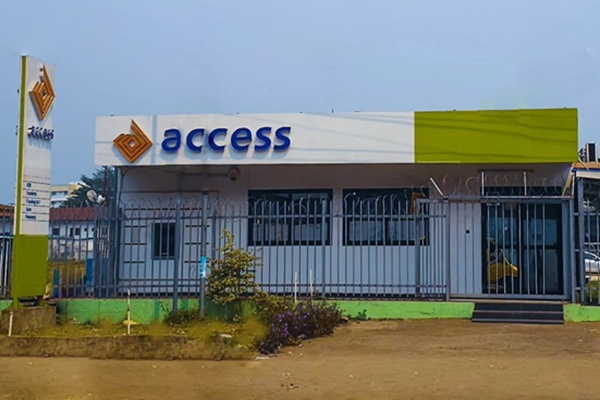
The development creates uncertainty around Access Bank DRC. The Nigerian group controls the Congolese subsidiary almost entirely, holding 99.98% of its capital, according to Access Holdings' consolidated financial statements as of March 31, 2026. In the group's books, the stake is valued at 13.2 billion naira, or about 22.3 billion Congolese francs based on a recent indicative exchange rate of 1 naira to 1.69 Congolese francs.
The issue is particularly sensitive because it goes beyond portfolio management. In its 2025 annual report, Access Holdings disclosed that it paid 1.8 billion naira in penalties for breaches of Central Bank of Nigeria rules and Nigerian banking law. Among those sanctions was a 200-million-naira fine linked to non-compliance with limits on aggregate equity investment in foreign subsidiaries.
At the end of the first quarter of 2026, Access Bank's portfolio of indirect foreign equity holdings remained elevated. Foreign banking subsidiaries represented 446.6 billion naira in book value, unchanged from the end of 2025. Compared with Access Bank Nigeria's shareholders' equity of around 2,143 billion naira in entity-level consolidated accounts, the exposure stands at roughly 20.8%, more than double the regulatory ceiling. To restore compliance, Access would need to reduce that exposure to around 214.3 billion naira, implying a reduction of 232.3 billion naira.
Several competing priorities
The key question is where and how Access Holdings will cut exposure. The bank can sell existing shares in certain subsidiaries, directly reducing the book value of its investments, or open those subsidiaries to new investors, diluting its stake while strengthening local capital bases. The first option would reduce regulatory exposure more quickly. The second makes more operational sense, especially in markets where the group wants to keep financing growth without giving up control.
The largest potential adjustment lies not in the Democratic Republic of Congo but in the United Kingdom. Access Bank UK accounts for 163.9 billion naira, or nearly 37% of the foreign equity portfolio. That represents roughly one-third of the group's excess exposure, but it is also one of Access's most strategic assets outside Nigeria. In 2025, the British unit generated 486.6 billion naira in operating income, compared with 84.7 billion naira for Access Bank DRC. A disposal in the United Kingdom would therefore reduce regulatory pressure quickly, but it would also affect a platform central to Africa-Europe trade flows, trade finance and foreign-currency revenues.
The situation in the DRC is different. The subsidiary would be relatively easy to dilute because Access owns nearly all of its capital. But the operation would be too small, in book-value terms, to solve the problem on its own. Even a sale of 30% of Access Bank DRC would reduce Access Bank Plc's exposure by only about 4 billion naira. Reducing the group's stake to just above 50% would free up around 6.6 billion naira. Relative to the adjustment required, the impact would remain limited.
That accounting constraint does not mean the DRC will be spared. On the contrary, it could be part of a broader package of minority stake sales, precisely because the group can bring in a local or institutional partner without losing control. For Access, the objective would be less about solving the regulatory equation in Kinshasa than about sending a signal: the group is gradually reducing its exposure, diversifying the shareholder base of its subsidiaries and responding to concerns from the Central Bank of Nigeria.
DRC: a profitable asset
The situation is more complicated because the Congolese subsidiary is now profitable. In 2025, Access Bank DRC generated 84.7 billion naira in operating income. Growth continued in the first quarter of 2026, with operating revenue rising to 20.3 billion naira from 17.2 billion naira a year earlier. Quarterly net profit increased from around 5.6 billion naira in the first quarter of 2025 to 7.9 billion naira in the same period of 2026.
The DRC is therefore a small asset on Access's balance sheet, but one that is beginning to contribute meaningfully to the group's African profitability. A 20% minority stake sale would automatically transfer one-fifth of those earnings to new shareholders. Based on first-quarter 2026 results, that would represent around 1.6 billion naira in quarterly net profit that would no longer accrue to Access shareholders. The earnings cost therefore appears larger than the regulatory relief such a transaction would provide.
In that context, the most likely scenario for Access Bank DRC is not an exit but a partial opening of its capital. The group could sell a limited minority stake, potentially between 10% and 25%, to a local investor, development finance institution or regional financial partner. That would allow Access to retain strategic control of the subsidiary while easing pressure from Nigerian regulators.
The DRC is not an isolated market for Nigerian banks. Both UBA and FirstBank also operate there. In both cases, however, the regulatory constraint appears less severe. UBA's 2025 accounts value its stake in its DRC subsidiary at 22.4 billion naira, while total investments across all subsidiaries stood at 260.6 billion naira, well below Access's level. Penalties reported by UBA in 2025 related to other regulatory issues and did not include comparable sanctions linked to aggregate investment in foreign subsidiaries.
FirstBank, for its part, initially acquired 75% of the former Banque internationale de crédit before purchasing the remaining 25%, making the Congolese unit wholly owned. But publicly available information reviewed for this article does not indicate constraints comparable to those facing Access Holdings.
For the Congolese subsidiary, the issue is therefore less an immediate threat than a period of shareholder uncertainty. Access Bank DRC could remain under the group's control while welcoming new investors. But the subsidiary is now part of a broader balancing act, driven from Lagos and overseen by Abuja: reducing international exposure without weakening the businesses supporting the group's African growth.
Idriss Linge, with Ecofin Agency