




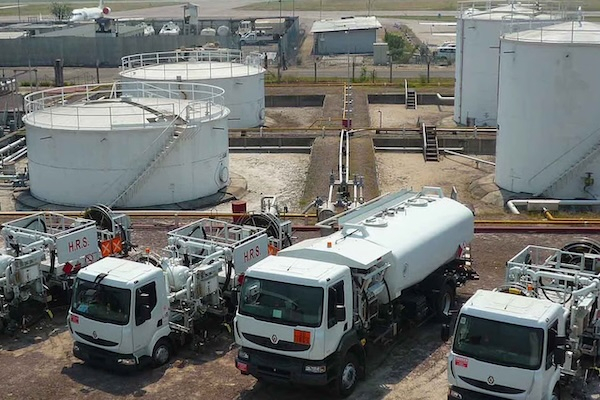
The Democratic Republic of Congo is considering building a strategic reserve of at least 50,000 tonnes of ground and aviation fuels to reduce the risk of supply disruptions, state broadcaster RTNC reported.
The option was discussed at a meeting chaired by Hydrocarbons Minister Acacia Bandubola Mbongo on March 9, 2026, amid heightened tensions on global oil markets.
The proposed reserve would cover only a small share of national demand. The DRC imports all of its refined petroleum products. According to the 2023 report from the Central Bank of The Congo, the country’s consumption stood at 2,804,698 cubic metres that year. Using standard conversion factors, that corresponds to roughly 2.3 to 2.4 million tonnes annually.
A 50,000-tonne reserve would therefore represent about 2% of yearly consumption, equivalent to only a few days of supply.
Recent demand trends suggest the gap could be even larger. After a pump-price reduction on Oct. 3, 2024, fuel demand at filling stations in Kinshasa tripled to about 4,500 cubic metres per day from 1,500 previously, according to the Ministry of National Economy.
RTNC did not say whether the planned reserve would come on top of existing legal requirements. According to the Hydrocarbons Ministry, the state is supposed to maintain minimum reserves equivalent to 60 days of consumption across different petroleum products. By the authorities' own admission, that target has not been met.
RTNC also reported that the government plans to make advance payments starting in early April to cover losses and foregone revenues from the first quarter of 2026, allowing oil companies to replenish fuel stocks. The downstream sector remains vulnerable to delays in compensation payments and cash-flow pressures.
The plan suggests authorities expect a reversal of the trend observed in 2025. The state said it recorded gains rather than losses in part of last year. It reported more than $22 million in the fourth quarter in the western zone, traditionally loss-making, and more than $44 million in the second quarter in the southern, eastern and northern zones, which are generally profitable.
Officials also discussed creating a mechanism to closely monitor developments in global oil markets, with stronger coordination between the Hydrocarbons Ministry and the Congo Central Bank to anticipate price swings and adjust pricing policies quickly.
Middle East tensions
The conflict involving the United States, Israel and Iran has disrupted energy markets. Fighting has forced production shutdowns and logistical disruptions in several Gulf countries, major hydrocarbon producers, affecting oil and gas exports from the Middle East.
The situation has been compounded by tensions around the Strait of Hormuz, a strategic chokepoint through which a large share of the world's oil and liquefied natural gas passes.
In a note published on March 10, 2026, UNCTAD said the strait handles around 20 million barrels per day, representing nearly 25% of global seaborne oil trade. The agency said the route is one of the world's main energy chokepoints and that recent disruptions have revived concerns about global supply.
The tensions have quickly pushed prices higher. Brent crude repeatedly rose above $100 a barrel and briefly approached $120 on March 9.
Pierre Mukoko & Boaz Kabeya