





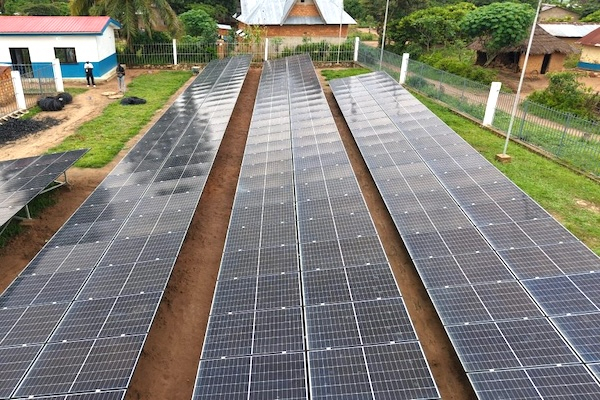
The Democratic Republic of Congo's National Rural Electrification and Energy Services Agency (ANSER) has provisionally awarded three contracts for the construction of solar photovoltaic power plants in the provinces of Mongala, Equateur and Mai-Ndombe. The combined value of the projects amounts to approximately $12.1 million, inclusive of taxes, according to procurement decisions reviewed by this publication.
The projects form part of ANSER's broader efforts to expand electricity access in rural and peri-urban areas through decentralized renewable energy solutions. The contracts cover the construction of solar power plants in Bumba, Lukolela, and Nioki Centre, localities where electricity supply remains limited and where access to the national grid is either inadequate or nonexistent.
The procurement processes were conducted under Congolese public procurement regulations and received non-objection notices from the Directorate General for Public Procurement Control (DGCMP), a requirement for the validation of public contracts in the country.
GOSHOP Energy Secures Two Contracts
Two of the three contracts were provisionally awarded to GOSHOP Energy SARL, a company already active in the Democratic Republic of Congo's solar energy sector.
The first contract concerns the construction of a 350-kWp solar photovoltaic plant in Bumba, located in Mongala province. According to a provisional award decision dated June 3, 2026, the project is valued at approximately $1.75 million, inclusive of taxes.
The second contract covers a solar plant of the same capacity in Lukolela, in Equateur province. The provisional award, dated May 29, 2026, places the value of that project at approximately $1.55 million, inclusive of taxes.
Together, the two projects represent a combined capacity of 700 kWp and an investment of roughly $3.3 million.
GOSHOP Energy has previously collaborated with ANSER through projects implemented under the government's 145 Territories Local Development Programme (PDL-145T). Among these initiatives are solar electrification projects in Lumumba-Ville, designed to improve electricity access for households as well as community infrastructure and public services.
The company operates across several segments of the energy sector, including solar generation, mini-grid development, battery storage systems and electrical infrastructure.
Nioki Centre Project Accounts for Majority of Investment
The largest of the three projects will be developed in Nioki Centre, a town in Mai-Ndombe province. The provisional award decision, dated May 27, 2026, assigns the contract to the EMC-ELICOM consortium.
The project involves the construction of a 3,000-kWp (3-MWp) solar photovoltaic power plant, making it significantly larger than the facilities planned for Bumba and Lukolela. With a contract value of approximately $8.79 million, inclusive of taxes, the Nioki project accounts for nearly three-quarters of the total investment represented by the three awards.
Its generating capacity is almost nine times greater than that of each of the other two planned installations, underscoring its strategic importance within ANSER's current rural electrification programme.
The EMC-ELICOM consortium brings together companies specialized in electromechanical engineering and technical equipment. Once completed, the plant is expected to improve electricity supply in Nioki and surrounding areas, where residents and businesses continue to face significant energy access challenges.
Expanding Rural Electrification Through Decentralized Solar Solutions
The awards are aligned with ANSER's mandate to promote electrification and energy services in rural and peri-urban areas across the Democratic Republic of Congo. Faced with the country's vast territory and limited grid coverage, the agency has increasingly relied on decentralized energy solutions, particularly solar photovoltaic systems, to reach communities located far from major transmission networks.
Despite possessing some of Africa's largest hydropower resources, the Democratic Republic of Congo continues to record one of the continent's lowest electricity access rates. In many rural areas, households, schools, health centres and businesses depend on diesel generators, small standalone solar systems or have no reliable source of electricity at all.
Projects such as those planned for Bumba, Lukolela and Nioki are intended to help bridge that gap by providing localized generation capacity capable of supporting households, public institutions and productive economic activities.
Awards Remain Subject to Finalization
The contracts remain provisional at this stage. The award decisions reviewed do not yet provide detailed information regarding implementation schedules, commissioning dates, financing structures or final contractual arrangements.
As with many infrastructure projects in the country, the key challenge will be moving from contract award to operational infrastructure. Successful implementation will depend on factors including financing mobilization, equipment procurement, logistics, construction timelines and long-term operation and maintenance arrangements.
In several rural and peri-urban localities across the country, limited electricity access continues to constrain economic activity, the delivery of basic social services and the development of small and medium-sized enterprises. The effectiveness of these projects will therefore be measured not only by installed capacity but also by their ability to provide reliable and sustainable electricity to communities that have long remained underserved.
Ronsard Luabeya