




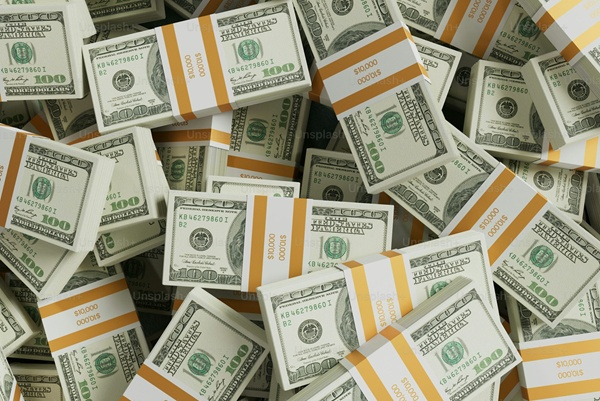
The governor of the Democratic Republic of Congo’s central bank said 85% of the $10 billion in U.S. dollar cash imported into the country in 2025 never entered the banking system.
Of the $10 billion in dollar banknotes brought into the country that year, only about $1.5 billion was reflected in bank deposits, central bank governor André Wamesso said at an April 28 press conference.
“The Banque Centrale du Congo conducted a study. In 2025, we imported $10 billion in U.S. dollar banknotes, but deposits increased by only around $1.5 billion,” Wamesso said. “Where did the remaining $8.5 billion go?”
The question was largely rhetorical. In an interview broadcast on April 18 by Top Congo, Wamesso had already said that part of the imported cash was being used by money-laundering networks and terrorist financiers. The former economic adviser to President Felix Tshisekedi said armed groups operating in eastern Congo paid fighters in dollars despite having no formal means of obtaining them.
In response, the BCC’s Monetary Policy Committee decided at its April 9 meeting to grant the central bank sole authority to import foreign-currency banknotes and to ban foreign-currency cash transactions from April 9, 2027.
U.S. sanctions
At the April 28 press conference, Wamesso also warned that the uncontrolled circulation of dollar cash posed risks to the Congolese financial system.
With several rebel leaders already under U.S. sanctions, he said the DRC could face accusations that U.S. currency was circulating for the benefit of sanctioned individuals. That, he warned, could lead to restrictions on access to the U.S. dollar financial system, a risk heightened by the country’s placement on the Financial Action Task Force (FATF) grey list in 2022, which has strained ties between Congolese banks and correspondent banks abroad.
“These measures are also intended to help the country comply with U.S. sanctions,” Wamesso said, adding that the U.S. government “fully supports” the BCC’s decisions.
Washington has increasingly used sanctions as a tool to secure access to critical minerals in eastern DRC.
“The Treasury Department will not hesitate to take action against groups that deny the United States and our allies access to the critical minerals vital for our national defense,” John K. Hurley, the Treasury under secretary for terrorism and financial intelligence, said in August 2025 after sanctions were imposed on armed group leaders and networks accused of fueling instability in mineral-rich areas, including coltan- and tin-producing zones.
Less than a year later, Washington escalated further by sanctioning former President Joseph Kabila.
Pierre Mukoko