




DRC plans to adjust water and electricity tariffs that have long been set by ministerial decree and kept below actual production costs. The national utilities, SNEL and REGIDESO, have argued for years that such pricing prevents them from maintaining reliable service and investing in infrastructure upgrades.
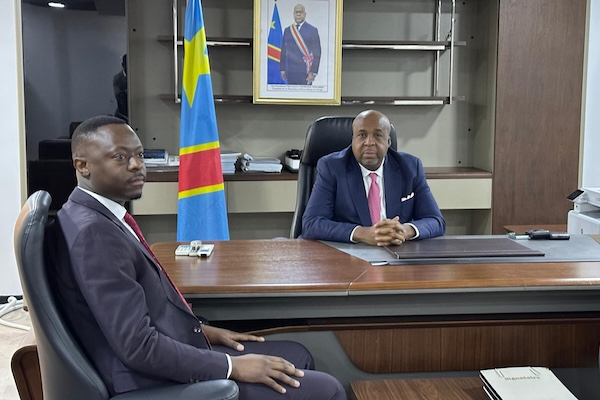
Speaking at the Makutano Forum on November 26, 2025, Minister of Hydraulic Resources and Electricity Aimé Molendo Sakombi said he had submitted a memo to the Council of Ministers proposing a six-month emergency plan for REGIDESO. The plan calls for liberalizing tariffs to bring them in line with actual costs and for settling the government’s arrears to the utility.
Asked about electricity, the Minister said the situation was similar. He added that additional memos were being prepared and that the government intended to “take the bull by the horns.” Under the National Energy Compact, the government’s roadmap to raise electricity access from 21.5 percent to 62.5 percent by 2030, the state committed to adopting a tariff regime by January 2026 that would allow SNEL to cover the cost of providing reliable service.
Speaking on Top Congo FM on December 1, 2025, REGIDESO General Manager David Tshilumba said the planned adjustment to the social water tariff would gradually raise it above 0.43 dollars per cubic meter, representing an increase of roughly 80 to 100 percent. He emphasized that the change would be phased in over several years and applied in stages.
Tshilumba added that the Deputy Prime Minister and Minister of National Economy had told him it was time to resolve the issue and that the matter would be addressed through the Council of Ministers.
Below-Cost Pricing
According to Tshilumba, the current tariff for households averages about 0.25 dollars per cubic meter, while the production cost is around 1.15 dollars. He said a cost-reflective tariff is necessary for the company to operate sustainably without heavy state subsidies. Households account for 80 percent of REGIDESO’s water consumption, while commercial and industrial users, who pay more than 2 dollars per cubic meter, represent only 20 percent of demand.
The utility also faces significant unpaid government bills. Tshilumba estimates state arrears at 628 billion Congolese francs. With the settlement of these arrears and the gradual adjustment of tariffs, REGIDESO plans to diversify its activities to expand its revenue base. Water sales currently account for 95 percent of its revenue, according to Bloomfield Investment.
In that context, REGIDESO announced in 2024 the construction of a factory in the Maluku Special Economic Zone to produce pipes and plumbing equipment. Ten hectares have already been allocated to the project, according to Radio Okapi, citing SEZ Agency General Manager Auguy Bolanda. The utility has also created a subsidiary for electricity production, RégiEnergies, and is preparing to launch bottled water sales in Kinshasa.
On the electricity side, SNEL sells power at an average rate of 0.17 dollars per kilowatt-hour under a decree issued on November 5, 2022. When fixed tariffs are included, the National Energy Compact estimates the effective rate at about 0.09 dollars, which remains insufficient to cover production costs.
Mini-grid operators apply authority-approved tariffs that are higher than SNEL’s, ranging from 0.25 to 0.70 dollars per kilowatt-hour, according to the National Energy Compact. Virunga Energies, active in North Kivu, reports selling electricity at 0.25 dollars per kilowatt-hour for households and 0.235 dollars for small and medium-sized businesses.
Pierre Mukoko & Timothée Manoke