




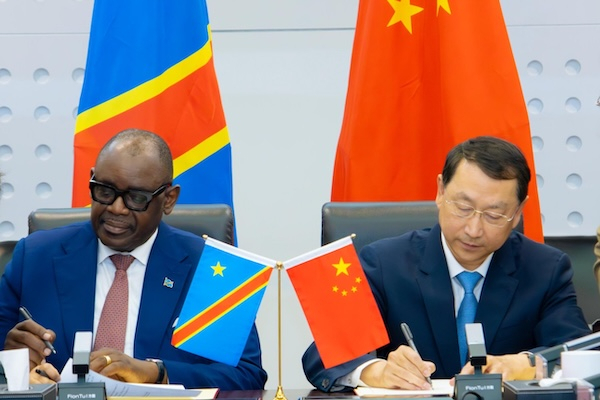
The Democratic Republic of Congo is moving to tighten oversight of Chinese investment in its mining sector. On March 26, Congolese Mining Minister Louis Watum Kabamba and his Chinese counterpart, Guan Zhi'ou, signed a memorandum of understanding on cooperation in geology and mineral resources in Beijing.
Kinshasa described the agreement as a “structured framework for cooperation” based on ongoing consultation, adherence to Congolese law, investment protection and in-country processing of natural resources.
The move signals a policy shift. Long dominated by largely unconstrained Chinese investment, Congo’s mining sector is now moving toward tighter regulation. The aim is to capture greater domestic value and secure higher economic returns as global demand for critical minerals, including cobalt, copper and lithium, continues to rise.
Between 2000 and 2022, China committed $23.7 billion in loans and grants to the DRC, according to U.S.-based research center AidData, making it the second-largest African recipient of Chinese financing. Loans accounted for 98% of the total. AidData also notes that the DRC is China’s largest bilateral development partner on the continent, well ahead of most traditional donors.
ESG risks
Kinshasa, however, is no longer willing to engage without safeguards. The Sicomines project served as a turning point. The venture, involving Chinese firms including China Railway, Sinohydro and Zhejiang Huayou, was designed to finance infrastructure through mining revenues. A 2023 audit by the Inspectorate General of Finance found that only about one-third of the $4.5 billion allocated to infrastructure had been disbursed, prompting a renegotiation of the agreement originally signed in 2008.
That process led to a fifth amendment signed in March 2024 under President Félix Tshisekedi. The revised deal is expected to channel nearly $5.5 billion in additional infrastructure spending between 2024 and 2040, provided international copper prices remain above $8,000 per metric ton. Disbursements could rise further if prices reach $12,000 per ton. The amendment also provides for a technical and financial audit covering the contract’s implementation since inception, launched in early March 2026.
Congolese authorities say the memorandum aligns with the strategic direction set during high-level talks in 2023 between Presidents Tshisekedi and Xi Jinping. It was signed, however, after the DRC concluded a separate strategic partnership with the United States focused on critical minerals, the Sakania-Lobito corridor, formalizing the artisanal mining sector and expanding local processing capacity. China is no longer the DRC’s only strategic partner for its resources.
Shortcomings in the previous model have also driven the shift. AidData estimates that 36% of China’s infrastructure portfolio in the DRC carries significant exposure to environmental, social and governance risks. More notably, only 5.5% of Chinese-financed infrastructure projects in the country included strong contractual ESG safeguards between 2000 and 2022, well below global levels.
Pierre Mukoko & Ronsard Luabeya