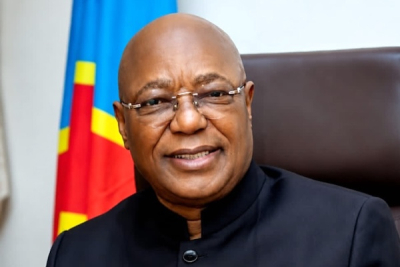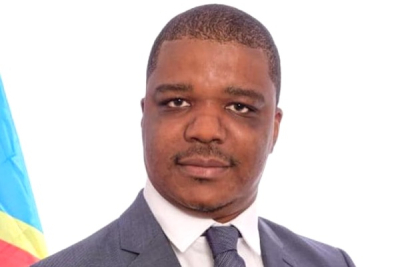





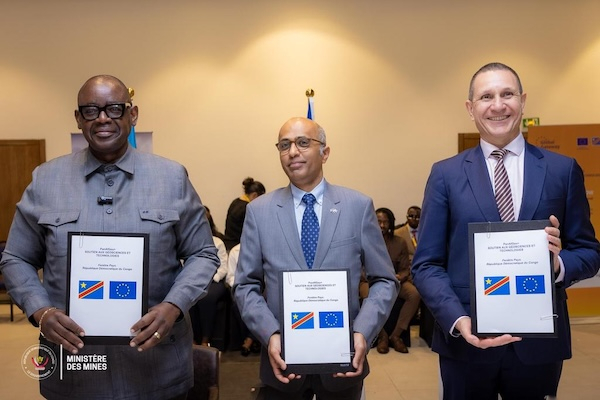
The Democratic Republic of Congo signed a geological data partnership agreement with the European Union on March 19 in Kinshasa. Congo's mines minister, Louis Watum, and the EU delegation's chargé d'affaires ad interim in the DRC, Fabrice Basile, signed the accord, under which the country will participate in PanAfGeo+ Invest, an EU-funded program aimed at strengthening geological services and subsurface data management across Africa.
In the DRC, the program will consolidate the national geoscientific database, preserve historical archives, carry out geological surveys across several provinces and conduct studies in selected artisanal mining areas. The objective is twofold: to improve knowledge of Congo's subsoil and to better guide investment decisions.
PanAfGeo+ Invest builds on the original PanAfGeo program, which ran from 2016 to 2024 and trained nearly 1,750 African geoscientists. Through the new program, the EU plans to invest 45 million euros across seven African countries between 2026 and 2029 to support technological capacity and geoscience development. The DRC will receive nearly 11 million euros, or roughly a quarter of the total funding.
BRGM's Coordinating Role
For the Bureau de recherches géologiques et minières (BRGM), which coordinates the program, the aim is to support projects aligned with European partners’ priorities. In that context, the EU announced on March 19 an additional 6 million euros to complete the digitization of geological archives held at the Royal Museum for Central Africa in Tervuren, Belgium. The digitization project, which began in 2023, is one of the reasons Brussels has cited for opposing a separate digitization contract the DRC awarded to American company KoBold Metals covering the same archives.
The fate of the KoBold Metals contract remains unclear. "The country’s subsoil is part of its national heritage. All partners who help us better understand this heritage are welcome. We will work with them," mines minister Watum said.
These developments expand the EU’s access to geological data in the DRC, which has become a strategic lever in the international competition for critical minerals. Earlier this year, Spanish company Xcalibur also secured a $298 million contract for airborne geophysical mapping and geological survey work across the DRC.
Boaz Kabeya