





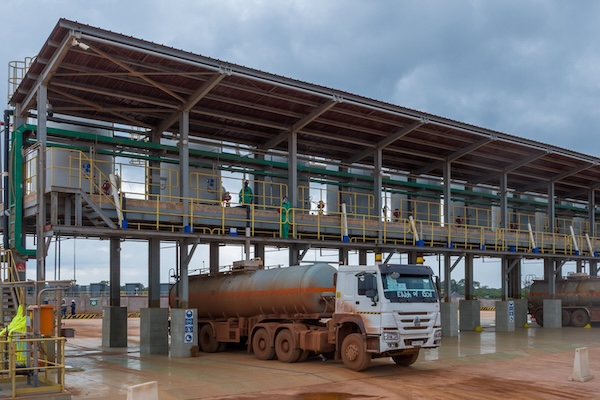
Zambia has authorized a limited resumption of sulfuric acid exports to the Democratic Republic of Congo, offering partial relief to Congolese copper and cobalt producers facing shortages of the critical processing input for several months.
Zambian Trade Minister Chipoka Mulenga told Reuters that Chambishi Copper Smelter and Mopani Copper Mines have been allowed to resume some deliveries to Congo after rebuilding stocks allocated to the domestic market.
Lusaka remains cautious, however. Zambia will cap export volumes to avoid renewed pressure on local supply. The government could broaden its authorizations if market conditions continue to improve.
Sulfuric acid is essential for processing oxidized copper and cobalt ores, particularly in Congo's Copperbelt. Zambia suspended exports in September 2025 before introducing export controls from March onward, worsening supply difficulties for several mining companies in Congo, the world's largest cobalt producer and second-largest copper producer.
DR Congo consumes roughly 2 million metric tons of sulfuric acid per year, some of which is supplied through imports from Zambia, which itself produces close to 2 million metric tons annually. According to Reuters, Zambia's restrictions had already forced some Congolese producers to reduce sulfuric acid consumption and consider output adjustments. Mopani is expected to supply Glencore, while Chambishi Copper Smelter would export to three Chinese mining companies operating in DR Congo.
Kamoa turns the shortage into a revenue source
The regional supply crunch is not affecting all miners equally. At Ivanhoe Mines, sulfuric acid shortages have instead become a strategic commercial advantage for the Kamoa-Kakula complex.
According to Ivanhoe Mines' quarterly report published on May 6, the Kamoa-Kakula smelter produced 117,871 metric tons of high-concentration sulfuric acid in the first quarter of 2026, of which 107,700 metric tons were sold to six customers at an average price of $467 per metric ton.
The company said a new delivery contract for June was signed at $725 per metric ton, while other contracts are due for renegotiation.
The surge in sulfuric acid prices is directly improving Kamoa-Kakula's margins. Revenue from acid sales already covers the smelter's operating costs. In the first quarter, those revenues represented approximately $705 per metric ton of copper produced, compared with estimated smelter operating costs of around $595 per metric ton.
Ivanhoe Mines co-chair Robert Friedland now describes sulfuric acid production as a strategic advantage for the project. He said Kamoa-Kakula could generate close to $1 million per day in operating credits from sulfuric acid sales, helping offset rising diesel and logistics costs.
That is positive news for shareholders in Kamoa Copper, the joint venture that operates the mine.
Zambia's easing therefore does not fully resolve the problem. While it may reduce pressure on some Congolese miners in the short term, it also highlights the sector's dependence on regional suppliers for strategic industrial inputs.
Against that backdrop, Kamoa-Kakula stands out because of its vertically integrated operations. Its smelter not only reduces the logistics costs associated with exporting concentrates, but also produces locally a key input that has become scarce and expensive across the Copperbelt.
Pierre Mukoko & Ronsard Luabeya