




Commodities trader Mercuria announced on Feb. 9, 2026, "the completion of its first copper and cobalt transaction" with Entreprise Générale du Cobalt (EGC). The statement did not specify whether the deal involved a direct purchase, an offtake contract, or a marketing mandate.
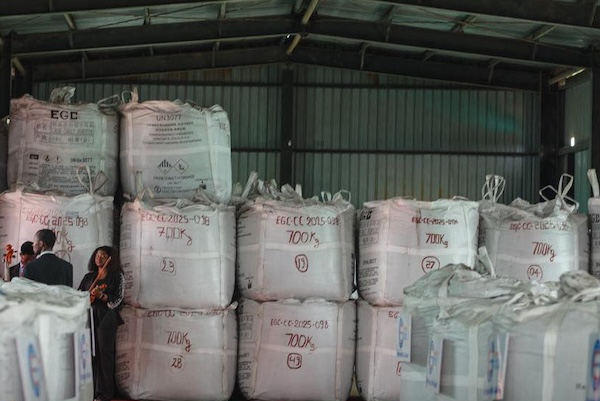
The announcement indicated simply that the transaction involves its first export shipment of copper and cobalt, without disclosing volumes. "The copper cathodes are intended for shipment to either the United States of America, the United Arab Emirates or Saudi Arabia," the statement said, positioning the operation as an extension of the joint venture between Gécamines, EGC's sole shareholder, and Mercuria, announced in late 2025 and dedicated to trading critical minerals.
In November 2019, EGC was mandated to develop a responsible artisanal cobalt value chain in the Democratic Republic of Congo (DRC) by organizing and regulating artisanal and small-scale mining. In this capacity, the company holds a monopoly on the purchase, processing, refining, sale, and export of cobalt extracted by artisanal miners or artisanal mining companies in the country.
Strengthened by Export Quotas
This position was also strengthened by the cobalt export quota policy that took effect in the DRC on Oct. 16. Under this policy, EGC was allocated the fifth-largest export quota: 1,775 metric tons for 2025, and 5,640 metric tons for 2026 and 2027, subject to possible adjustments based on global market developments by the end of 2026 or prospects for local processing of cobalt hydroxide into higher-value products. Problems with the new export system in 2025 led to the rollover of that year's quotas into 2026. In total, EGC could export up to 7,415 metric tons of cobalt in 2026.
On Nov. 13 in Kolwezi, EGC presented its first production of 1,000 metric tons of artisanal cobalt, described as structured, ethical, and traceable. The copper cathodes mentioned in the transaction announced by Mercuria were reportedly produced from copper residues recovered after processing artisanal cobalt.
Also on Feb. 9, 2026, EGC and Trafigura, another commodities trader, announced they had agreed to "the first delivery of copper and cobalt to global markets via the Lobito Atlantic Railway (LAR)," without specifying either the quantity or the date. According to Franck Rogozin, Trafigura's head of metals and minerals for Africa, the aim is to "collaborate with EGC to facilitate the transport of copper and cobalt from responsible sources to global markets via the most efficient transport route from the DRC's Copperbelt."
Implementing the Partnership with the United States
Alongside Vecturis and Mota-Engil, Trafigura is a member of the LAR consortium, which has held since July 2022 a 30-year concession to operate and modernize the Angolan section of the Lobito corridor, 1,300 kilometers between the deep-water port of Lobito on Angola's Atlantic coast and the DRC border at Luau. In theory, this is the shortest route for exporting mining products from Kolwezi. But the roughly 450-kilometer Kolwezi-Luau line is in poor condition.
According to EGC's director general, Eric Kalala, the first copper shipment will go to U.S.-based customers, marking a tangible step in implementing the strategic partnership signed on Dec. 4 between Washington and Kinshasa in the critical minerals sector.
Under that agreement, Congolese state-owned companies must prioritize the U.S. market for their mining exports. The agreement also stipulates that over the next five years, 50% of copper, 30% of cobalt, and 90% of zinc marketed by these companies will transit through the Lobito corridor.
EGC and Trafigura have had a commercial agreement in place since 2020. The partnership provides financing to EGC to fulfill its mandate, in exchange for a portion of its cobalt hydroxide production. The companies have not disclosed the terms of the agreement. But in June 2022, in an open letter to the prime minister, a group of civil society organizations claimed the partnership involved financing of around $80 million for 50% of production, without further details.
Pierre Mukoko & Ronsard Luabeya