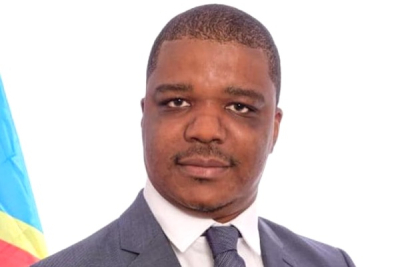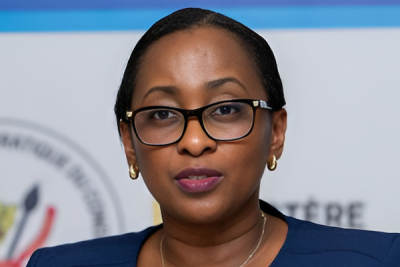





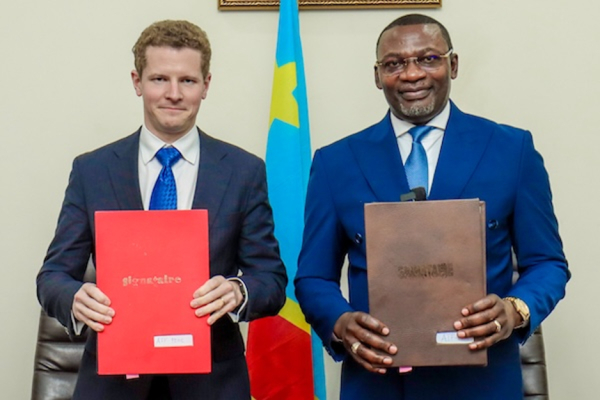
The Democratic Republic of Congo (DRC) has entered a new phase in the management of its infrastructure-for-minerals cooperation program with a group of Chinese companies. The Regulatory Agency for the Monitoring and Coordination of Collaboration Agreements (APCSC) announced on March 5, 2026, the signing of contracts to launch a technical and financial audit of the program.
The audit will examine the implementation of the project from its launch in April 2008 to the signing of its most recent amendment in March 2024. The Chinese consortium involved includes China Railway, Sinohydro and Zhejiang Huayou.
To implement the project, the parties created the Sino-Congolese Mines joint venture, known as Sicomines (SCM). The Chinese consortium holds a 68% stake, while the state-owned mining company Gécamines owns 32%. Sicomines is responsible for developing and mining copper and cobalt at the PE 9681 and PE 9682 permits in Mutshatsha, in Lualaba province, to finance infrastructure projects. Authorities also plan to certify the mineral resources associated with these permits.
The technical and financial audit has been awarded to the ATF-PCSC/Mayer Brown consortium, while SRK Consulting will carry out the certification mission. Little information is available about ATF-PCSC. Mayer Brown is an international law firm advising on infrastructure projects, particularly in the energy and natural resources sectors. SRK Consulting describes itself as an independent international consultancy specializing in mining, geology, water and environmental services.
According to the APCSC, the audit will examine how mobilized resources were used, assess the implementation of contractual commitments, and determine whether the project has been carried out in accordance with the cooperation agreement and its amendments. The review will cover several areas, including mining, finance, technical and infrastructure components, legal and contractual issues, as well as environmental and sustainability aspects. The agency said the findings should provide a detailed assessment of the project's implementation and offer recommendations to improve governance and performance.
$1.5 billion for infrastructure
The Sino-Congolese program has faced criticism on several fronts since its launch in 2008, including concerns over the transparency of loans, mining and infrastructure investments, and the revenues generated by Sicomines. Critics have also pointed to the absence of competitive bidding and the risk of inflated construction costs. The March 2024 amendment provided for a technical and financial audit to clarify these issues.
The amendment states that, at the time it was signed, $1.5 billion had already been borrowed for infrastructure, including principal and interest. This figure includes $300 million that had previously remained undisbursed before being made available after the amendment, as well as “all costs or expenses accepted by the parties.” According to a progress report presented in September 2025 by the Congolese Agency for Great Works (ACGT), only $1.277 billion is actually expected to be allocated to infrastructure projects.
However, the amount and purpose of other costs or expenses remain unclear. In a report published in January 2026, the U.S. research center AidData revealed that Sicomines granted loans totaling $82 million to Gécamines, though the interest rates were not specified. The cost of debt contracted from Eximbank China is known to fluctuate, as the interest rate is indexed to international market rates plus 1%. The debt is to be repaid over 25 years, including a 10-year grace period.
Information on completed infrastructure projects and their costs remains limited. In its July 2024 report, the International Monetary Fund (IMF) said that only $888 million in infrastructure loans had been disbursed by 2022, but data on project execution were scarce. IMF staff said they did not know how projects were selected or whether their implementation aligned with initial cost projections.
$9 billion in debt
While the agreement originally planned for a $3.2 billion loan to finance mining investments, AidData reports that Sicomines contracted $7.61 billion in debt between 2008 and 2020 to develop the mine. The first Eximbank China loan, granted in 2008 for $2.13 billion, carries a fixed interest rate of 6.1%, a 25-year maturity and a six-year grace period. The second loan, granted in 2013 for $2.61 billion, has a floating interest rate indexed to international market rates plus 3%, with a 25-year maturity and a 10-year grace period.
The first shareholder loan from the Chinese consortium in 2008 amounted to $1.07 billion and is interest-free. The second, valued at $1.77 billion, carries a floating interest rate indexed to international market rates plus 2.7%.
Over the period covered by the audit, the Sicomines joint venture reportedly contracted nearly $9 billion in total debt to finance infrastructure and develop its copper-cobalt mine. Under the cooperation agreement signed between the DRC and the Chinese companies, mining revenues must first be used to repay these loans, with the remaining funds then distributed as dividends.
The Sicomines mine began production in 2015 and reached full capacity in 2024, exporting 246,000 tonnes of copper. However, AidData reports defaults on loans used to develop the mine, although it did not provide a comprehensive assessment. Regarding the debt allocated to infrastructure, which must be repaid first, the research center said Sicomines had repaid $441.1 million by the end of 2020. As of December 31, 2021, the remaining balance on that loan stood at $658.78 million.
The audit results are expected to clarify the project's actual debt level and the share of revenues already used for repayment. These elements directly affect key provisions of the 2024 amendment, including the distribution of Sicomines’ capital and the payment of royalties and dividends. The amendment stipulates that the shareholding structure will remain unchanged and that royalties paid to Gécamines will be capped at 1.2% of turnover until all loans linked to the cooperation project, including principal and interest, are fully repaid.
The amendment also makes any new decisions regarding the project’s development conditional on the results of the technical and financial audit, the full certification of mineral resources, and the approval of an updated feasibility study.
Pierre Mukoko & Boaz Kabeya